The Hugoniot conditions are the conditions that must be satisfied on the discontinuity lines of the solutions of the equations of gas dynamics , as a consequence of the integral conservation laws .
Let be {\ displaystyle x = x (t) -}  the equation of one of the discontinuity lines of hydrodynamic quantities, which we will assume for the considered segment {\ displaystyle t_ {1} \ leqslant t \ leqslant t_ {2}}
  continuous tangent
Let be {\ displaystyle f (x, t)}  suffers a break on the line {\ displaystyle x = x (t)}
  .
.
Denote:
{\ displaystyle f_ {1} (t) = f (x (t) -0, t);} 
{\ displaystyle f_ {2} (t) = f (x (t) + 0, t);} 
{\ displaystyle [f] = f_ {2} (t) -f_ {1} (t)} ![{\ displaystyle [f] = f_ {2} (t) -f_ {1} (t)}](https://wikimedia.org/api/rest_v1/media/math/render/svg/92cd4db8922189d060a81ede3b815f52278df895)
The integral conservation laws in Euler coordinates have the form
{\ displaystyle (1) {\ begin {cases} \ oint \ limits _ {C} \ rho x ^ {\ nu} \ cdot dx- \ rho ux ^ {\ nu} \ cdot dt = 0, \\\ oint \ limits _ {C} \ rho ux ^ {\ nu} \ cdot dx- (p + \ rho u ^ {2}) x ^ {\ nu} \ cdot dt = - \ oint \ limits _ {G} \ oint \ limits _ {C} \ nu px ^ {\ nu -1} \ cdot dxdt, \\\ oint \ limits _ {C} \ rho (\ varepsilon + {\ frac {u ^ {2}} {2}}) x ^ {\ nu} \ cdot dx- \ rho u (\ varepsilon + {\ frac {p} {\ rho}} + {\ frac {u ^ {2}} {2}}) x ^ {\ nu} \ cdot dt = 0. \ end {cases}}} 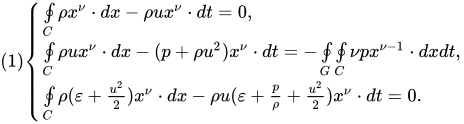
We write the conservation laws (2) for the circuit AA 'BB' , assuming that the lines A'B and B'A of circuit C , as well as the double integral {\ displaystyle \ oint \ limits _ {G} \ oint \ limits _ {C} \ nu px ^ {\ nu -1} \ cdot dxdt} 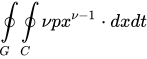 . Along the line {\ displaystyle x = x (t)} we have {\ displaystyle dx = Ddt}
  where {\ displaystyle D = D (t) = x ^ {\ prime} (t)}
  .
.
Therefore, for example, from the first equation of (1) , we obtain
{\ displaystyle \ int \ limits _ {t_ {1}} ^ {t_ {2}} x ^ {\ nu} \ left \ {(\ rho _ {2} (t) - \ rho _ {1} (t )) D (t) - (\ rho _ {2} (t) u_ {2} (t) - \ rho _ {1} (t) u_ {1} (t)) \ right \} \ cdot dx = 0}  {\ displaystyle, (2)}
Due to the arbitrariness of the integration limits in (2) , the integrand must be equal to zero i.e. {\ displaystyle x ^ {\ nu} (t) \ left \ {D (t) [\ rho] - [\ rho u] \ right \} = 0} ![{\ displaystyle x ^ {\ nu} (t) \ left \ {D (t) [\ rho] - [\ rho u] \ right \} = 0}](https://wikimedia.org/api/rest_v1/media/math/render/svg/af795d8c51f208c69fdd01629fb13101fb15fb2d) .
.
Reducing Equality by {\ displaystyle x ^ {\ nu}}  , we see that the conditions on the discontinuity line are the same for the three cases of symmetry {\ displaystyle \ nu = 0,1,2}
  .
.
Acting in a similar way with all conservation laws (1) , we obtain conditions on the discontinuity line {\ displaystyle x = x (t)}
{\ displaystyle D [\ rho] = [\ rho u],} ![{\ displaystyle D [\ rho] = [\ rho u],}](https://wikimedia.org/api/rest_v1/media/math/render/svg/57223df6d01ee7733bbd20dc51a8062dd509b649)
{\ displaystyle D [\ rho u] = [p + \ rho u ^ {2}],} ![{\ displaystyle D [\ rho u] = [p + \ rho u ^ {2}],}](https://wikimedia.org/api/rest_v1/media/math/render/svg/0fc7316d3b8eb07a80f53ea4b4bd785061fe0015)
{\ displaystyle D [\ rho (\ varepsilon + {\ frac {u ^ {2}} {2}})] = [\ rho u (\ varepsilon + {\ frac {p} {\ rho}} + {\ frac {u ^ {2}} {2}})}} ![{\ displaystyle D [\ rho (\ varepsilon + {\ frac {u ^ {2}} {2}})] = [\ rho u (\ varepsilon + {\ frac {p} {\ rho}} + {\ frac {u ^ {2}} {2}})}}](https://wikimedia.org/api/rest_v1/media/math/render/svg/002e1dcab7e12496bb64e4e0f97e282f4f27d8fd)
which connect jumps of hydrodynamic quantities on the discontinuity line {\ displaystyle x = x (t)} and speed {\ displaystyle D = x ^ {\ prime} (t)}  break lines.
The latter relations are called the conditions of hydrodynamic compatibility of the gap or the Hugoniot conditions .