Andrzej Opalinsky ( Polish Andrzej Opaliński , 1575 - December 19, 1623 , Chenzhen ) - Polish church and statesman, Probst Plotsky (from 1591), the Great Crown Secretary since 1605 , Bishop of Poznan (1607–1623).
| Andrzej Opalinsky | ||
|---|---|---|
| polish Andrzej opaliński | ||
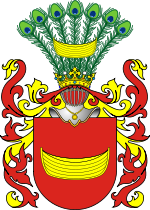 Family coat of arms of the Opalinsky "Lodz" | ||
| ||
| October 31, 1607 - December 19, 1623 | ||
| Church | Roman catholic church | |
| Predecessor | Vavzhinets Goslitsky | |
| Successor | Jan Venzhik | |
| Birth | 1575 | |
| Death | December 19, 1623 Chenzhen | |
| Dynasty | ||
| Father | ||
| Holy Order | November 12, 1607 | |
Content
Biography
Representative of the Polish magnate clan Opalinsky coat of arms " Lodz ". The second son of the Marshal of the Great Crown Andrzej Opalinsky ( 1540 - 1593 ) and Elzbieta Kosczeletska (c. 1545 - 1601 ). Brothers - Kravchik crown Peter the Opalinsky and Marshal the great crown Lukas Opalinsky .
At the age of 15, Andrzej Opalinsky became a titular probst of the Plock department . In 1592 - 1595 he studied in Rome , where he received the posts of secretary and chamberlain of Pope Clement VIII . After returning to his homeland, he was involved in politics. In 1604, he was appointed Secretary of the Great Crown. The Polish king Sigismund III Vasa sent him as an ambassador to the Holy Roman Emperors Rudolf II and Ferdinand II in order to get permission from them to marry Constance of Austria . At the same time he was elected ambassador ( deputy ) to the Greater Poland Seymic in Sroda in 1600 , 1602 and 1606 , unsuccessfully trying to convince the Greater Poland nobility to support royal politics. To this end, in 1608, he created at his residence in Slupce a congress of senators, officials and most of the nobility. This congress brought the desired result, and Greater Poland supported the king on the seismic in 1618, the campaign of the Polish prince Wladyslaw Waza to the Russian state . [ clarify ]
Along with his political career, he climbed the spiritual career ladder. On June 30, 1606, he became coadjutor of the Poznan bishop and at the same time received an appointment from the pope to the position of titular bishop of Sinopolis . After the death of Vavzhintsy Goslitsky, Andrzej Opalinsky was appointed October 31, 1607 as bishop of Poznan. The official appointment to the dignity occurred on November 12 of that year.
As bishop of Poznan, Andrzej Opalinsky organized the synod of the diocese in 1608 , which in 1612 decided to transfer the indemnity to the royal treasury for the needs of the Commonwealth. In April 1612 he inspected the churches in the Poznan diocese, starting with the Poznan Cathedral, which was destroyed by a fire in the same year. Before his death, he managed to begin reconstruction of the Poznan Cathedral, but did not live to see the completion of work. He died in Czhenzhen and was buried in Radlin .
Among people [ what? ] he was respected for his extraordinary conscientiousness in managing the diocese. In addition, he was known as the enemy of the Reformation and the guardian of the Jesuit collegium in Poznan .
Notes
Sources
- Antoni Gąsiorowski, Jerzy Topolski [red.]: Wielkopolski Słownik Biograficzny. Warszawa-Poznań: Państwowe Wydawnictwo Naukowe, 1981, s. 529. ISBN 83-01-02722-3 .