Benjamin Franklin ( born Benjamin Franklin ; January 17, 1706 , Boston , Massachusetts Bay Province - April 17, 1790 , Philadelphia , USA ) - American politician , diplomat , polymatist , inventor , writer , journalist , publisher , freemason [1] . One of the leaders of the US War of Independence .
| Benjamin Franklin | |||||||
|---|---|---|---|---|---|---|---|
| Benjamin franklin | |||||||
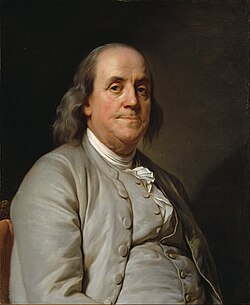 Portrait of Benjamin Franklin by Joseph Duplessis (Paris, c. 1785 ) | |||||||
| |||||||
| Vice President | Charles Briddle Peter Mulenberg David Redick | ||||||
| Predecessor | John Dickinson | ||||||
| Successor | Thomas Mifflin | ||||||
| |||||||
| Predecessor | position established | ||||||
| Successor | Jonathan Russell | ||||||
| |||||||
| Predecessor | position established | ||||||
| Successor | Thomas Jefferson | ||||||
| |||||||
| Predecessor | position established | ||||||
| Successor | Richard bash | ||||||
| |||||||
| Predecessor | Isaac Norris | ||||||
| Successor | Isaac Norris | ||||||
| Birth | January 17, 1706 Boston , Massachusetts Bay | ||||||
| Death | April 17, 1790 (84 years old) Philadelphia , PA , USA | ||||||
| Burial place | |||||||
| Father | Josiah Franklin | ||||||
| Mother | Abia Folger | ||||||
| Spouse | Deborah Reid | ||||||
| Children | William Franklin Frances Folger Franklin Sarah Franklin | ||||||
| Education | |||||||
| Activities | politician , scientist , diplomat , inventor , writer , journalist , publisher | ||||||
| Religion | |||||||
| Autograph | |||||||
| Awards | Copley Medal ( 1753 ) [d] [d] | ||||||
| Scientific activity | |||||||
| Scientific field | physics , geography | ||||||
| Place of work | |||||||
| Known as | Gulf Stream researcher, inventor of lightning rods and bifocal glasses | ||||||


Benjamin Franklin is the only founding father to sign all three of the most important historical documents underlying the formation of the United States of America as an independent state: the Declaration of US Independence , the US Constitution and the Versailles Peace Treaty of 1783 ( Second Paris Peace Treaty ), which formally concluded the war for the independence of the thirteen British colonies in North America from Britain .
One of the developers of the design of the Great Seal of the USA . The first American to become a foreign member of the St. Petersburg Academy of Sciences (since 1917 - the Russian Academy of Sciences).
The portrait of Benjamin Franklin has been depicted on the hundred-dollar bill of the US Federal Reserve since 1914 .
Contrary to popular belief, Franklin was never the president of the United States .
Content
Biography
Benjamin Franklin was born on January 17, 1706 on Milk Street in Boston, the 15th out of 17 children in the family of an emigrant from England, Josiah Franklin, is (1657-1745) - a craftsman engaged in the manufacture of soap and candles. Received education on his own. Josiah wanted his son to go to school, but he only had enough money for two years of education. From the age of 12, Benjamin began to work as an apprentice in the printing house of his brother James, and printing became his main specialty for many years.
In 1727 he founded his own printing house in Philadelphia . From 1729 to 1748 he published The Pennsylvania Newspaper, and from 1732 to 1758 he published the annual Almanac of Poor Richard.
In 1728, Benjamin Franklin founded the Philadelphia discussion group of artisans and merchants, the Club of Leather Aprons (Dzhunto), which turned into the American Philosophical Society in 1743 .
In 1731 he founded the first public library in America, in 1751 the Philadelphia Academy, which became the basis of the University of Pennsylvania . From 1737 to 1753 he served as the postmaster of Pennsylvania , from 1753 to 1774 - the same position on the scale of all North American colonies.
In 1776 he was sent as an ambassador to France with the aim of achieving an alliance with her against England, as well as a loan. He was elected a member of the academies of many countries, including the Russian Academy of Sciences ( 1789 , the first American member of the Petersburg Academy of Sciences ).
Franklin was a Freemason [2] and was included in the greatest Masonic lodge “Nine Sisters” [3] .
Benjamin Franklin - one of the authors of the American Constitution ( 1787 ).
The author of the aphorism Time is Money (from "Tips for the Young Merchant", 1748).
Franklin was the de facto spiritual leader of the new American nation in the second half of the 18th century and the first half of the 19th century.
Franklin died on April 17, 1790 . About 20 thousand people gathered for his funeral in Philadelphia, despite the fact that the entire population of the city that year was 33,000 people, including infants.
An epitaph was engraved on his tombstone: “He pulled out lightning from the sky, and then scepters from tyrants”
Autobiography
The autobiography of Benjamin Franklin is traditionally called an incomplete record of his own life, written between 1771 and 1790 [4] [5] . However, Franklin himself probably considered this work to be his memoirs. The publication of the document occurred after the death of the author [6] .
Views
The political views of Benjamin Franklin were based on the concept of natural and inalienable human rights , to which he attributed life, freedom, property. Franklin's views on the political structure of the North American colonies over time, however, have changed. Until 1765, he regarded the colonies as part of the British Empire. Then he came up with the idea of a federal system, based on the complete equality of all colonies and the mother country under the rule of the king. Finally, when the contradictions between England and the colonies became insoluble, Franklin, convinced after the failure of his appeal in the British Parliament that there was no way to influence London’s policy with the help of petitions, advocated the complete separation of the colonies from the metropolis and the declaration of political independence [7] . Later, he opposed the strengthening of the role of the executive branch, in particular, against granting George Washington extraordinary powers, for establishing universal suffrage, not limited by property qualifications, and was a strong opponent of slavery .
According to his philosophical views, Benjamin Franklin joined deism [8] [9] . The orthodox church dogma opposed the idea of a “natural religion," in which the role of God was reduced to the act of creating the world. He formulated his own version of the theory of labor value [8] .
In accordance with what was stated in his Autobiography, Franklin developed and tried to implement a plan to achieve moral excellence and eradicate bad habits, which was based on developing a skill in the 13 virtues he listed [10] .
Ratings
From a letter from Robespierre addressed to B. Franklin: "You are the most famous scientist in the world ...".
Dale Carnegie : “If you want excellent advice on how to handle people, manage yourself and improve your personal qualities, read Benjamin Franklin's autobiography - one of the most fascinating life stories.”
By the decision of the World Peace Council, Franklin's name is included in the list of the most prominent representatives of Humanity .
Scientific and inventive activity
- Introduced the now generally accepted designation of electrically charged states "+" and "-";
- established the identity of atmospheric and friction-generated electricity and provided evidence of the electrical nature of lightning;
- found that metal tips connected to the earth remove electric charges from charged bodies even without touching them and proposed a lightning rod project in 1752 ;
- invented bifocal glasses (1784);
- received a patent for the design of a rocking chair ;
- in 1742, he invented an efficient, economical small-sized stove for heating homes, called the Franklin stove (or “Pennsylvania fireplace”), and in 1770 he fundamentally improved it and did not specifically patent it for the benefit of all fellow citizens;
- put forward the idea of an electric motor and demonstrated an "electric wheel" rotating under the influence of electrostatic forces;
- first applied an electric spark to an explosion of gunpowder ;
- explained the principle of operation of the Leyden jar , having established that the dielectric separating the conductive plates plays the main role in it;
- fundamentally improved the glass harmonica for which Mozart, Beethoven, Donizetti, R. Strauss, Glinka and Tchaikovsky began to compose;
- developed his own time management system;
- collected extensive data on storm winds (Nord-Ostach) and proposed a theory explaining their origin;
- with the participation of Benjamin Franklin, measurements were made of the speed, width and depth of the Gulf Stream , and this current, which was named Benjamin Franklin, was mapped (1770).
Gulf Stream Learning
As director of the Colonial Post Office, he drew attention to complaints that the mail packetbots departing from the English port of Falmouth to New York lasted two weeks longer than ordinary merchant ships from London to New Port , a little east of New York. It turned out that the Gulf Stream was to blame. English sailors, unfamiliar with this movement, commanded the postal ships, and American sailors, who from time to time took part in marine industries off the coast of America, commanded the merchant ships. At the insistence of Franklin, sailors began to put their observations on maps, resulting in the first Gulf Stream map [11] .
The study of atmospheric electricity
The experience of Franklin in clarifying the electrical nature of lightning is widely known. In 1750, he published a paper in which he proposed an experiment using a kite launched into a thunderstorm. Such an experiment was conducted on May 10, 1752 by the French scientist Thomas-Francois Dalibard . Unaware of Dalibard's experience, Franklin conducted his own experiment with a kite on June 15, 1752 in Philadelphia . Franklin's experience was described in Joseph Priestley 's 1767 History and Present Status of Electricity . Priestley says that Franklin was isolated during the experiment in order to avoid creating a deadly current path (some researchers died during such experiments: in 1753, a Russian scientist, Georg Richmann, died while studying atmospheric electricity with an ungrounded device). In his notes, Franklin says that he knew about the danger and found an alternative way of demonstrating the electrical nature of lightning, as evidenced by his use of grounding . A common version of the experiment says that Franklin did not wait for lightning to strike a launched snake (this would be deadly). Instead, he launched the kite into a thundercloud and found that the kite was collecting electric charge.
Some of Franklin's works
- "Autobiography";
- "Reasoning about freedom and necessity, pleasure and suffering";
- "Experiments and observations of electricity";
- “Necessary advice for those who would like to become rich”;
- "The path to abundance";
- "Almanac of a simpleton Richard";
- "Whistle" (letter - story).
Memory
Sculptures
Franklin Monument at Lincoln Park Chicago
Franklin Monument at the University of Pennsylvania
Toponyms
- In 1935, the International Astronomical Union named Franklin the crater on the visible side of the moon .
In philately
United States Postage Stamp
1861 yearUnited States Postage Stamp
1895 yearUnited States Postage Stamp
1903 yearUnited States Postage Stamp
1918 yearPostage stamp USSR
1956 year
- Franklin is also depicted on a 1976 UK postage stamp.
In Bonistics
Since 1914, Benjamin Franklin has been depicted on all US $ 100 bills.
100 US dollars. Series 1914
100 US dollars. Series 1934
100 US dollars. 2006 series
100 US dollars. 2009 series
Cultural Image
In painting
Edward Harrison May. Lady Howe Checkmates Benjamin Franklin (1867)
“Benjamin Franklin receives a charge of electric current from heaven” Artist Benjamin West (1738-1820)
In detail:
- “Lady Howe Matting Benjamin Franklin,” painting by Edward Harrison May
In the movie
- John Paul Jones ( 1959 )
- John Adams (2008)
- “ Sons of Freedom ” (2015)
See also
- The Benjamin Franklin Effect
Notes
- ↑ Benjamin Franklin , freemasonry.bcy.ca (Retrieved June 19, 2010)
- ↑ Daniel Ligou, ed. Dictionnaire de la franc-maçonnerie (Paris: Presses Universitaires de France, 1987)
- ↑ Louis Amiable, Une loge maçonnique d'avant 1789, la loge des Neuf Sœurs (Les Editions Maçonnique de France, Paris 1989)
- ↑ Benjamin Franklin's Autobiography: Finding Franklin, A Resource Guide (Virtual Programs & Services, Library of Congress) . www.loc.gov. Date of treatment February 12, 2017.
- ↑ Librivox. LibriVox (English) . librivox.org. Date of treatment February 12, 2017.
- ↑ Benjamin Franklin. The Autobiography of Benjamin Franklin / Charles William Eliot. - 1994-07-01.
- ↑ HW Brands. The First American: The Life and Times of Benjamin Franklin c 371 -372 . - Knopf Doubleday Publishing Group, 2010-05-26. - 786 p. - ISBN 9780307754943 .
- ↑ 1 2 “Franklin” - an article in the New Philosophical Encyclopedia .
- ↑ US Founding Fathers: Articles of Faith | Washington ProFile - International News & Information Agency
- ↑ Autobiography of Benjamin Franklin (English) (Russian)
- ↑ Shokalsky Yu. M. Oceanography. - L .: Gidrometeoizdat, 1959.- S. 540.
Literature
- Abramov Y. V.V. Franklin, his life, social and scientific activity: Biographical sketch . - SPb. : Printing house of the partnership "Public good", 1891.
- Anikin A.V. Chapter Seven. Franklin and political economy overseas // Youth of science: Life and ideas of thinkers-economists before Marx. - 2nd ed. - M .: Politizdat , 1975 .-- S. 135-148. - 384 p. - 50,000 copies.
- B. Franklin and Russia. Philosophical Age, anthology No. 32-33. SPb, 2006.
- Benjamin Franklin. Biography. - M .: "Mann, Ivanov and Ferber" , 2013. - S. 480. - ISBN 978-5-91657-672-6 .
- Vladimirov V.N. Franklin - 1934. - 224 p. (The life of wonderful people )
- Ivanov R.F. Franklin. - M .: Young Guard, 1972. - ( ZHZL ).
- Speranskaya L. N. The doctrine of the value of B. Franklin // World History of Economic Thought : In 6 volumes / Ch. ed. V.N. Cherkovets. - M .: Thought , 1987. - T. I. From the inception of economic thought to the first theoretical systems of political life. - S. 439-441. - 606 s. - 20,000 copies. - ISBN 5-244-00038-1 .
- Wilson M. American scientists and inventors / Per. from English B. Ramses ; under the editorship of N. Trenova. - M .: Knowledge , 1975 .-- S. 11-18. - 136 p. - 100,000 copies.
- Franklin, Benjamin // Encyclopedic Dictionary of Brockhaus and Efron : 86 volumes (82 volumes and 4 additional). - SPb. , 1890-1907.
- Franklin Benjamin // Ulyanovsk - Frankfort. - M .: Soviet Encyclopedia, 1977. - ( Great Soviet Encyclopedia : [in 30 vols.] / Ch. Ed. A. M. Prokhorov ; 1969-1978, vol. 27).
- Temples Yu. A. Franklin Benjamin (Veniamin) (Franklin Benjamin) // Physicists: Biographical Reference / Ed. A.I. Akhiezer . - Ed. 2nd, rev. and add. - M .: Nauka , 1983 .-- S. 283. - 400 p. - 200,000 copies. (in per.)
Links
- Benjamin Franklin's autobiography
- Franklin diary
- The history of a paradox of electrical engineering
- Franklin Squares
- Benjamin Franklin's time management system
- B. Franklin “On criminal laws and the practice of privateering”
- B. Franklin "Historical Overview of the Constitution and Government of Pennsylvania"