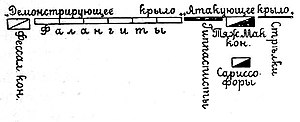
Drawing from the article “ History of Military Art ”
(“The Military Encyclopedia of Sytin ”; 1913)
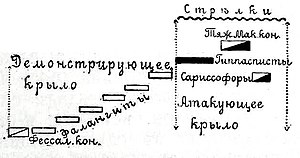
Drawing from the article “ History of Military Art ”
(“The Military Encyclopedia of Sytin ”; 1913)
Sarissophore or sarisophore [1] ( Greek σαρισσοφόρος ) that is, bearing the sarissa - a foot warrior , who formed the basis of the Macedonian phalanx .
The name comes from a long peak - sarissa. The armament of the sarissophore consisted of the following components:
- long, up to 6 meters, peak - sarissa held with two hands
- a small round shield mounted on the forearm to hold the peak with both hands (small compared to the heavy hoplite shield)
- open lightweight helmet (compared to Corinthian )
- relatively light cuirass (compared to hoplites ), or linothorax ( armor from many layers of tarred fabric)
- short sword or mahira
- Leggings (with diadochi almost disappeared)
Like the hoplites, they were supported by peltasts and slingers , but, unlike the classical Greek phalanx , cavalry played a very important role in the Macedonian phalanx, and Alexander the Great gained many of his victories by combining the phalanx with the heavy cavalry - getaira .
See also
- Dyadochi
Notes
- ↑ Sarisophores // Military Encyclopedia / P.S. Grachev . - Moscow : Military Publishing House , 2003. - V. 7. - S. 385. - ISBN 5-203-01874-X .