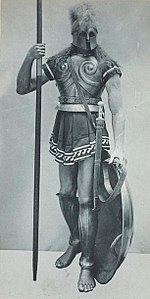
Goplit ( dr. Greek ὁπλίτης ) is an ancient Greek heavily armed foot warrior [1] . The word comes from the name of a heavy round shield - hoplon ( dr. Greek ὅπλον ); Wed Peltast , named for the light shield - Pelt .
Content
- 1 History
- 2 Equipment
- 2.1 Armament
- 2.2 Armor
- 3 Build and learn
- 4 Hoplites
- 5 notes
- 6 Literature
- 7 References
History
It is assumed that they first appeared in the Argos army [2] . The hoplites served in the armies of the Greek city-states and were essentially citizen soldiers, since it was the duty of a citizen of any free policy to perform military service. Therefore, any meeting of citizens was a meeting of soldiers - currently serving or serving veterans. The hoplites are heavily armed Greek foot soldiers. After the reforms of Solon in Athens , the representatives of the most numerous Zevgit class were supposed to go to war, being equipped as hoplites. It is likely that in other Greek policies, middle-class citizens became hoplites during the war, as the warrior had to provide himself with weapons and equipment at his own expense.
The hoplites dominated the battlefield for four centuries, approximately from the beginning of the 7th century BC. e. Before King Philip II (father of Alexander the Great ) hoplites formed the basis of the classical phalanx .
The surviving text of the oath taken by a citizen before entering military service:
I swear not to shame this sacred weapon, not to leave a comrade standing next to me in the ranks. I will protect these sacred and civil places and I will not leave my fatherland. I will do everything to make it bigger and more powerful. I will listen to those who are currently in power and comply with the laws that are in force now and will be in the future. If anyone tries to cancel them, I will not let them do this while I have the strength. I swear to honor my ancestors. I take the gods as witnesses to Aglavra, Hestia, Eney, Enialia, Ares, Athena, Zeus, Tallia, Auxo, Hegemon, Heracles, the borders of the motherland and its bread, barley, wine, olives and fig trees.
Equipment
The Greek states moved towards providing warriors with weapons closer to the end of the classical period . Until this time, hoplite citizens had to take care of their weapons themselves, although a set of weapons was quite expensive. By the end of the VI century BC. e. In Athens, a law was passed according to which settlers in Salamis had to provide themselves with armor worth 30 drams. This amount was equal to the monthly income of the craftsman of that time. In this case, expensive weapons were usually passed from father to son. In ancient Greece, the production of weapons was concentrated in large cities, and small settlements were armed due to imports. Under Pericles, a workshop for the production of shields was organized in Athens, over 120 slaves worked there, not counting free citizens, this was the largest production of ancient Greece.
Armament
- Goplon - a large round heavy shield , also called "Argivsky" . Due to gravity (8 kg), the shield was thrown first when fleeing, so the loss of the shield was considered a great shame. A large shield was also used as a stretcher on which the dead were carried, which is why the origin of the phrase “ with a shield or on a shield ” is associated, according to a legend that belonged to a certain Spartan [3] .
- Xyphos is a short straight sword , or mahira is a short curved sword with a reverse bend.
- Dory - a spear about 3 meters long, consisting of a shaft made of wood (either ash or dogwood ), 5 centimeters in diameter and weighing from 1 to 2 kilograms [4] , and also consisting of a flat leaf-shaped iron tip, whose weight balanced by inflow. In earlier images, hoplites often have a second spear used for throwing, but in a later, classical period, hoplites have only one spear.
Armor
- Hippothorax is an anatomical cuirass (usually full armor weighed near talent , but armor weighing two talents was also found [5] ) or linothorax is a linen shell.
- Knimids Leggings .
- A deaf helmet known as Corinthian .
- Bracers that, although known since the Mycenaean era, were used by hoplites until the middle of the 5th century BC. e. There are archaeological finds dating back to the 7th-5th centuries BC. e., but most of the finds date back to the VI-V centuries BC. e., also found the shoulders and legguards of the VI century BC. e. mainly on the territory of the Peloponnesian Peninsula; during this period in Sparta, a reform of the weighting of the hoplites was carried out (apparently, due to the fact that the Spartan army was only 8 mors - about 4 thousand soldiers - and the reform was carried out to save the life of the Spartians ).
From the middle of the 5th century BC e. throughout Greece, hoplite equipment began to lighten, hippothoraxes began to be replaced by linothoraxes, bracers disappear from use, as the structure became deeper and denser, the number of soldiers in the units increased to 256 (except for Sparta, she still had the classical system of groups of 144 people ), because of which chopping strikes are delivered less often, and more often stabbing strokes, in which the hand was no longer in danger of being cut off, the spears began to lengthen from 3 meters to 3.5-4 meters , hoplites gradually degenerated into a sarissophus horov . From the middle of the 5th century BC e. mercenary hoplites appear, which were already dispensed with linotoraxes, reinforced with scales on the stomach, more open Halkidic helmets and domed bronze caps called “pilos”, argiv shields (hoplons), new elongated spears - introduced by the Thebes from the Thebes strategist Epaminondas later adopted by Philip of Macedon for his sarissophores). The same applies to other parts of the armor, which during the reign of Mycenae were much more complete, in fact representing bronze armor.
Build and learn
The first serious test of strength for Greek military doctrine was the Persian invasion in 546 BC. e. , causing a sharp change in tactics. Initially, hoplite citizens formed “fila” , which were formed without taking into account age, blood relationship and the level of military training (one of the first references to “fila” appeared in Homer's Iliad). However, the number of such army divisions was very difficult to observe due to natural causes: birth, death, death in battle. Initially, the "phyla" were divided into "phratries" ("fraternities"), and the "phratries" were divided into genera ( γένος ). But the phratry system of division lost its meaning in the course of reforms around the VIII century BC. e. According to Herodotus , as a result of Lycurgus' reforms, new units appeared: ( ἐνωμοτία ), triacades ("thirty", τριάκας ) and Sissitia [6] [7] .
The oath-giving citizen was called an " epheb " and for two years had to undergo a program of physical and military training - an "ephebat." Elements of the "ephebat" were similar in many Greek city-states. The physical training included a special training session - “ hoplitodrome ” ( -drome ( Greek δρόμος ) - road, street), which was a hoplite run in heavy weapons - in a helmet, in armor, in greaves, with a shield and with weapons (sword, spear) - all with a total weight of about thirty kilograms, which developed endurance and strength. Over time, the hoplitodrome became part of ancient Greek sports and was conducted at a distance of one or two stages.
Around the VII century BC e. in Greece, they invented a special system specifically for hoplites - the phalanx [8] [9] .
The hoplites fought with the support of the peltasts and slingers (sometimes mercenary archers from Crete were also present). Cavalry , if any, usually played only a supporting role, especially among the Spartans, who considered cavalry unnecessary. And since the Spartan phalanx was considered the ideal example of the phalanx, the horses were mainly used to transport wealthy warriors to the battlefield. However, the student of Socrates Alcibiades , among other things, went down in history by the fact that on his horse, alone, he covered the retreat of the phalanx, in the front row of which was Socrates.
Curiously, an elite foot detachment of 300 Spartiates (full citizens), which appeared even before the Lycurgus reform, was called the "horsemen" detachment. In addition to escorting the king in the war, in peacetime, the "riders" served as a quick reaction police detachment.
The victories of the Greeks in the Greco-Persian wars led to high demand in neighboring countries (especially Persia) for hired hoplites.
Hoplite Helots
During the Greco-Persian wars, starting from 424 BC. e., in Sparta, there was a tradition to call laconic helots (rural semi-slaves - semi-serfs) as hoplites during the war, with the subsequent granting of freedom to them. The reason for this was the small number of citizens of their own, who were barely enough to keep the Messenian helots in obedience, for which the war Kriptia was declared the last annually [10] .
Notes
- ↑ Hoplites // Military Encyclopedia : [in 18 vol.] / Ed. V.F. Novitsky [et al.]. - SPb. ; [ M. ]: Type. t-va I. D. Sytin , 1911-1915.
- ↑ See the review of sources in note 48 in book. Kelly, Thomas. A History of Argos to 500 BC . - Minneapolis: University of Minnesota Press, 1977 .-- P. 180. - 226 p. - (Minnesota Monographs in the Humanities, number 9). - ISBN 978-0-8166-5801-5 .
- ↑ Plutarch . Sayings of spartan women
- ↑ McNab, Chris. A History of the World in 100 Weapons . - Osprey Publishing, 2014 .-- P. 46. - 384 p. - (General Military). - ISBN 978-1472803467 .
- ↑ “Demetrius took this carapace for himself, and gave the second one to the epiric Alkim, the most warlike and strongest of his subordinates: his full armor weighed two talents - twice as much as any of the other soldiers” (Plutarch. Demetrius, 21).
- ↑ Herodotus . Story. I, 65, 6
- ↑ Pridek, A. Triacade // Brockhaus and Efron Encyclopedic Dictionary : in 86 volumes (82 volumes and 4 additional). - SPb. , 1901. - T. XXXIIIa. - S. 853.
- ↑ B. Bayer, W. Bierstein, and others. The history of mankind. - 2002. - ISBN 5-17-012785-5 .
- ↑ Andreev Yu. V., Koshelenko G.A., Kuzishchin V.I., Marinovich L.P. History of Ancient Greece / Kuzishchin V.I. .. - M .: Higher School, 2001. - 399 p. - 10,000 copies. - ISBN 5-06-003676-6 .
- ↑ Pechatnova, 2001 .
Literature
- Verry John. The wars of antiquity. From the Greco-Persian Wars to the fall of Rome / Transl. from English T. Barakina, A. Nikitina, E. Nikitina, S. Samchenko, T. Senkina, A. Chekh. - M .: Eksmo, 2009. - 2nd ed. - 232 p.: Ill. - Series "Military History of Mankind". - ISBN 978-5-699-30727-2 .
- Greek hoplite // Military-historical almanac "Soldier" / Ed. V.I. Kiselev. - Artyomovsk: Military-historical club "Veteran"; Type of. "Book", 2002. - 36 p.: 6 p. incl.
- Cambridge History of the Ancient World . - T. III, part 3: The expansion of the Greek world. VIII-VI centuries. BC e. - M .: Ladomir, 2007. (About hoplites: pp. 405–407, 532–533, 553–557, etc.). - ISBN 978-5-86218-467-9 .
- Connolly Peter. Greece and Rome. Encyclopedia of Military History / Transl. from English S. Lopukhova, A. S. Khromova. - M .: Eksmo-Press, 2000 .-- 320 p .: ill. - ISBN 5-04-005183-2 .
- Park Herbert William. Greek mercenaries. Dogs of war of ancient Hellas / Transl. from English L. A. Igorevsky. - M.: Centerpolygraph CJSC, 2013. - 288 p. - ISBN 978-5-9524-5093-6 .
- Lavrenov S. Ya. Army of Ancient Greece. - M .: LLC "AST"; Astrel, 2001 .-- 48 pp., Ill. - "Military-historical series" Soldier "." - ISBN 5-17-004689-8 .
- Nefedkin A.K. The main stages of the formation of the hoplite phalanx: military aspect of the problem // Bulletin of Ancient History . - 2002. - No. 1.
- Pechatnova L.G. History of Sparta (the period of archaics and classics) . - SPb. : Humanitarian Academy, 2001. - 510 p. - ISBN 5-93762-008-9 .
- Second Neil. Army of Sparta / Per. from English A. V. Krasulina. - M .: LLC "AST"; Astrel, 2004 .-- 72 pp., Ill. - Series "Elite troops." - ISBN 5-17-023262-4 .