The Sogdian language is dead (later monuments date back to the beginning of the 11th century), the language of the East Iranian group of Iranian languages , which was spoken in Sogdian in the Zeravshan River Valley on the territory of modern Uzbekistan and Tajikistan, as well as in numerous Sogdian colonies along the so-called Silk Road . Most of the monuments were found in Turpan in the Xinjiang Uygur Autonomous Region of the PRC, Dunhuang in the Chinese province of Gansu and in the Mug Fortress in Tajikistan.
| Sogdian language | |
|---|---|
| Self name | suγδīk (sugdik) |
| Country | Sogdiana |
| Total number of speakers | |
| Extinct | mainly by the beginning of the 11th century |
| Classification | |
| Category | Languages of Eurasia |
Indo-European family
| |
| Writing | Sogdian writing |
| Language Codes | |
| GOST 7.75–97 | Sog 613 |
| ISO 639-1 | - |
| ISO 639-2 | sog |
| ISO 639-3 | sog |
| IETF | |
| Glottolog | |
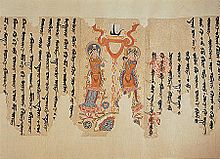


The Sogdian language (self-name sγwδy'n'k, sγwδy'w and similar variants) refers to the East Iranian branch of languages.
According to some modern scholars, the Yagnob language , spoken by the population of the Yagnob river valley in Tajikistan, goes back to a dialect very close to the Sogdian language.
History
The Sogdian language was first identified by Frederick Karl Andreas at the end of the 19th century from Manichaean works discovered in the Turpan oasis .
Sogdian shares a common ancestor with other north-eastern Iranian languages: Khotan , Tumshuk , Bactrian , Khorezm and other languages. Sogdians migrated to the Zeravshan valley in the second half of II - the beginning of I millennium BC. e. After the conquests, the Sogdians began a peaceful territorial expansion, in the III century. n e. they create trade settlements in oases in Western China and Mongolia along caravan trade routes .
CV c. n e. native speakers of the Sogdian language settle in the Ferghana Valley , in the oasis of Chach and in Semirechye . Before the Arab conquest, the Sogdian language dominated in the territory from the Zeravshan valley to Lake Issyk-Kul , Sogdian trading agents constantly lived in China and the Seven Rivers, active Sogdian trade caused the Sogdian language to become the lingua franca of the Central Asian region. [1] Religious literature in the Sogdian language was actively developed, Manichean, Buddhist and Christian texts were actively created and translated. Sogdian was used as a literary in the Uigur Kaganate until the creation of its own written language there.
There was a process of mutual enrichment of the Sogdian and Turkic languages. In the Sogdian texts of the Mug documents, there are borrowings from the Turkic language. For example, "yttuku" - "send", "embassy", "bediz" - "carving, ornament" and more. The purely Turkic word “sozum” - “my order” is also found there. [2] [3]
Since the VIII century, after the Arab conquest, the Sogdian culture gradually fell into decay, and the Sogdian language was supplanted by the Persian . By the 9th century, most of Sogd’s population spoke Persian, but in the 10th century Mukaddasi wrote: “I testify to the existence of Sogdian dialects in the Zeravshan valley.” Sogdian inscriptions of the 10th-11th centuries were found on the territory of Kyrgyzstan. Sogdian was finally supplanted by Turkic languages by the 12th century.
Currently, a small enclave of speakers of the Yagnob language , one of the Sogdian dialects, has been preserved in the valley of the Yagnob River .
The Sogdian language was the official language of Sogdiana, this is evidenced by the so-called “ Old Letters ” - a collection of official documents and letters of Tsar Devashtich, found in the Mug fortress, located 5 km from the village of Dar Dar, Aininsk district of the Sogd region of Tajikistan . The literary language used in the writing of Buddhist and Manichaean texts was somewhat different from the colloquial one, which wrote epigraphic monuments, "Old Letters" and Christian texts .
Writing
To write Sogdian texts, we used our own consonant alphabet , developed from Aramaic writing . The vast majority of Christian texts are written in the Syriac script adapted to Sogdian phonetics, while the Manichean texts are written in the modernized version of the Palmyra script, also dating back to the Aramaic prototype, or in the “national” Sogdian script.
Like most other Central Iranian languages , Sogdian used writing that dates back to Aramaic writing . As in the Pahlavi letter close to him, heterograms were widely used in Sogdian writing. The letter did not show the vowels unambiguously - therefore, texts are considered to be consonant sequences: for example, the feminine proper name δγwtγnch (customary to read Dgudgonch ) from a marriage contract found on Mount Mug in western Tajikistan . The reconstruction of the phonetic appearance of Sogdian words is thus difficult; in many cases, glosses (most often, proper names) from Arabic, Chinese and other sources help, as well as material from Yagnob and other Iranian languages.
Sogdian writing is the immediate predecessor of Uyghur writing , which, in turn, dates back to Mongolian writing , still used by the Mongols living in Inner Mongolia (autonomy of China ), and, ultimately, Manchu writing .
Sogdian language pattern (Aramaic heterograms in capital letters in transliteration)
Transliteration : MN sγwδy-k MLK 'δy-w'šty-c' t x'xsrc xwβw 'pšwnw δrwth γ-rβ nm'cyw
Literal translation: From the Sogdian king Devashtich to the Hahsar ruler Afshun (I wish good) health (and) many greetings ...
Phonetics and Phonology
Data on the phonetics of the Sogdian language is known only approximately, since Sogdian refers to dead languages.
Vocalism
Vowels
In Sogdian, there is an opposition of vowels in longitude - long (ā, ē, ü and ō) and short (a, e, u, o) vowels are distinguished. The brevity or longitude of a vowel determines the rhythmic characteristics of the root, which, in turn, determine the morphological characteristics of the root.
The main problem for the reconstruction of Sogdian vocalism is the consonant nature of Sogdian writing: only long vowels are necessarily displayed on the letter, while short vowels are indicated irregularly or not at all. To designate vowels, like the Semitic languages ( Hebrew , Aramaic , Arabic ) are used the so-called. matres lectionis - consonants in the meaning of vowels, and only three letters are used: iodine (transmitted by Latin y), vav (w) and alaf ('). Thus, different sounds can be denoted by the same sign: so, ē, e, ī and i are denoted by y , and ō, o, ū and u are denoted by w .
| Row | Front | Average | Rear | |||
|---|---|---|---|---|---|---|
| Longitude | Brief | Long | Brief | Long | Brief | Long |
| Top lift | i | ī | ( ɨ ) | u | ū | |
| Medium rise | e | ē | ( ə ) | o | ō | |
| Lower rise | a | ā | ||||
[ɨ] (indicated by the letter Ain ) appears only in the position before the consonants [sp], [st], [sn].
seam appears as a result of the reduction of the short vowels [a], [e] and [u] in an unstressed position.
Diphthongs
In Sogdian, there were long diphthongs of secondary education [āi] and [āu]. The original Iranian diphthongs * ai and * au became transformed into [ē] and [ō].
The nasal overtone [ṃ] could act as the second member of the diphthong. Some scientists believe that [r] could act in the same capacity, creating short diphthongs [ər], [ur], [ir].
Consonants
| Labial | Dental | Alveolar | Palatal | Velar | |
|---|---|---|---|---|---|
| Explosive / Affricates | p ( b ) | t ( d ) ( ʦ ) | ʧ ( ʤ ) | k ( g ) | |
| Fricatives | f β | θ δ | s z | ʂ ʐ | x γ |
| Nasal | m | n | |||
| Flowing | w | r ( l ) | y | ( h ) |
- - sounds [b], [d], [g] are positional allophones [β], [δ], [ʧ] and [γ] respectively and are detected only in the position after nasal [n] and [m] .
- sounds are present only in borrowed words.
- sounds [ ʧ ], [ ʤ ], [ ʂ ], [ ʐ ] in the traditional Iranian transcription are designated as [č], [ĵ], [š] and [ž] respectively.
Syllable
Typical syllable structure: CCVCC, for example škwrΘ [škōrΘ] ( difficult ), but other schemes are possible (CVC, CV, VC, CCV, VCC, CCCV, VCCC). A consonant cluster of three consonants is allowed both at the beginning and at the end of the syllable.
Super Segment Events
Accent
Stress in Sogdian is free, it is associated only with the number of vowels, it falls on the first syllable with a long vowel. If there are no long vowels in the root of the word, then the emphasis is shifted to inflection.
All unstressed short vowels except [o] are reduced to [ə].
“Heavy” and “light” foundations
The roots of words in the Sogdian language are divided into two categories: all roots that have at least one long vowel or diphthong in their composition are stressed and are called “heavy”; roots consisting of only short vowels are unstressed and are called “light”.
"Light" and "heavy" foundations are under the influence of the so-called. rhythmic law: “heavy” foundations pull the stress on themselves, due to which the endings, being reduced, mutate, but this does not happen with “light” foundations. Due to this, words with “light” and “heavy” stems are tilted and conjugated in different ways: for example, the reduced endings of names with “heavy” stems cease to differ, and these nouns have only three case forms instead of six for words with “light” strings .
Morphology
The Sogdian language is one of mixed languages, combining the characteristics of synthetic and agglutinative languages .
Name
Declination
In the Sogdian language, the names had a gender category, there was a masculine, feminine and neuter gender, with the neuter gender dying and the nouns of the middle gender gradually becoming masculine or feminine.
The declination of “light” and heavy “foundations” is fundamentally different. If the “light” foundations have 6 cases, then the “heavy” ones, due to the reduction of vowel inflections, have only three cases. The "light" foundations on - u and - ya leaned somewhat differently than the other "light" foundations. Despite the effect of the "rhythmic law", in Sogdian there was a tendency to build inflections of "heavy" foundations on the model of "light".
The category of the number is represented by the plural and singular. The plural of all genera leaned equally.
Declination of the “light” foundations
| Case | Male basics on a | Wed basics on a | Feminine. basics on ā | Male basics on u | Feminine. basics on ū | Male basis at ya | Feminine. basics on yā | Multiply. number |
|---|---|---|---|---|---|---|---|---|
| nom . | -i | -u | -a, -e | -a | -a | -i | -yā | -ta, -īšt, - (y) a |
| voc . | -u | -u | -a | -i, -u | -ū | -iya | -yā | -te, -īšt (e), - (y) a |
| acc . | -u | -u | -u, -a | -u | -u | - (iy) ī | -yā (yī) | -tya, -īštī, -ān (u) |
| gen .- dat . | -ē | -yē | -ya | - (uy) ī | -uya | - (iy) ī | -yā (yī) | -tya, -īštī, -ān (u) |
| loc . | -ya | -ya | -ya | - (uy) ī | -uya | - (iy) ī | -yā (yī) | -tya, -īštī, -ān (u) |
| instr .- abl . | -a | -a | -ya | - (uy) ī | -uya | - (iy) ī | -yā (yī) | -tya, -īštī, -ān (u) |
Declination of “heavy” foundations
In heavy foundations, the declension of the names of the male and middle genera does not differ.
| Case | Husband. and cf. kind | Wives kind | Mn number |
|---|---|---|---|
| Straight | -Ø | -Ø | -t |
| Vocative | -Ø, -a | -e | -te |
| Indirect | -ī | -ī | -tī |
Adjectives
Adjectives were inclined similarly to nouns. In the feminine gender, the majority of adjectives received the ending - č , for example, the adjective "mixed" masc. pətristē , but fem. pətrisč .
The comparative degree was created using the suffix - (i) star , for example murzək-star is “shorter” with murzək short. Superlatives were formed using the -tar suffix. In Buddhist texts, an excellent form was formed using the comparative adjective + words ēw “one” or āδparm “completely”, for example, ew murzək-star “shortest”.
Pronoun
Personal pronouns
In the Sogdian language there were personal pronouns of only the first and second persons, instead of the third person, the demonstrative pronoun was used similarly to the ancient Greek and Old Slavonic languages.
| Case | 1 sg | 2 sg | 1 pl | 2 pl |
|---|---|---|---|---|
| Direct case | azu | taγu | māx (u) | šmax (u) |
| Oblique case | maná | tawa | ||
| Critical form direct case | -m | -f (i) | man | -fan |
| Critical form oblique case | -mi | -t (i) | -tan |
Demonstrative Pronouns
There are two types of demonstrative pronouns in the Sogdian language: with strong deixis and weak, the former are used as personal pronouns of the 3rd person and as articles, the latter as actual demonstrative pronouns.
Demonstrative pronouns of the Sogdian language are divided into three classes depending on the distance from the speaker to the object: proximal (close distance), medial (middle distance) and distal (long distance), the system is similar to the existing in Armenian and Georgian languages.
Verb
As in other Indo-Aryan languages, the verb has two foundations, present and past tense, the latter are present tense with added augment . Rhythmically the basics are divided into light and heavy, similar to the nominal basics.
As in other Indo-Aryan languages , the verb has two bases, present and past tenses , for example, the verb “do” kun- has the past tense əkt- ? so I do sounds like (azu) kunam , and “I did” (azu) əktu . Some verbs have a separate basis for imperfect.
Rhythmically stems are divided into light and heavy in the same way as nominal stems.
Personal forms of the verb have the categories of numbers (singular and plural) and persons (first, second, third)
Time
In the Sogdian language, there are present , past , future and perfection .
Present
The indicative mood of the present tense is formed by adding the personal ending of the present tense to the present tense. the verb “listen” ( patγōš -) of the 1st person singular in presentation will be patγōšam , 2nd l. units h. patγōš , etc.
Personal endings in the present
| Face | Light base | Heavy base |
|---|---|---|
| one | -ām | -am |
| 2 | -ē, (-Ø) | -Ø, -ē |
| 3 | -ti | -t |
| one | -ēm (an) | -ēm (an) |
| 2 | -θa, -ta | -θ (a), -t (a) |
| 3 | -and | -and |
Imperfect
The imperfect is formed by adding the personal ending of the imperfect to the base of the imperfect, if the verb does not have the base of the imperfect, then the ending is added to the present tense. So, the verb “listen” ( patγōš -) of the 1st person singular in the imperfect will be patγōšu , 2nd L. units h. patγōši , etc.
Personal endings of imperfect
| Face | Light base | Heavy base |
|---|---|---|
| 1 sg. | -u | -Ø, -u |
| 2 sg. | -i | -Ø, -i |
| 3 sg. | -a | -Ø |
| 1 pl. | -ēm (u), -ēm (an) | -ēm (u), -ēm (an) |
| 2 pl. | -θa, -ta | -θ (a), -t (a) |
| 3 pl. | -and | -and |
Elapsed Time
The past tense is formed using the pure basis of the past tense and the personal form of the present tense of the auxiliary verb. For transitive verbs the verb “to be” was used as- , for intransitive verbs the verb “to have” δar- was used .
| Transitive verb | Intransitive verb | |||
|---|---|---|---|---|
| Number | Units hours | Mn hours | Units hours | Mn hours |
| 1 sg | wēt-δaram | wēt-δarēm | murt-im | murt-ēm |
| 2 sg | wēt-δarē | wēt-δarθ | murt-iš | murt-asθ |
| 3 sg | wēt-δari | wēt-δarant | murt-i | murt-ant |
- verb “see” is used, the basis of the present tense wēn , the basis of the past tense wēt .
- verb "to die" is used, the basis of the present tense mir , the basis of the past tense murt .
Type (linguistics)
In the Sogdian language, the verb has a perfect and imperfect form.
Inclination
In Sogdian, there are indicative , desirable , subjunctive , imperative and possible moods.
Nonpersonal Forms of the Verb
Non-personal forms of the verb in Sogdian include: present participles and past tenses, infinitives of the present and past tenses, gerund and the verb adjective.
Past Infinitive
The past tense infinitive was formed from the past tense base + ending -e or without ending, for example βaγt-e (“give”, present tense basis βaxš- ) and γōβāt (“ give praise”, present tense basis γōβ- ).
Present Infinitive
The present infinitive is formed differently in Christian, Buddhist and Manichaean texts (as an example, the verb with the basis wēn “see” is used.:
- Christian texts used the preposition par + present tense with -u or without: par wēn (u) .
- In Manichean texts, the present tense was used with or without the ending -i : wēn (i) .
- In Buddhist texts, the base was augmented by the suffix * -aka , which was reduced to -ē : wēn-ē .
Gerund
Gerund was formed by adding the ending -kya or -kī to the present tense: βar-kya “offering”, wāβ-ki “speaking”.
Sources of language material
An array of texts has reached the Sogdian language, for the most part these are Manichaean treatises, but Christian ( Nestorian ) and Buddhist works, as well as economic and administrative documents (so-called “ letters from Mount Mug ”) have been found [4] .
See also
- Yagnob language
Notes
- ↑ For example, the Bugut stela installed in Mongolia during the first Türkic Haganate contained, among other things, an inscription in the Sogdian language, see [1]
- ↑ Livshits V.A., Sogdians in Semirechye: linguistic and epigraphic evidence // Krasnaya rechka and Burana. Frunze. 1989, p. 79-80
- ↑ Livshits V.A., Sogdian documents from Mount Mug. Issue 2. Reading. Transfer. Comment. Legal documents and letters. M., 1962, p. 29, 55
- ↑ Sogdian documents from Mount Mug. Reading, translation, commentary. Issue II (Legal Documents and Letters). Reading, translation and commentary by V. A. Livshits. M., Publishing House of Oriental Literature, 1962
Sources
- Skjaervo, P. Manichaean Sogdian Primer . Harvad. 2007.
- Vinogradova S.P. Sogdian language // Languages of the world. Iranian Languages III. East Iranian languages. M .: Indrik, 2000.
- Yoshida, Y. Sogdian // The Iranian Languages. Ed. by G. Windfuhr. L and NY: Routledge. 2009.
Links
- Sogdian texts on TITUS
- Kümmel, MJ Mitteliranisch II: Sogdisch (inaccessible link) - German grammar of the Sogdian language. [2]