Ivan Ivanovich Betsky (also Betsky on February 3 [14], 1704 , Stockholm - on August 25 [ September 4 ] 1795 [2] , St. Petersburg ) - a prominent figure in the Russian Enlightenment , personal secretary of Empress Catherine II (1762-1779), president of the Imperial Academy Arts (1763-1795), the initiator of the Smolny Institute (1764) and Orphanages in Moscow (1764) and St. Petersburg (1770) with a hospital for women in labor. With his assistance, the Imperial Commercial School , a school at the Academy of Arts , where boys of different classes (except serfs), a department for girls-bourgeois at the Smolny Institute, were opened. He headed the commission on stone construction in St. Petersburg and Moscow . By educating Betskoy sought to create a "new breed of people" - nobles and representatives of other classes capable of humane treatment of peasants and fair administration of the state.
| Ivan Ivanovich Betskoy | ||||
|---|---|---|---|---|
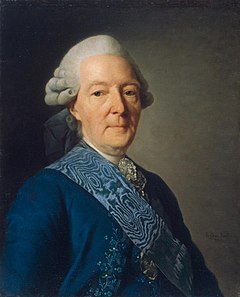 Portrait of I. I. Betsky works of Alexander Roslin (1777) | ||||
| ||||
| Birth | February 3 (14), 1704 Stockholm [1] | |||
| Death | August 25 ( September 4 ) 1795 (91 years old) St. Petersburg | |||
| Burial place | ||||
| Father | Prince Ivan Yuryevich Trubetskoy | |||
| Children | ||||
| Awards |
| |||


Biography
The illegitimate son of Field Marshal Prince Ivan Yuryevich Trubetskoy , whose abbreviated surname he later received, and an unknown by the name of the Swedish Baroness from the Wrede clan (or according to E.E. Trubetskoy, Countess from the Shparr clan). Born in Stockholm, where his father was held captive, and lived there in his childhood. Having received, first under the guidance of his father, "an extraordinary teaching," Beckoi was sent for further education to Copenhagen , in the local cadet corps; then he served in the Danish cavalry regiment for a short time, during the training he was discarded by a horse and badly dented, which, apparently, led him to refuse military service.
He traveled around Europe for a long time, and from 1722 to 1726 he spent “for science” in Paris , where, at the same time, he was a secretary under Russian after and was introduced to the Duchess Johannes Elizabeth of Anhalt-Zerbst (mother of Catherine II ), who at that time , and subsequently treated him very graciously (due to which there was a hypothesis that Catherine II was his daughter).
In Russia, Betskaya was at first an adjutant outhouse with his father in Kiev and Moscow , and in 1729 decided to serve in the College of Foreign Affairs, from which he was often sent as a courier to Berlin , Vienna and Paris. Thanks to his father and half-sister Anastasia Ivanovna , the wife of Prince Ludwig of Hesse-Gomburgsky , Betskoy became close to the court of Elizabeth Petrovna . The research of P. M. Maikov established that he did not take part in the coup on November 25 ( December 6 ), 1741, which elevated Elizabeth to the throne.
Due to the machinations of Chancellor Bestuzhev, Betskaya was forced ( 1747 ) to resign. He went abroad and, on his way there, tried, according to his own words, “not to miss anything from the lengthy living book of nature and everything that was seen, more expressively than any books teaching to draw all the important information for a great education of the heart and mind . ” Betskoy lived abroad for 15 years, mainly in Paris, where he attended social salons, made acquaintance with encyclopedists, and through conversations and reading he learned the ideas that were then fashionable.
Peter III at the beginning of 1762 summoned Betsky to Petersburg, promoted to lieutenant general and appointed chief director of the office of the buildings and houses of his majesty . In the coup on June 28 (July 9), 1762, Betskoy did not take part, and apparently did not know anything about preparations for him; perhaps because he was always indifferent to politics in the proper sense. Catherine, who knew Betsky from her very arrival in Russia, brought him closer to her, appreciated his education, elegant taste, his tendency to rationalism, on which she herself was brought up. Betskoy did not intervene in state affairs and had no influence on them; he dissociated himself from a special field - educational.
By decree of March 3, 1763, management was entrusted to him, and in 1764 he was appointed president of the Academy of Arts , at which he organized an educational school. On September 1, 1763, a manifesto was published on the establishment of a Moscow educational house according to a plan drawn up, according to one source, by Betsky himself, and according to another, by A.A. Barsov , professor at Moscow University, according to Betsky’s instructions. According to Betsky, an “educational society of noble maidens” was opened in St. Petersburg (later the Smolny Institute ), entrusted to his main care and leadership. In 1765 he was appointed chief of the land gentry corps , for which he compiled a charter on a new basis. His activities in this post were ambiguous. S.R. Vorontsov evaluated her like this:
The officers coming out of the old cadet corps were good military men and nothing more; raised by Betsky, they played comedies, wrote poems, knew, in a word, everything, except what the officer should have known. [3]
In 1768, Catherine II promoted Betsky to the rank of Actual Privy Councilor . In 1772 , according to Betsky’s plan and at the expense of Procopius Demidov , an Educational Commercial School for merchant children was established.
Having entrusted Betsky with the leadership of all educational and educational institutions, Catherine endowed him with great wealth, a significant portion of which he devoted to charity affairs and especially to the development of educational institutions. On the model of Moscow, Betskaya opened an educational house in St. Petersburg , and under him instituted a widow and a safe treasury, based on the generous donations made by him. In St. Petersburg, funny verses of various contents went about Betsky, such as:
Ivan Ivanovich Betsky,
German man
Child carer
Wore a Swedish wig, etc.
In 1773, the Senate in a ceremonial ceremony presented Betsky, beaten out in his honor, according to the Highest Will, for the establishment of scholarships in 1772 at his own expense, a large gold medal with the inscription: “For love of the fatherland. From the Senate on November 20, 1772 ” [4] . As the director of the Chancellery of Buildings, Betskaya contributed a lot to decorating St. Petersburg with government buildings and structures; the largest monuments of this side of his activity were the monument to Peter the Great , the granite embankment of the Neva and canals and the lattice of the Summer Garden . Towards the end of Betsky’s life, Catherine lost interest in him, deprived him of the title of her reader. From her expression: “Betskoi appropriates himself to the glory of the state,” one can think that the reason for the cooling was rooted in the empress’s confidence that Betskoi ascribes herself the merit of educational reform, while Catherine herself claimed a significant role in this matter.
Betskoi was buried in the Alexander Nevsky Lavra [5] ( Annunciation Church of the Alexander Nevsky Lavra ). On his gravestone are placed medallions with the image of the medal "For the love of homeland" and the inscription:
WHAT I DESERVED IN ITS USEFUL DAYS |
To the demise of the benefactor
<...>
There was a ray of mercy, Betskoy, you!
Who poured streams in blood;
Who transformed hail to dust -
You are full of mercy, love,
Saved, stored, taught, wrote;
Who shine metal - you were eliminated;
Who was wealthy - you were suppressed;
Who wasted - you are the life of the shore;
Who is for yourself - you lived for everyone.
<...>
Pedagogical Views
The main principles of the educational reform undertaken by Betsky were set forth by him in his report: “General institution for the education of youth of both sexes”, approved by the empress on March 12 ( 23 ), 1764 [6] . In the “General Institution” - in general aphoristic expressions, and in the charters - on points, in the appendix to practical needs, the pedagogical views of Western European rationalism are stated. Betsky’s views on the methods of education were progressive for their time: educators should be “conscientious and worthy people as examples” , teach without coercion, taking into account the child’s inclinations, and not use corporal punishment.
Betskoi from the far from coinciding views of Locke , Rousseau and Helvetius , accepting one and discarding the other, made up the whole system. It was based on the task of creating a new breed of people. Betsky’s image of a new person is definitely not drawn anywhere, but judging by the scattered remarks, his main feature was the absence of the negative properties that were characteristic of his contemporaries. Some positive touches are as follows: "A person, feeling like a man, ... should not be allowed to treat himself like an animal" ; “So that with the graceful mind the most elegant still connected heart” ; "A person must know the rules of civilian life . "
Catherine, who, like Betsky, was a follower of enlightening philosophy, sympathized with this grandiose idea, and the “General Plan” was compiled by Betsky without doubt after a preliminary discussion of his main provisions together with the empress. The means to achieve the "new breed" is education. Without denying the importance of general education, the formation of the mind, Betskoi transfers the center of gravity to the formation of the heart, to education. “The root of all evil and good is upbringing ,” he says. "Decorated or enlightened by the sciences of the mind does not make a good and direct citizen, but in many cases it’s even more harmful if someone is brought up not in virtues from the most tender youth of his age . "
According to Rousseau, Betskoy admits that a person is by nature not angry, but kind, and the child’s soul is like wax, on which you can write anything. Betskoy offers educational institutions to write good on her: “To affirm the youth’s heart in laudable inclinations, to arouse a desire for industriousness in them, and to fear idleness; teach them decent behavior, courtesy, condolences on the poor, unhappy; to train them in house-building ... and to root them in them ... a tendency to neatness and cleanliness . ”
It is important to form the first generation in this direction first, “new fathers and mothers who would be able to instill the same direct and thorough parenting rules in their hearts that they themselves have received, and so following from childbirth to childbirth, to future ages . ”
But upbringing cannot achieve its goal if the first educated generations are not completely isolated from the elders adjacent to them, mired in ignorance, routine and vices. This idea, only slightly outlined by Rousseau ( “there are no inborn vices and atrocities, but bad examples inspire them” ), Betskoy developed to the extreme. Betsky thinks that between the old generation and the new one, an artificial barrier must be created so that the first, “brutal and furious in words and deeds,” is deprived of the opportunity to exert any influence on the second. Closed educational institutions (boarding schools) should have served as such an artificial barrier, where, under the guidance of enlightened mentors, children and youths would have stood up until their hearts got stronger and their minds matured, that is, until they were 18–20 years old.
Portrait of A. Roslin
Like Locke, Betskoy recognized the importance of physical education and the need to reckon with the temperament of the child, and like Rousseau "believed the need to follow in the footsteps of nature, not overcoming and not breaking it, but contributing to it . " Betskaya also merged with the idea of pedagogical political and social aspiration: to create in Russia an educated third estate , "the third rank of people." He saw how the moral, political, and especially economic importance of this estate grew in the West, and regretted that in Russia only “two ranks were established: nobles and peasants,” and merchants, burghers, artisans, and the meanings associated with these ranks of the industry in public life did not have.
“ In foreign countries ,” argued Betskoi, “the third order of the people, instituted over several centuries, continues from generation to generation: but as here (in Russia) this rank is not yet found, it is believed that it is necessary ... Direct intention a new institution (the Educational Home) - to produce people who are able to serve the homeland with their own hands in various arts and crafts . ” The establishment of a number of institutions (educational homes, petty bourgeois schools under the gentry corps and at the Academy of Arts), in addition to its direct and immediate tasks - to bring up rootless children, to educate lower classes children - was aimed precisely at creating this "third rank of people." All of Betsky’s pedagogical plans and the charters of the institutions created by him are collected in a separate publication: “Institutions and Charters Relating to the Education of Both Sexes of Youth” ( St. Petersburg , 1774). With the intensification of the noble reaction after the Peasant War (1773–75), these views seemed too liberal, and Betskoy was removed from the leadership of educational institutions.
Rewards
Knight of orders
- Order of St. Alexander Nevsky February 9 (20), 1762
- Order of the Holy Apostle Andrew the First-Called April 21 ( May 2 ) 1768
- Order of St. Vladimir I degree , October 23 ( November 3 ), 1782 . On the day the order is established.
Personal life
Betskaya was single, but had a number of “pupils”, including Anastasia Sokolova , whom he bequeathed 80,000 rubles in silver and 40,000 banknotes, as well as two stone houses on Palace Embankment . He was the curator of the Smolny Institute, and, already an elderly person, he took the 17-year-old graduate Glafira Alymova , who was very jealous, into his house to live. When the girl got married and, unable to withstand Betsky’s constant control, fled with her husband to Moscow, Betsky was struck by a blow, he almost died and retired from most of his affairs.
Memory
- In 1868, a bust of Betsky was installed in the courtyard of the Petersburg Educational House (1868, an enlarged copy of the sculptor A.P. Lavretsky from the original by Y. I. Zemelgak , 1803; 52 Moika Embankment ).
- Betsky’s bronze figure is placed on the monuments to Empress Catherine II in St. Petersburg and Tsarskoye Selo, on the frieze of the monument “Millennium of Russia” .
- Partly preserved Betsky’s House , located in St. Petersburg at the address: Palace Embankment. , 2 .
In Fiction
- Yuri Limanov “The Lovely Child of Sin”, historical novel, 2005
- Mikhail Kazovsky “Catherine: Wisdom and Love”, historical novel, 2010
- Mikhail Kazovsky “Lomonosov’s Heir”, historical novel, 2011
Notes
- ↑ Betskoy, Ivan Ivanovich // Military Encyclopedia : [in 18 vol.] / Ed. V.F. Novitsky [et al.]. - SPb. ; [ M. ]: Type. t-va I. D. Sytin , 1911-1915.
- ↑ TsGIA SPb. f.19. Op. 111. d.118. with. 16. Metric books of the Cathedral of St. Isaac of Dalmatia.
- ↑ Cit. by A. Kamenev. History of officer training in Russia. M .: VPA them. Lenin, 1990, p. 33.
- ↑ Iversen Yu. G. Medals in honor of Russian statesmen and private individuals. T. 1. St. Petersburg., 1880-1896.
- ↑ Betskoi Ivan Ivanovich
- ↑ General institution for the education of both sexes of youth . Archive of the issues of the journal "Domestic Notes" 2001-2014, No. 3 (18) 2004.
Literature
- Maykov P.M. Betskoy, Ivan Ivanovich // Russian Biographical Dictionary : in 25 volumes. - SPb. - M. , 1896-1918.
- Betsky, Ivan Ivanovich // Brockhaus and Efron Encyclopedic Dictionary : 86 volumes (82 volumes and 4 additional). - SPb. , 1890-1907.
- Майков П. М. Иван Иванович Бецкой. Опыт биографии . - SPb. : тип. т-ва «Обществ. польза», 1904.
- Лаппо-Данилевский А. С. И. И. Бецкой и его система воспитания. Отзыв о сочинении П. М. Майкова «Иван Иванович Бецкой. Опыт биографии». - SPb. , 1904.
- Бецкой И. И. Письма И. И. Бецкого к императрице Екатерине Второй / Коммент. П. М. Майкова // Русская старина, 1896. — Т. 88. — № 11. — С. 381—420.
- Бецкой И. И. Письмо к Григорию Григорьевичу Гогелю, С.-Петербург, апреля 1784 г. / Сообщ. А. Ф. Бычков // Русская старина, 1873. — Т. 8. — № 11. — С. 715—717.
- Бецкой И. И. Челобитная И. И. Бецкого об увольнении его в отпуск за границу / Сообщ. А. Ф. Бычков // Русский архив, 1866. — Вып. 11. — Стб. 1567—1569.
- (недоступная ссылка) Бецкой, Иван Иванович Учреждение Императорского Воспитательного для приносных детей дома и госпиталя для бедных родильниц в столичном городе Москве. Генеральный план Имп. Московского воспитательного дома и госпиталя [Текст] : [в 3 ч.] : Ч.1-3 / И. И. Бецкой. — 2-е изд. — СПб. : Акад. наук, 1767. — [256] с. : ил. — Б. ц. Приплетено: 1.Бецкой, Иван Иванович. Прибавление к изданию трех частей Генерального плана Имп. Московского воспитательного дома для желающих ведать знатнейшие заведения… / И. И. Бецкой. — СПб. : Акад. наук, 1768. — 112, 5 с. : 1 л. ил. 2.Бецкой, Иван Иванович. Краткое наставление, выбранное из лучших авторов с некоторыми физическими примечаниями о воспитании детей от рождения их до юношества / И. И. Бецкой. — СПб. : Шляхетский сухопут. корпус, 1766. — 5, 49 с. (inaccessible link)
- Пятковский А. П. С.-Петербургский воспитательный дом под управлением И. И. Бецкого. (Историческое исследование по архивным источникам) // Русская старина, 1875. — Т. 12. — № 1. — С. 146—159; № 2. — С. 359—380; № 4. — С. 665—680; Т. 13. — № 5. — С. 177—199 , № 8. — С. 532—533; Т. 14. — № 11. — С. 421—443; № 12. — С. 618—638.
- Ржевская Г. И. Памятные записки Глафиры Ивановны Ржевской // Русский архив, 1871. — Кн. 1. — Вып. 1. — Стб. 1-52.
- Бецкой И. И. Генерального плана Императорского воспитательного дома исполнительное учреждение вдовьей, ссудной и сохранной казны, в пользу всего общества. СПб., 1772.
- Бецкой И. И. Краткое наставление выбранное из лучших авторов с некоторыми физическими примечаниями о воспитании детей от рождения их до юношества. СПб.,1776.
- Бецкой И. И. План коммерческого воспитательного училища. СПб., 1772.
- Бецкой И. И. Устав воспитания двухсот благородных девиц учреждённого Её Величеством Государынею Императрицею Екатериною Второю , Самодержицею Всероссийскою Материю Отечества, и прочее и прочее и прочее. СПб., 1764.