The Euphrosynian cemetery in Vilnius is one of the oldest and most valuable in the historical and cultural respect of the Orthodox necropolises of Lithuania . It is located in the southern part of the city behind the Acute Brahma and the railway on Lepkalne Street (Lipovka, Liepkalnio g. ).
| Cemetery | |
| Evfrosinievskoe cemetery | |
|---|---|
 | |
| A country |  Lithuania Lithuania |
| City | Vilnius |
| Denomination | |
| First mention | 1798 year |
| Established | |
| condition | Acting |

History
The land for the cemetery was allotted in 1796 by the city council from urban lands.
In 1837, the cemetery church of St. Euphrosyne of Polotsk was founded. Since the construction of the temple, the cemetery has been under church jurisdiction. Significant funds for the purchase of additional land and improvement of the cemetery were donated by the merchant T.F. Zaitsev .
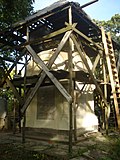
After his death, the executor in 1843 erected a tomb in the form of a grotto in a sandy mountain. In 1914, the tomb of Tikhon Zaitsev was expanded and rebuilt into the cave church of St. Tikhon Zadonsky . The church was consecrated by the Archbishop of Lithuania and Vilnius Tikhon (Bellavin) .
In 1865, the church of Euphrosyne of Polotsk was expanded and rebuilt. In the same year, under the project of architect N. M. Chagin and academician of the Academy of Arts A. I. Rezanov , the chapel of St. George the Victorious was built at the burial place of Russian soldiers and officers who fell during the suppression of the 1863 uprising , with memorial marble tables on three exterior walls on which are carved the names of the fallen and buried here Russian soldiers. The chapel was built on the amount donated by the Empress Maria Alexandrovna and her children (500 rubles), as well as collected by subscription (M.N. Muravyov allocated the amount of 4000 rubles missing for the construction of the chapel). A Byzantine style chapel was erected on a granite pedestal. Inside the chapel was an icon of St. George, painted by academician N.I. Tikhobrazov . The chapel was consecrated on August 25, 1865 [1] [2] (currently it has been renovated, a mosaic icon of St. George the Victorious is placed inside).
At the cemetery during the German occupation of Vilnius during World War II, the Nazis buried Soviet prisoners of war and civilians who were shot, dead from wounds and diseases, in the pits. In 1942 - 1943 1,151 people were buried here; the names and surnames of 382 of them are known. In 1997, at the expense of the Russian Federation , a memorial to the victims of fascism was erected: a wall lined with marble chips, in the niche of which a monument was erected. The inscription is carved on black polished granite :
Everlasting memory
to the victims of fascism
executedin 1941-1944
In 2002, the memorial was restored at the expense of the Russian Federation with the assistance of the Russian Embassy in Lithuania. [3] During this restoration, tables were installed on the wall with the famous names of the dead.
In 1948, the cemetery was nationalized. After the restoration of Lithuanian independence in 1991, the city authorities transferred the cemetery to the management of the parish community.
Not far from the cemetery on Naujininkų street, 20 is an Old Believer cemetery .
Burials
Many prominent officials, military leaders, church hierarchs, outstanding figures of Russian culture of Vilna and Lithuania of the 19th - 20th centuries are buried in the cemetery:
- Andrei Ivanovich Bukharsky ( 1770 - 1833 ), Senator, Privy Councilor, Post Director of the Lithuanian Post Office; The author of od and comedies popular at the end of the 18th century .
- Anna Mikhailovna Daragan ( 1806 - 1877 ), teacher and writer, children's writer.
- Pavel Vasilievich Kukolnik ( 1795 - 1884 ), historian, poet, teacher, playwright, professor of history and statistics, University of Vilna , brother of N.V. Kukolnik .
- Semyon Vukolovich Sholkovich ( 1840 - 1886 ), publicist, historian, archaeographer.
- Yakov Fedorovich Golovatsky ( 1814 - 1888 ), Ukrainian poet , Ukrainian and Russian historian and folklorist.
- Vasily Alekseevich von Rotkirch ( 1819 - 1891 ), lieutenant general , writer, playwright, researcher of Lithuanian mythology.
- Mikhail Ivanovich Zeidler ( 1816 - 1892 ), lieutenant general , sculptor and painter, friend of M. Yu. Lermontov .
- Julian Fomich Krachkovsky ( 1840 - 1903 ), historian and local historian, father of the famous orientalist I. Yu. Krachkovsky .
- priest John Shreubovich, rector of the St. Nicholas Church (? - 1910 ), father of actor Vasily Ivanovich Kachalov .
- Archpriest Michael Kuzmenko, Rector of the Savior-Euphrosyne Church of the city of Polotsk
- priest and writer John Antonovich Kotovic , ( 1839 - 1911 ), editor of the Lithuanian Diocesan Vedomosti: a monument made of local gray granite with a high stone cross and a photograph on china.
- Ivan Petrovich Trutnev ( 1827 - 1912 ), artist, participant in the exhibitions of the Wanderers , creator and director of the Vilna Drawing School .
- Xenophon Govorsky ( 1811 - 1871 ) - Russian archaeologist, historian, journalist and publisher.
Gallery
Grave of V.A. von Rothkirch
Grave of I.P. Trutnev
Graves of E.P. Verevkina (nee Daragan), A.M. Daragan and P.M. Daragana
Tombstone of A. Bukhara
Notes
- ↑ Belarus and Lithuania. The historical fate of the Northwest Territory. - St. Petersburg: Printing House of the Partnership “Public Benefit”, 1890.
- ↑ Dobriansky F. Old and New Vilna . - Third edition. - Vilna: Printing house of A. G. Syrkin, 1904. - S. 175. - 286 p.
- ↑ Book of memory. World War II military grave album in Lithuania. = Atminimo knyga. Antrojo pasaulinio karo karių kapinių Lietuvoje albumas. Sudarytojas Vaigutis Stančikas. Vilnius: Gairės, 2006. ISBN 9986-625-59-9 . S. 57.
Literature
- Joseph (Sokolov) . Vilensky Orthodox Necropolis. Vilna, 1892.
- Leo Savitsky. Orthodox cemetery of Vilna. By the centenary of the church of St. Euphrosyne. Vilno, 1938.