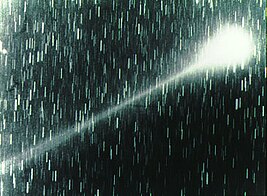
Comet Jacobini-Zinner (officially 21P / Giacobini-Zinner ) was discovered by M. Jacobini ( Nice , France ) in the constellation Aquarius on December 20, 1900. It was discovered again by E. Zinner ( Bamberg , Germany ) two perihelions later during observation of variables stars near β Shield on October 23, 1913 .
| 21P / Jacobini - Zinner | |
|---|---|
 | |
| Opening | |
| Discoverer | Michelle Jacobini Ernst Zinner |
| opening date | December 20, 1900 |
| Alternative notation | P / 1900 Y1 ; 1900 III ; 1900c; P / 1913 U1 ; 1913 V ; 1913e; 1926 VI ; 1926e; 1933 III ; 1933c; 1940 I ; 1939l; 1946 V ; 1946c; 1959 VIII ; 1959b; 1966 I ; 1965g; 1972 VI ; 1972d; 1979 III ; 1978h; 1985 XIII ; 1984e; 1992 IX ; 1991m |
| Orbit characteristics | |
| Age of July 9, 2005 | |
| Eccentricity | 0.7057 |
| Semimajor axis ( a ) | 3.527 a. e. |
| Perihelion ( q ) | 1,038 a. e. |
| Aphelion ( Q ) | 6.015 a. e. |
| Circulation Period ( P ) | 6,623 a |
| Orbital inclination | 31.8 ° |
| Last perihelion | July 2, 2005 February 11, 2012 |
| Next perihelion | September 12, 2018 |
| physical characteristics | |
| Meteor showers | |
| Draconids (Jacobinides) | |
The meteor shower Draconida (also known as the Jacobinids) is associated with the comet Jacobini - Zinner.
This comet was the target for the International Cometary Explorer (Explorer 59) spacecraft, which passed through the gas tail of Comet Jacobini-Zinner on September 11, 1985 .
Comet Jacobini - Zinner is a periodic comet with a circulation period of 6.6 years. The diameter of its core is estimated at 2 km. In 1946 and 1959, flashes of 0.5–1.0 stars were observed in the comet. led.
On September 12, 2018, the comet will pass the perihelion at a distance of 1.03 AU from the sun. A few days later, when it will pass at a minimum distance from the Earth (0.307 AU), its brilliance will reach +6 stars. led [1] .
Notes
Links
| Short period comets with numbers | ||
|---|---|---|
| ◄ 19P / Borelli • 20D / Westphalia • Jacobini - Zinner • 22P / Kopf • 23P / Borsen - Metcalf ► | ||