Modest Petrovich Musorgsky [5] [6] ( March 9 [21], 1839 , p. Karevo , Pskov province - March 16 [28], 1881 , St. Petersburg ) - Russian composer, member of The Mighty Handful . He worked in various genres: in his creative heritage operas, orchestral plays, cycles of vocal and piano music, romances and songs, choirs.
| Modest Petrovich Mussorgsky | |
|---|---|
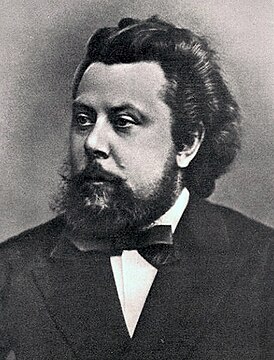 M.P. Mussorgsky. 1870 photo | |
| basic information | |
| Date of Birth | |
| Place of Birth | Karevo village , Toropetsky district , Pskov province Russian Empire |
| Date of death | |
| A place of death | |
| Buried | |
| A country | |
| Professions | composer |
| Instruments | |
| Genres | opera, chamber vocal lyrics, piano music |
In Mussorgsky’s work, Russian national features found an original and vivid expression, but his originality during his life was not fully appreciated. From the beginning of the 20th century to the present, his operas Boris Godunov and Khovanshchina , the cycle of piano miniatures Pictures from the Exhibition , the vocal cycles Songs and Dances of Death , Children's, and other compositions are recognized masterpieces of world musical art.
Content
- 1 Biography
- 1.1 Recent years
- 2 Creativity
- 3 Recognition
- 4 Works
- 4.1 For musical theater
- 4.2 For orchestra
- 4.3 For choir with accompaniment
- 4.4 For piano
- 4.5 For voice and piano
- 4.5.1 Unfinished songs and romances
- 4.6 Unsaved and / or lost works
- 5 Literary works
- 6 Memory
- 6.1 Settlements with streets named after Mussorgsky
- 6.2 Monuments
- 6.3 Other objects
- 6.4 Mussorgsky in the cinema and in the theater
- 7 Notes
- 8 Literature
- 9 References
Biography
Mussorgsky’s father came from an old noble family of Mussorgsky [7] . Until the age of 10, Modest and his older brother Filaret received home education. In 1849 , having moved to St. Petersburg, the brothers entered the German school of Petrishule . In 1852, without graduating from college, Modest enrolled in the School of Guard Ensigns , where, thanks to the law teacher Father Krupsky, he "deeply penetrated the very essence" of Greek, Catholic and Protestant church music [8] . After graduating from school in 1856 , Mussorgsky did not serve for long in the Life Guards Preobrazhensky regiment (in those years he met A.S. Dargomyzhsky ), then in the main engineering department, in the Ministry of State Property and in state control.
By the time he entered the Balakirev music club, Mussorgsky was a superbly educated and erudite Russian officer (he could freely read and speak French and German, understood Latin and Greek) and strove to become, as he put it, “music”. Balakirev made Mussorgsky pay attention to music classes. Under his leadership, Mussorgsky read orchestral scores, analyzed harmony, counterpoint and form in the works of recognized Russian and European composers, developed the skill for their critical evaluation.
Musorgsky studied piano (from 1849) with A. A. Gerke and became a good pianist . Having a beautiful chamber baritone by nature, he willingly sang in the evenings in private musical collections. In 1852 , the first publication of the composer, the piano polka “Ensign”, was published in St. Petersburg. In 1858 , Mussorgsky wrote two scherzo - B-dur and cis-moll, one of which (B-dur) was orchestrated by him and in 1860 performed in a concert of the Russian Musical Society .
Mussorgsky began work on the large form with music for the tragedy of Sophocles "Oedipus", but did not finish it (one choir was performed in a concert by K. N. Lyadov in 1861, and was also published posthumously among other works by the composer). The following big ideas - operas based on Flaubert’s novel “ Salambo ” [9] (also called “Libyan”) and the plot of Gogol’s “ Marriage ” - were also not fully realized. Mussorgsky used music from these sketches in his later compositions.
Mussorgsky completed the next major plan, the opera Boris Godunov , according to the tragedy of the same name by A. S. Pushkin. In October 1870, the final materials were presented by the composer to the Directorate of the Imperial Theaters. On February 10, 1871, the repertoire committee, which consisted mainly of foreigners, rejected the opera without explanation [10] ; According to E. Napravnik (who was a member of the committee), the reason for the refusal of the production was the lack of a “female element” in the opera [11] . The premiere of Boris took place at the Mariinsky Theater in St. Petersburg only in 1874 on the material of the second edition of the opera, in which the composer was forced to make significant changes. Even before the premiere, in January of that year, the St. Petersburg music publisher V.V. Bessel published an opera (in clavier).
In 1872, Mussorgsky conceived the dramatic opera ("folk musical drama") " Khovanshchina " (according to the plan of V.V. Stasov ), while also working on a comic opera based on the plot of Gogol 's Sorochinsky Fair . Khovanshchina was almost completely finished in the clavier, but (with the exception of two fragments) not instrumented. During the life of Mussorgsky, "Khovanshchina" was not published and was not put on.
Mussorgsky composed the first two acts for the “Sorochinskaya Fair”, as well as several scenes for the third act: Dream Parubka (where he used the music of the symphonic fantasy “Night on the Bald Mountain”, made earlier for unfulfilled collective work - the opera-ballet “Mlada”), Dumku Parasi and Hopak.
Recent years
In the 1870s, Mussorgsky was painfully experiencing the gradual collapse of The Mighty Handful - a trend that he took as a concession to musical conformism, cowardice, even betrayal of the Russian idea:
Without a banner, without desires, without seeing and not wanting to see into the distance, they pore over what has been done for a long time, what nobody calls them to ... <...> A mighty bunch has degenerated into soulless traitors; The “scourge” turned out to be a baby’s whip.
- Letter to V.V. Stasov, 19-20.10.1875
The misunderstanding of his work in the official academic environment was painful, as, for example, at the Mariinsky Theater , which was then led by foreigners and compatriots sympathetic to Western opera fashion. But a hundred times more painful was the rejection of his innovation by people whom he considered close friends - Balakirev, Cui, Rimsky-Korsakov:
At the first show of the 2nd act of the “Sorochinskaya Fair”, I was convinced of the fundamental misunderstanding by the musicians of the collapsed “handful” of Little Russian comic: it was such a chill from their views and demands that “the heart froze,” as Protopope Avvakum says. Nevertheless, I paused, became thoughtful, and checked myself more than once. It cannot be that I was a circle not right in my aspirations, it cannot be. But it’s annoying that with the musicians of the collapsed “handful” one has to interpret through the “barrier”, behind which they remained.
- Letter to A. A. Golenishchev-Kutuzov 11.11.1877
These feelings of unrecognition and "incomprehensibility" were expressed in "nervous fever" [12] , which intensified in the second half of the 1870s, and as a result, in addiction to alcohol. Mussorgsky was not in the habit of making preliminary sketches, sketches, and drafts. He pondered everything for a long time, composed and recorded completely finished music. This feature of his creative method, multiplied by nervous illness and alcoholism, was the reason for the slowed down process of creating music in the last years of his life. After retiring from the "forest department" (where he served as the junior head-captain since 1872), he lost a permanent (albeit small) source of income and was content with casual earnings and little financial support from friends. The last bright event was a trip arranged by his friend, singer D.M. Leonova in July-September 1879 in the south of Russia. During the tour, Leonova Mussorgsky acted as her accompanist, including (and often) performed his own innovative compositions. A characteristic feature of his late pianism was a free and harmoniously bold improvisation [13] . The concerts of Russian musicians that were given in Poltava, Elizavetgrad, Nikolaev, Kherson, Odessa, Sevastopol, Rostov-on-Don, Voronezh and other cities were held with unchanged success, assuring the composer (albeit not for long) that his path "to new shores "is chosen rightly.
One of Mussorgsky’s last public speeches took place at the evening of F.M.Dostoevsky in St. Petersburg, February 4, 1881. When a portrait of the great writer, bordered with mourning, was brought out before the public, Mussorgsky sat down at the piano and improvised the funeral bell ringing. This improvisation that struck those present was (according to the recollections of an eyewitness) his "last" forgive "not only to the deceased singer" humiliated and insulted ", but also to everyone alive" [14] .
Mussorgsky died in the Nikolaev military hospital in Petersburg [15] , where he was placed on February 13 after an attack of delirium tremens . There, a few days before his death, Ilya Repin painted the only lifetime portrait of the composer. Mussorgsky was buried in the Tikhvin cemetery of the Alexander Nevsky Lavra .
In 1972, the M.P. Museum-Reserve was opened in the village of Naumovo (Kuninsky district, Pskov region) in the Chirikov estate (Mussorgsky's maternal line). Mussorgsky . The Mussorgsky estate in the village of Karevo (located nearby) was not preserved.
Creativity
In Musorgsky's musical work, Russian national features were found in an original and vivid expression. This defining feature of his style manifested itself manifoldly: in the ability to handle folk songs and church music (including the old Russian monody ), in melody, harmony ( modalisms , linearity , non-standard chords , including quarter chords), rhythm (complex, “Non-square” meters , original rhythm formulas ), form; finally, in the development of plots, mainly from Russian life. Mussorgsky is a hater of routine; for him there were no authorities in music. He paid little attention to the rules of musical “grammar”, seeing in them not the provisions of science, but only a collection of composing techniques of past eras, which he did not want to use (for example, he almost completely lacked the imitation- polyphonic development of musical material, which was inherent in many to his Western colleagues, especially in Germany). Hence the constant desire of Mussorgsky-composer to novelty in everything.
Mussorgsky's specialty is vocal music. On the one hand, he strove for realism, on the other hand, for a colorful and expressive disclosure of the word. In an effort to follow the word, musicologists see continuity with the creative method of A. S. Dargomyzhsky . Love lyrics as such attracted him little [16] . Mussorgsky’s specific style is widely manifested in those cases when he turns to Russian peasant life. Mussorgsky’s songs “Kalistrat”, “Lullaby of Yeryomushki” (lyrics by N. A. Nekrasov ), “Sleep, sleep, the peasant son” (from “Voivode” by A. N. Ostrovsky ), “Hopak” (from “Gaydamakov” T. Shevchenko ), “Svetik Savishna” (to the verses of Mussorgsky himself, who skillfully stylized the folk five-syllable ) and many others. etc. In such songs and romances, Mussorgsky finds a truthful and dramatic musical expression for hopelessness and sorrow, which is hidden under the external humor of the lyrics. Mussorgsky did a good job of humor, irony and satire (in the fairy tale about “The Goat”, in the Latin-tinkering Latin “Seminarist”, in love with the priest’s daughter, in the musical pamphlet “Rayok”, in the song “Haste” [17] , etc.). Expressive recitation distinguishes the song "Orphan" and the ballad "Forgotten" (on the plot of the famous painting by V.V. Vereshchagin ). Mussorgsky managed to find completely new, original tasks, to apply new peculiar techniques for their implementation, which was clearly expressed in his vocal paintings from children's life, in a short cycle under the title “Children's” (the text belongs to the composer) [18] [19] . The vocal cycle “Songs and Dances of Death” ( 1875 - 1877 ; words of Golenishchev-Kutuzov ; “Trepak” - a picture of a drunken drunken peasant in the forest; “Lullaby” sounds from the mother’s face at the bedside of her dying child, etc. is of exceptional dramatic power. )
Mussorgsky’s most ambitious creative achievements are concentrated in the field of opera, which he called his own variety (including so that his creations in this genre would not cause association with the dominant concert-romantic opera aesthetics in Russia) “musical drama”. “Boris Godunov”, written on the basis of Pushkin’s drama of the same name (as well as under the great influence of Karamzin’s interpretation of this plot), is one of the best works of the world musical theater. The musical language and dramaturgy of Boris meant a complete break with the routine of the then opera house; the action of the musical drama was now performed with specific musical means. Both author's editions of Boris Godunov (1869 and 1872), significantly differing from each other in dramaturgy, are, in fact, two equal author’s solutions to the same tragic conflict [20] .
Mussorgsky’s pioneering opera was very different from the romantic stereotypes of opera performance that prevailed in his time. This explains the initial sharp criticism of “Boris”, which saw “unsuccessful libretto” in the innovations of drama, and “many roughnesses and misses” in music. For Mussorgsky, the negative reaction of his friends, the “Kuchkists,” all except A.P. Borodin, was especially painful.
He spoke sharply and tactlessly about “Boris” Balakirev, and he did it publicly [21] . Rimsky-Korsakov claimed that Mussorgsky was inexperienced in instrumentation , although it was sometimes not without color and a good variety of orchestral colors [22] . Most of the "friends" distinguished Cui, who published shortly after the premiere of "Boris" devastating review. In his opinion, the libretto of the opera
... does not hold water. There is no plot in it, there is no development of characters due to the course of events, there is no integral dramatic interest. This is a series of scenes that, however, have some touch with a known fact, but a number of scenes are embroidered, scattered, organically unrelated.
- St. Petersburg Gazette, 6.2.1874
Similar allegations migrated to Soviet textbooks of musical literature. In reality, not only the instrumentation, dramaturgy, compositional technique, but also the whole style of Mussorgsky did not fit into the Procrustean bed of romantic musical aesthetics that prevailed during the years of his life.
Colleagues and contemporaries reacted even more skeptically to Mussorgsky’s next opera (its genre was designated by the author as “folk musical drama”) “Khovanshchina” - on the subject of historical events in Russia at the end of the 17th century (split and streltsy rebellion). “Khovanshchina”, based on which Mussorgsky put his own script and text, was written with great interruptions and, at the time of his death, was almost entirely completed in the clavier [23] . The design of this work and its scale are also unusual. Compared to Boris Godunov, Khovanshchina is not just a drama of one historical person (through which the theme of power, crime, conscience and retribution is revealed), but already a kind of “impersonal” historiosophical drama, in which, in the absence of a pronounced “central »Of a character (typical of the standard opera drama of that time), whole layers of folk life are revealed and the theme of the spiritual tragedy of the whole people that occurs when the Russian traditional way is broken is raised.
Mussorgsky left only a few compositions for the orchestra, from which the symphonic painting “Night on the Bald Mountain” stands out. This is a colorful picture of the “Sabbath of the Spirits of Darkness” and the “magnificence of Chernobog.” Менее известны Скерцо B-dur (с «восточной» серединой, на сплошном органном пункте ; 1858), Интермеццо (сочинено для фортепиано в 1862 г., инструментовано в 1867 г.), построенное на теме, напоминающей музыку XVIII в. , и торжественный марш «Взятие Карса» (1880), приуроченный к победе русских над турками в 1877 г. [24]
Выдающееся произведение Мусоргского для фортепиано — цикл пьес « Картинки с выставки », написанный в 1874 году как музыкальные иллюстрации-эпизоды к акварелям В. А. Гартмана . Контрастные пьесы-впечатления пронизаны русской темой-рефреном, отражающей смену настроений при переходе от одной картины к другой. Русская тема открывает композицию и она же заканчивает её («Богатырские ворота»), теперь преображаясь в гимн России и её православной вере.
Recognition
За 10 лет «Борис Годунов» был дан в Мариинском театре 15 раз и затем снят с репертуара. Музыка Мусоргского завоевала признание в России и во всём мире уже после смерти композитора (характерно, что на его надгробном камне изображён нотный фрагмент из хора «Поражение Сеннахериба», известного и по сей день только знатокам).
На большую сцену/концертную эстраду музыку Мусоргского вывел Н. А. Римский-Корсаков, который отдал нескольких лет жизни, чтобы привести в порядок наследие своего покойного друга. Современные музыканты зачастую оценивают редакции Римского-Корсакова как «неаутентичные», поскольку редактор решительно вмешивался не только в инструментовку, но зачастую правил «из лучших побуждений» и гармонию , и ритмику , и форму оригинала. Типичный «редакционный метод» Римского-Корсакова задокументирован им в предисловии к редакции «Женитьбы»:
Частые перемены размера с двухдольного на трёхдольный, не ощущаемые слухом и ритмическим чувством, <…> в некоторых случаях <…> уничтожены посредством вставки или отнятия промежуточных пауз. <…> Некоторые аккорды и сочетания, не имеющие музыкального обоснования, заменены другими, подходящими по настроению, но более обоснованными.
— Н. А. Римский-Корсаков [25]
Несмотря на очевидные недостатки редакторского волюнтаризма Римского-Корсакова, историки признают, что именно благодаря его грандиозному труду оперные и оркестровые сочинения Мусоргского были восприняты как законченная и грамотно оформленная музыка, вошли в регулярную исполнительскую практику. Их международному признанию способствовало восхищённое отношение Дебюсси , Равеля , Стравинского , членов так называемой « Шестёрки », а также антрепренёрская деятельность Сергея Дягилева , который впервые за границей поставил оперы в начале XX века в рамках своих « Русских сезонов » (в Париже ).
В XIX веке полномасштабные постановки опер Мусоргского были чрезвычайно редки. Опера «Борис Годунов» была поставлена в 1888 г. на сцене московского Большого театра. В конце ноября 1896 г. она же была поставлена в Петербурге на сцене Большой залы Музыкального общества (новое здание Консерватории) при участии членов «Общества музыкальных собраний». Первое исполнение «Хованщины» состоялось в 1886 году в Петербурге, в зале Кононова [26] , силами любительского Музыкально-драматического кружка. На профессиональной оперной сцене «Хованщина» была поставлена впервые в 1897 г. в Русской частной опере Мамонтова (на сцене Театра Солодовникова, с участием Ф. И. Шаляпина ).
Из оркестровых произведений Мусоргского всемирную известность приобрела симфоническая картина «Ночь на Лысой горе». Ныне практикуется исполнение этого сочинения в редакции Н. А. Римского-Корсакова, реже — в авторской редакции. Программность и колорит фортепианных «Картинок с выставки» вдохновили композиторов на создание оркестровых (в последнее время также «электронных») их обработок; самая знаменитая и наиболее широко представленная на концертной эстраде оркестровка «Картинок» принадлежит М. Равелю .
In the XX century, composers continued to process Mussorgsky’s music, to a greater or lesser extent introducing elements of their own style, their “individual reading”. Some of the composer's editions of theater, piano, and vocal music (D. D. Shostakovich, M. Ravel, V. Ya. Shebalin, I. Markevich, E. V. Denisov, and many others) became quite repertoire. At the same time, interest in the “original” Mussorgsky was revived, publications appeared based on a thorough study of the original sources . The pioneer of such an activity was the Russian source critic P. A. Lamm , who published the claviers of Boris Godunov and Khovanshchina in the 1930s, as well as the composer's vocal and piano compositions, all in the author’s edition.
Mussorgsky’s music had a huge impact on all subsequent generations of composers. In his innovative interpretation of melody and especially in harmony, musicologists now see anticipation of some specific features of XX century music [27] . The dramaturgy of Musorgsky’s musical and theatrical works influenced the works of L. Janachek , I.F. Stravinsky , D.D. Shostakovich, A. Berg (the dramaturgy of his opera “ Wozzeck ” according to the principle of “scene-fragment” is very close to “Boris Godunov”) , O. Messiana . Mussorgsky’s vocal and declamatory style was greatly influenced by F. Pulenk [28] . Mussorgsky’s works were orchestrated by E.V. Denisov , N.S. Korndorf , E.F. Svetlanov , D.D. Shostakovich , R.K. Shchedrin and other famous composers.
Compositions
For Musical Theater
The author of all the libretto is M.P. Mussorgsky
- The opera Boris Godunov (1869, 2nd ed. 1872) [29] . Based on the tragedy of the same name by A. S. Pushkin . Premiere (2nd edition, with bills): Petersburg, Mariinsky Theater, 27.1.1874. A critical edition of the score and clavier in the 2nd edition: P. A. Lamm (1928). Premiere production of the original (so-called “first”, or “initial”) edition: Moscow, Mus. Theater of Stanislavsky and Nemirovich-Danchenko in March 1929 [30] ; as amended by E. M. Levashev - in the same theater, in December 1989 (under the direction of E. V. Kolobov ).
- The opera Khovanshchina (c. 1873-1880, not finished). Subheading: Folk Musical Drama. All the music was preserved in the clavier, except for the end of the 2nd act (after Shaklovity’s remark “I ordered to find”) and some parts of the 5th act (the scene of Martha and Andrei Khovansky is not harmonized, the “Love burial of Martha” is lost and probably not written the final scene of the self-immolation of the schismatics [31] ). In the score, two fragments of the 3rd act (archer’s choir and Martha’s song) are preserved. The first concert staging - Music and Drama Club of Lovers, St. Petersburg, Kononov Hall, February 9, 1886; on the stage of the opera house - at the Russian Private Opera (Mamontova), Moscow, November 12, 1897. Editions: N. A. Rimsky-Korsakov (1883), B.V. Asafiev (1931), D. D. Shostakovich (1958). A critical edition of the clavier: P. A. Lamm (1932).
- Opera "Marriage". (1868, not finished). To the text of the play of the same name by N.V. Gogol . Dedicated to V.V. Stasov. The first action in the clavier, the original subtitle to it: “The Experience of Dramatic Music in Prose” has been preserved. Editorial staff: N. A. Rimsky-Korsakov (1908, clavier of I act), M. M. Ippolitov-Ivanov (1931, finished II, III, IV of the action), P. Lamm (1933, exact reproduction of the author’s manuscript of the clavier), G N. Rozhdestvensky (1985).
- The opera Sorochinskaya Fair (1874-1880, not finished). According to the novel of the same name by N.V. Gogol. Dedications: “Dummy of Parasi” - E. A. Miloradovich, “Song of Khivri” - A. N. Molas. In 1886, the Khivri Song, The Dummy of Parasi, and Hopak of Funny Paroboks were published in the author’s editorial office. Editorial: C. A. Cui (1917), V. Ya. Shebalin (1931).
- The opera Salambo (1863-1866, not finished). Subtitle: Based on the novel by G. Flaubert “Salambo” , with the introduction of verses by V. A. Zhukovsky, A. N. Maykov , A. I. Polezhaev . The opera was supposed four actions (seven paintings). In the clavier are written: "Song of the Balearic" (1st action, 1st picture). Scene in Tanita’s temple in Carthage (2nd action, 2nd picture), Scene in front of the Moloch’s temple (3rd action, 1st picture), Scene in the Acropolis dungeon. Dungeon in the rock. Mato in chains (4th act, 1st picture), Female choir (Priestesses console Salambo and dress her in wedding clothes) (4th act, 2nd picture), Vol .: 1884 (score and clavier of the Female Choir from the 2nd picture of the 4th action in the editorship and instrumentation of N. A. Rimsky-Korsakov), 1939 (ed.). Edited by Zoltan Peshko (1979).
For orchestra
- Scherzo B-dur for orchestra (1858; dedicated to A. S. Gussakovsky); first edition - 1860.
- Alla marcia notturna. A small march for an orchestra (in the character of a night procession) (1861).
- Intermezzo in modo classico (1867; dedicated to A.P. Borodin); first edition - 1883, as amended by N. A. Rimsky-Korsakov [32] .
- A night on Lysa Gora , a symphonic picture (the author's name is “Ivan's Night on Lysa Gora”; 1867); first edition - 1886, as amended by N. A. Rimsky-Korsakov) [33] .
- The capture of Kars . Solemn march for a large orchestra (1880); first edition - 1883, as amended and edited by N. A. Rimsky-Korsakov.
For choir with accompaniment
- March of Shamil, for a four-voice male choir and soloists (tenor and bass) with an orchestra (1859) [34] . Pos. A. Arsenyev.
- Jesus Navin , for soloists, choir and piano (1866; 1877, second edition of Nadezhda Nikolaevna Rimsky-Korsakova ; 1883, edition in the editorial and instrumentation of N. A. Rimsky-Korsakov).
- Defeat of Sennacherib, for choir and orchestra to the words of J. G. Byron from “Jewish Melodies” (1867; 1874 - second edition, with Mussorgsky’s note “Second exposition, improved according to the remarks of Vladimir Vasilievich Stasov”; 1871 - edition, for choir with piano).
For piano
- Pictures from the exhibition , a series of plays (1874); orchestrations of various composers, including Maurice Ravel, Sergey Gorchakov (1955), Lawrence Leonard, Keith Emerson , etc.
- Polka “The Ensign” (1852)
- Scherzo cis-moll (1858), ded. Lyubov Mikhailovna Bube
- Ein Kinderscherz (Children's prank; other names: "Children's Games", "Corners"; 1859-60), dedicated. Nikolai Alexandrovich Levashov
- Intermezzo (1861), ded. A.P. Borodin
- Impromptu “Remembering Beltov and Lub” [35] (1865)
- Nanny and I. From childhood memories (1865)
- Thought. A play on the theme of V. A. Loginov (1865), ded. V. A. Loginov
- La capricieuse (minx). A play on the theme of L. Heyden (1865), ded. Nadezhda Petrovna Opochinina
- Scherzo "Seamstress" (1871)
- On the southern coast of Crimea. From travel notes (1879), ded. Daria Mikhailovna Leonova
- Tear (1880)
- In the village. Quasi fantasia (1880). Pos. I. Gorbunov.
- Capriccio “Near the southern coast of Crimea. Ghurzuf at Ayu-Dag "(1880)
- Meditation (feuillet d'album) (Meditation. Album Leaf; 1880)
For voice and piano
- Young years. Collection of romances and songs (1857-1866)
- Where are you, asterisk? Song (lyrics by N.P. Grekov ). Orchestral edition (1858)
- Happy hour. Table Song (words by A.V. Koltsov )
- The leaves rustled dejectedly (words by A. N. Pleshcheev ; var. Title: “Musical story”)
- I have many towers and gardens. Romance (words by A.V. Koltsov)
- Prayer (“I, Mother of God”; words by M. Yu. Lermontov)
- Why, say, soul-girl. Romance (words by an unknown author)
- What do you have words of love. Romance (lyrics by A.N. Ammosov )
- Winds blow, lush winds. Song (lyrics by A.V. Koltsov)
- We parted proudly. Romance (var. Title: “But if I could meet with you”; words of V. S. Kurochkin )
- Ah, why do you need your eyes at times (var. Title: “Baby”; words by A. N. Plescheev)
- Song of the Elder (words by I.V. Goethe from "Wilhelm Meister"; Russian translation, probably, Mussorgsky)
- Saul’s song before the battle (words by J. G. Byron, per. P. A. Kozlov ; two editions; var. Title: “Tsar Saul”)
- Night. Fantasy (“My voice is for you” ...; Mussorgsky’s free processing of the text by A. S. Pushkin; two editions). Orchestral edition (1868)
- Calistratus (words by N. A. Nekrasov; var. Title: "Kalistratushka")
- Outcast (words by I. I. Goltz-Miller )
- Sleep, sleep, peasant son. Lullaby song (words from the play by A. N. Ostrovsky “Voivode”; two editions;; var. Title: Lullaby from the “Voivode” Ostrovsky)
- Balearic’s song at a feast in the gardens of Hamilcar (from the opera Libyan / Salambo; Mussorgsky’s words based on the novel by G. Flaubert )
- Canto popolare toscano (Ogni sabato avrete; var. Title: Tuscan song) Tuscan folk song, Mussorgsky's arrangement of two voices
- Children’s. Episodes from children's life. Vocal cycle to the words of the composer (1870) [36]
- With a nanny (1868; dedicated to “the great teacher of musical truth A. S. Dargomyzhsky”; var. Title: Child)
- In the corner (1870; dedicated to V.A. Hartmann)
- Beetle (1870; dedicated to V.V. Stasov)
- With a doll (1870; dedicated to "Tanyushka and Goga Musorgsky" [37] ; var. Title: Lullaby)
- I went on a stick (dedicated to "D. V. and P. S. Stasov")
- Cat Sailor
- For the coming dream (1870; dedicated to “Sasha Cui” [38] )
- " Without the sun ." Vocal cycle to verses by A. A. Golenishchev-Kutuzov (1874)
- In four walls
- You did not recognize me in the crowd
- Noisy noisy day is over
- Miss you To the album of the secular young lady
- Elegy
- Above a river
- Songs and dances of death . Vocal cycle to verses by A. A. Golenishchev-Kutuzov (1877)
- Trepak. Dedicated to O. Petrov
- Lullaby. Dedicated to A. Vorobyeva-Petrova
- Serenade. Dedicated to L. Glinka-Shestakova
- Commander. Dedicated to A. Golenishchev-Kutuzov. Orchestrations: E.V. Denisova , N.S. Korndorf , D.D. Shostakovich .
- Romances and songs (alphabetically; subtitles belong to the author, unless otherwise indicated):
- Ah, you drunken grouse. From the adventures of Pakhomych (words of Mussorgsky)
- Evening song (lyrics by A. N. Plescheev)
- Vision (words by A. A. Golenishchev-Kutuzov)
- Lord of my days (words by A. S. Pushkin)
- Hopak (words from the poem “Gaydamaky” by T. G. Shevchenko, translated by L. A. Mei ; remark by M .: “The old man sings and dances”; var. Title: “Kobzar”). Orchestral edition (1868)
- Silently flew up the heavenly souls from the mountains
- Children's song (words by L. A. May)
- Jewish song (lyrics by L. A. Mei; poetical compilation of an excerpt from the Song of Solomon )
- Desire (words by G. Heine, translation by L. A. Mei; dedicated to “N. P. Opochinina, in memory of her trial above me”)
- Desire of the heart (unknown author)
- Forgotten (ballad; words by A. A. Golenishchev-Kutuzov)
- Many have grown from my tears (verses by G. Heine translated by M. Mikhailov)
- Classic (words of Mussorgsky)
- Goat (Mussorgsky's words; Stasov's title, original title: “Secular fairy tale”)
- Lullaby of Yeryomushki (words by N. A. Nekrasov; two editions; var. Title: Song of Eremushka)
- Cat Sailor (words of Mussorgsky; from the unrealized vocal cycle "At the Cottage", 1872) [39]
- On the Dnieper (words from the poem "Gaydamaki" T. G. Shevchenko)
- It was not God's thunder that struck (the words of A.K. Tolstoy; var. Title: It didn’t hit God's thunder)
- Incomprehensible (words of Mussorgsky; remark of M .: "mistress to the Christmas tree")
- Mischievous (words of Mussorgsky)
- Oh, whether it’s an honor to shake flax for a young man (words by A. K. Tolstoy)
- Mephistopheles song in Auerbach cellar (other names: “Flea”, “Song about a flea”, “Mephistopheles song in Auerbach cellar about a flea”; words from Faust by I. Goethe translated by A. N. Strugovshchikov )
- Revel Story (words by A.V. Koltsov; var. Title: Peasant revel)
- By mushrooms (words by L. A. Mei)
- I went on a stick (words of Mussorgsky; from an unrealized vocal cycle "At the cottage", 1872) [40]
- Over the Don, the garden blooms (words by A. V. Koltsov)
- Rayok. Musical joke (words of Mussorgsky)
- Sowing, parting (words by A. K. Tolstoy)
- Orphan (words of Mussorgsky). Two author's editions: in the first song is dedicated to E. S. Borodina, in the second - to the singer A. Ya. Vorobyova-Petrova . The autograph of the 2nd edition contains an inscription: “I am the enemy of transpositions . Your genius conquered me, and I transposed. "
- Seminarian. A picture from nature (Mussorgsky's words; two editions); for censorship reasons, the song was banned in Russia
- Svetik Savishna. Song of the Fool (Mussorgsky's words)
- Arrogance (words by A. K. Tolstoy) [41]
- Wanderer (words by F. Rückert, Russian translation by A. N. Pleshcheev)
- White-sided chatterbox. Joke (words of A. S. Pushkin from two poems: “White-sided chatterbox” and “Jingle bells”)
- Meines Herzens Sehnsucht (unknown author; 1858)
- Evening song (lyrics by A. N. Plescheev)
- Ah, you drunken grouse. From the adventures of Pakhomych (words of Mussorgsky)
- Arrangements of vocal numbers from the operas Marriage, Boris Godunov, Sorochinskaya Fair, Khovanshchina for voice and piano
Unfinished Songs and Romances
- Nettle mountain. Non-fiction (words of Mussorgsky; var. Name: Between heaven and earth)
- Tombstone (words of Mussorgsky; var. Title: “Evil fate”, “Evil death”; on the death of N. P. Opochinina). Now performed in the red. V. G. Karatygina
Unsaved and / or lost works
- Storm on the Black Sea. Great musical picture for piano.
- Vocalises for three female voices: Andante cantabile, Largo, Andante giusto (1880).
- Sonata in C Major for FP. 4 hands (1861).
Literary works
Mussorgsky did not engage in musical criticism (like Cui) or musicology (like Odoevsky). Moreover, in the epistolary (about 270 letters have been preserved), he manifests himself as an outstanding and inventive writer (numerous neologisms are indicative, including with the use of Slavicisms), who is fluent in rhetorical techniques [42] . Letters are full of bright (sometimes using obscene vocabulary ) stylistic characteristics of modern musicians, critical remarks on musical compositions of different eras and styles. Mussorgsky's epistolary was published repeatedly in Soviet times, invariably with banknotes. There is no critical publication of Mussorgsky’s letters.
- Letters to V.V. Stasov. SPb .: Edition of the Russian Musical Newspaper , 1911. 166 p.
- Letters and documents. Collected and prepared for publication by A.N. Rimsky-Korsakov with the participation of V.D. Komarova-Stasova. Moscow-Leningrad, 1932 (230 letters, with detailed comments; autobiographical note; chronograph of the life of Mussorgsky; all letters addressed to Mussorgsky).
- Letters to A. A. Golenishchev-Kutuzov, ed. Yu. V. Keldysh. Comments by P.V. Aravin. M-L .: Muzgiz, 1939.116 s. (25 letters not included in the Rimsky-Korsakov collection)
- Literary heritage. Prince 1: Letters. Biographical materials and documents / Ed. M.S. Pekelis. M .: Music, 1971.
- Literary heritage. Prince 2: Literary Works / Under the General Ed. M.S. Pekelis. M .: Music, 1972.
- Letters. M., 1981 (270 letters; plural reprints).
Memory
Settlements with streets named after Mussorgsky
Note. Localities are listed in alphabetical order.
- Alma-Ata , Barnaul , Berdsk , Bishkek , Brest , Vladivostok , Vladimir , Yekaterinburg , Znamenka , Kaliningrad , Kamensk-Uralsky , Kramatorsk , Krasnodar , Krasnoyarsk , Krasniy Luch , Krivoy Rog , Kurgan , Lipetsk , Magnitogorsk , Moscow , Nelidovo , Penza , Ryazan , Samara , Sofia , Stavropol , Sterlitamak , Suvorov , Tver , Toropets , Tyumen , Ufa , Kharkov (Musorgsky Lane), Cheboksary , Chernivtsi
Monuments
- Pskov
- St. Petersburg
- Moscow
- Yekaterinburg
- Karevo village
- Great Luke
Other objects
- Museum-Reserve M.P. Mussorgsky
- Ural State Conservatory in Yekaterinburg since 1939
- Mikhailovsky Theater in St. Petersburg
- St. Petersburg College of Music named after M.P. Mussorgsky .
- Minor planet 1059 Mussorgskia .
- In honor of Mussorgsky named a crater on Mercury .
- Astrakhan School of Music named after M.P. Mussorgsky.
- Musorgsky College of Music in Tver.
- Ferry "Composer Mussorgsky".
- Airbus A321 aircraft (VP-BWP number) of Aeroflot airline
- Музыкальная школа имени М.П Мусоргского в Твери .
- Children's Music School No. 7 named after М. П. Мусоргского в Харькове.
- Детская музыкальная школа им. М. П. Мусоргского в г. Великие Луки
- Детская музыкальная школа им. М. П. Мусоргского в г. Зеленоград (Москва)
- Детская школа искусств им. М. П. Мусоргского в Ясногорске (Тульская область)
Мусоргский в кино и в театре
- Художественный фильм « Мусоргский » (1950, режиссёр Г. Рошаль).
- Телевизионный спектакль «К новым берегам» (1969, режиссёр Ю. Богатыренко).
Notes
- ↑ 1 2 Большая российская энциклопедия — Большая российская энциклопедия , 2016. — ISBN 978-5-85270-320-0
- ↑ 1 2 Moussorgsky, Modeste Petrovich // 1911 Encyclopædia Britannica — 11 — New York City : 1911.
- ↑ 1 2 Э. Мусоргский // Музыкальный словарь : Перевод с 5-го немецкого издания / под ред. Ю. Д. Энгель — М. : Музыкальное издательство П. И. Юргенсона , 1901. — Т. 2. — С. 886–888.
- ↑ Мусоргский Модест Петрович // Большая советская энциклопедия : [в 30 т.] / под ред. A. M. Prokhorov - 3rd ed. - M .: Soviet Encyclopedia , 1969.
- ↑ В ряде вторичных источников встречаются утверждения об ударении на второй слог фамилии. Эта гипотеза опровергается тем фактом, что в прижизненных документах существует разнобой в написаниях фамилии композитора, затрагивающий второй гласный и не затрагивающий первого (Мус а рский, Мус е рский, Мус у рский и т. д.). См., например: Н. С. Новиков. Молитва Мусоргского. Поиски и находки. / Издание второе, дополненное. — Великие Луки, 2009. — С. 107—114.
- ↑ По свидетельству А. Н. Римского-Корсакова , «…произносил он её [свою фамилию] всегда на настоящий русский лад, с ударением на у — Му́соргский, а отнюдь не полонизируя её, как это теперь многие делают — Мусо́ргский.» См. Унбегаун Б. Русские фамилии / Пер. с англ.; Общ. ed. Б. А. Успенского . — М. : Прогресс, 1989. — С. 345. — ISBN 5-01-001045-3 .
- ↑ Фамилией «Мусорский» композитор подписывал деловые бумаги и письма в 1850-х и начале 1860-х гг.; с буквой «г» стал писать свою фамилию примерно с 1863 г. (Письмо М. А. Балакиреву, № 44). Правописание через «г» зафиксировала, в том числе, и краткая «Автобиография» композитора (сохранился её автограф).
- ↑ Автобиографическая записка (1880). См.: М. П. Мусоргский. Письма и документы. М., 1932, с.422.
- ↑ Именно такое ударение (на второй слог) в распетом тексте у Мусоргского.
- ↑ В голосовании по этому вопросу приняли участие семь человек: Людвиг Вильгельм Маурер — композитор и дирижёр Французского театра в Петербурге; Эдуард Францевич Направник — композитор и (с 1869 г.) главный дирижёр Мариинского театра; Игнатий Касперович Воячек — фаготист, композитор и дирижёр Михайловского театра; Сильвен Манжан — капельмейстер оркестра петербургского Французского драматического театра; Алексей Дмитриевич Попков — скрипач и балетный дирижёр; Эдуард Бетц — капельмейстер Немецкой драмы в Петербурге; Джованни Ферреро — контрабасист оркестра Итальянской оперы. В результате тайного голосования, как следует из рапорта, «выпало шесть черных шаров и один белый».
- ↑ Орлова А. Труды и дни М. П. Мусоргского <…>, с.213.
- ↑ Собственное выражение Мусоргского. Диагностическое определение этой болезни неизвестно.
- ↑ «Мусоргский, увлекаясь исполняемым им аккомпанементом, часто отвлекался и создавал своё, показывая нам такие модуляции и аккорды, приходившие ему в голову, что мы — ученики поражались и восхищались ими, а Леонова удивительно тонко исполняла выливавшиеся из его рук мелодии» (из воспоминаний А. А. Демидовой). Цит. по: Орлова А. А. Труды и дни <…>, с.592.
- ↑ Со слов профессора В. Г. Дружинина записал И. И. Лапшин. Цит. по: Орлова А. А. Труды и дни <…>, с.599.
- ↑ Подробней о нём см. здесь .
- ↑ Лучшие его лирические романсы — «Ночь» (на слова А. С. Пушкина ) и «Еврейская мелодия» (на слова Л. А. Мея ).
- ↑ На те же стихи А. К. Толстого написал свою известную песню А. П. Бородин.
- ↑ Детская вызвала восторг Ф. Листа , о котором 19 мая 1873 года сообщала его ученица А. фон Шорн: «Волшебные пальцы великого исполнителя выдавали, как он взволновался, перенесенный этой музыкой на зарю собственного детства <…> Лист восклицал: „Любопытно!… и как ново! Какие находки!… Никто другой так этого бы не сказал“ И тысячу других выражений удивления и удовольствия».
- ↑ Хотя в отечественном музыковедении «Детскую» традиционно называют «циклом», в действительности это сюита (сборник) детских песен. По этой причине исполнители иногда меняют порядок следования пьес в «Детской», что было бы невозможно в «цикле» (в основе концепции которого лежит единая и сквозная драматургическая идея).
- ↑ В наше время оперные театры мира стремятся ставить оперу «Борис Годунов» в авторских редакциях — первой или второй, не совмещая их.
- ↑ «Модинька оскорблен несправедливыми и высокомерными отзывами Милия о "Борисе", высказываемыми бестактно и резко в присутствии людей, которые вовсе не должны бы слышать это» (из письма Бородина от 25.10.1871). Цит. по: Письма А. П. Бородина. Vol. 1. М., 1928, с. 312.
- ↑ Позже Римский-Корсаков оправдывался: «Своей обработкой и оркестровкой „Бориса Годунова“… я остался несказанно доволен. Яростные почитатели Мусоргского немного морщились, о чём-то сожалея… Но ведь дав новую обработку „Бориса“, я не уничтожил первоначальный вид, я не закрасил старые фрески. Если когда-нибудь придут к тому, что оригинал лучше, ценнее моей обработки, то обработку мою бросят и будут давать „Бориса“ по оригинальной партитуре» (Летопись моей музыкальной жизни. СПб., 1909, с. 351).
- ↑ Среди существующих на сегодняшний день редакций оперы, выполненных другими композиторами, наиболее близкой к оригиналу считается редакция Д. Д. Шостаковича, оркестровавшего не оркестрованные автором страницы клавира и дописавшего собственную музыку в Пятый (недописанный Мусоргским) акт оперы.
- ↑ Часть музыки взята из «Марша князей», написанного композитором для (неосуществлённого совместного проекта) оперы « Млада ».
- ↑ Cit. по: Мусоргский М.П. Женитьба. Клавир. [М.-Л., 1931], с. без номера («От издательства»).
- ↑ О зале Кононова см. здесь .
- ↑ Например: Холопов Ю. Н. Мусоргский как композитор XX века // Мусоргский и музыка XX века. М.: Музыка, 1989.
- ↑ «Неустанно играю и переигрываю Мусоргского. Просто немыслимо, сколь многим я ему обязан» (запись в «песенном» дневнике 1946 года). Цит. по: Пуленк Ф. Я и мои друзья. М., 1977, с. 147.
- ↑ Идею оперы подал Мусоргскому его друг, литературовед и филолог В. В. Никольский .
- ↑ См. Беляев В. М. «Борис Годунов» в театре имени Станиславского // Жизнь искусства, 1929, № 12, 17 марта, с.10-11.
- ↑ Мусоргский предполагал сочинить её в зависимости от «сценической техники» (письмо Стасову от 22.08.1880).
- ↑ Основой оркестрового сочинения послужила фортепианная пьеса «Интермеццо», к которой автор дописал трио.
- ↑ В начале партитуры значится: Содержание — 1. Сбор ведьм, их толки и сплетни; 2. Поезд сатаны; 3. Чёрная служба; 4. Шабаш.
- ↑ Рукопись Марша (без заголовка, в виде клавира) хранится в РНБ под шифром Ф.61 (В. И. Бельский), ед. hr 19. В русском тексте используется первая строка Корана «Ла Илляха иль Алла» («Нет Бога, кроме Аллаха») и несколько бессмысленных слов, по-видимому, записанных Мусоргским от носителя на слух. На последней странице рукописи — дата и автограф: «11 октября 1859 года, Модест Мусоргский».
- ↑ Люба и Бельтов — герои романа А.Герцена « Кто виноват ».
- ↑ Первые издания: 1871 (№ 2, 3, 4), 1872 (полностью; обложка издания выполнена по рисунку И. Е. Репина), 1907 (с добавлением песен «Кот Матрос» и «Поехал на палочке»).
- ↑ Племянники Мусоргского Татьяна и Георгий, дети его брата Филарета.
- ↑ Сын Ц. А. Кюи, у которого Мусоргский был крёстным.
- ↑ В современной концертной практике «Кот Матрос» исполняется как № 6 цикла «Детская».
- ↑ В современной концертной практике «Поехал на палочке» исполняется как № 7 цикла «Детская».
- ↑ 1877. На тот же текст позже (1885) написана песня А. П. Бородина.
- ↑ См., например, письмо Мусоргского Стасову от 12 июля 1872 г. .
Literature
- Наследие М. П. Мусоргского. Сборник материалов (к выпуску Полного академического собрания сочинений М. П. Мусоргского в 32 томах). Составление и общая редакция Е.Левашева, М.: Музыка, 1989 (содержит подробную библиографию [только русскоязычную] на год выпуска книги и самый полный на сегодняшний день перечень соч. Мусоргского с указанием рукописных источников).
- М. П. Мусоргский : [альбом / сост., авт. entry Art. и текста Р. К. Ширинян ]. — М. : Музыка, 1987.
- М. П. Мусоргский в воспоминаниях современников: сб. Art. / [сост., текстолог. ред., вступ. статья и коммент. Е. Гордеевой]. — М. : Музыка, 1989.
- М. П. Мусоргский и музыка ХХ века: сб. статей / [ред.-сост. Г. Головинский]. — М. : Музыка, 1990.
- М. П. Мусоргский. К пятидесятилетию со дня смерти 1881—1931. Статьи и материалы. Под редакцией Ю. Келдыша и В. Яковлева. Москва: Госмузиздат, 1932 (содержит ценные статьи и список сочинений, подготовленные П. А. Ламмом, воспоминания современников, письма, подробные указатели, первую публикацию сатирической картины К. Е. Маковского «Могучая кучка» и др.).
- Абызова Е. Н. «Картинки с выставки» Мусоргского. М.: Музыка, 1987.
- Абызова Е. Н. Модест Петрович Мусоргский. — М. : Музыка, 1985.
- Акулов Е. А. Три Бориса. Сравнительный музыкально-драматургический анализ партитур оперы «Борис Годунов» М. Мусоргского, Н. Римского-Корсакова, Д. Шостаковича. — М.: МАРТ, 1997.
- Бакаева Г. «Хованщина» М. Мусоргского — историческая народная музыкальная драма. — Киев: Музична Україна, 1976.
- Баскин В. С. Русские композиторы. М. П. Мусоргский. Очерк музыкальной деятельности. — М. : Ленанд, 2016.
- Беляев В. М. Мусоргский. Скрябин. Стравинский: сб. articles. — М. : Музыка, 1972.
- Берченко Р. Э. Композиторская режиссура Мусоргского. Москва: УРСС, 2003.
- Васильева А. Русский лабиринт. Биография М. П. Мусоргского. Псков: Псковская областная типография, 2008.
- Веприк А. М. Три оркестровые редакции первой картины пролога оперы Мусоргского «Борис Годунов» // Веприк А. М. Очерки по вопросам оркестровых стилей. — М.: Советский композитор, 1978.
- Гервер Л. "Тень непроглядная"и «свет в небесной вышине»: к сравнению совокупного поэтического текста в романсах Мусоргского и Римского-Корсакова // Русская музыка. Рубежи истории: мат-лы международной научной конференции; [редколл. С. Савенко,И. Скворцова и др.]. — М.: Моск. гос. консерватория им. П. И. Чайковского, 2005. — С. 78-99.
- Гервер Л. Л. Поэзия вокального творчества композитора как единый текст: романсы Мусоргского и Римского-Корсакова // Вестник истории, литературы, искусства: Альманах / Российская академия наук , Отделение историко-филологических наук; Главный редактор Г. М. Бонгард-Левин . — М. : Собрание, Наука , 2010. — Т. 7 . — С. 190—200 . — ISBN 978-5-02-037377-8 .
- Голенищев-Кутузов А. А. Воспоминания о М. П. Мусоргском // Музыкальное наследие. Вступ. статья и комментарии Ю. В. Келдыша. Вып. 1. М., 1935, с. 4-49.
- Головинский Г. Л. Мусоргский и фольклор. — М.: Музыка, 1994.
- Головинский Г. Л., Сабинина М. Д. Модест Петрович Мусоргский. — М.: Музыка, 1998.
- Гордеева Е. М. Композиторы «Могучей кучки». — М. : Музыка, 1985.
- Дурандина Е. Е. Вокальное творчество Мусоргского. — М. : Музыка, 1985.
- Жуйкова Л. Музыкальная эстетика М. П. Мусоргского. — СПб.: Композитор — Санкт-Петербург, 2015.
- Жуйкова-Миненко Л. Трагическое и комическое в творчестве М. П . Мусоргского / /Вопросы теории и эстетики музыки. - Vol. 14. — М. : Музыка,1975. — С. 39-64.
- Запорожец-Ишлинская Н. В. Оперы Мусоргского: Путеводитель. — М. : Музыка, 1985.
- Игорь Глебов (Б. Асафьев). Мусоргский. Опыт характеристики. — М., 1923.
- Кандинский А. И. О религиозно-нравственной основе «Хованщины» М. П. Мусоргского // Из истории русской музыкальной культуры. — М.: Московская консерватория, 2002
- Кандинский А. И. Статьи о русской музыке. — М.: Научно-издательский центр «Московская консерватория», 2010.
- Каратыгин В. Мусоргский. Шаляпин (очерки творчества). — П., 1922.
- Келдыш Ю. Романсовая лирика Мусоргского. — М., 1933.
- Лапшин И. И. Модест Петрович Мусоргский // Звучащие смыслы. Almanac. — СПб. : Изд. С.-Петерб. ун-та, 2007. — С. 275—322 (перепечатка статьи Лапшина 1917 г.)
- Левашев Е. М. Драма народа и драма совести в опере «Борис Годунов» // Советская музыка., 1983. № 5.
- Михайлов А. В. О мировоззрении М. П. Мусоргского // Михайлов А. В. Музыка в истории культуры: избранные статьи. М., 2008, с. 147—178.
- Музыкальный современник, 1917, № 5-6 (сдвоенный номер журнала, посвящённый М. П. Мусоргскому; содержит воспоминания и статьи И. И. Лапшина, статьи В. Г. Каратыгина, В. Д. Комаровой, А. Н. Римского-Корсакова, неизданные письма Мусоргского и др.)
- Новиков Н. С. Молитва Мусоргского. Поиски и находки. Изд.2, исправленное и дополненное. Великие Луки, 2009. ISBN 978-5-350-00176-1
- Новиков Н. С. У истоков великой музыки. Поиски и находки на родине М. П. Мусоргского. — Л.: Лениздат, 1989.
- Образцова И. М., Образцова Н. Ю. М. П. Мусоргский на Псковщине. — Л. : Лениздат, 1985.
- Оголевец А. С. Вокальная драматургия Мусоргского. — М. : Музыка, 1966.
- Орлов Г. П. Летопись жизни и творчества М. П. Мусоргского. — М.-Л.: Государственное музыкальное издательство, 1940.
- Орлова А. А. Мусоргский в Петербурге. — Л.: Лениздат, 1974.
- Орлова А. А. Труды и дни М. П. Мусоргского. Летопись жизни и творчества. — М.: Государственное музыкальное издательство, 1963. — 702 с. (формат книги увеличенный; содержит подробный хронограф)
- Полякова Л. В. «Картинки с выставки» М. П. Мусоргского. — М. : Музгиз, 1960.
- Попова Т. М. П. Мусоргский. — М. : Музгиз, 1959.
- Ручьевская Е. А. «Хованщина» Мусоргского как художественный феномен. К проблеме поэтики жанра. — СПб. : Композитор, 2005.
- Сабанеев Л. Л. О Мусоргском // Сабанеев Л. Л. Воспоминания о России. — М. : Классика — XXI, 2005.
- Сабинина М. Д. Мусоргский. История русской музыки. Том 7 , электронное издание, передано для публикации Государственным институтом искусствознания .
- Сквирская Т. З., Хаздан Е. В. Еврейский напев в записи М. П. Мусоргского // Петербургский музыкальный архив. Вып.10. СПб.: Издательство Политехнического университета, 2012, С.73-86.
- Смирнов М. А. Фортепианные произведения композиторов «Могучей кучки». — М.: Музыка, 1971.
- Соловцов А. М. П. Мусоргский. — М.-Л., 1945.
- Стасов В. В. Перов и Мусоргский // Русская Старина, 1883, т. XXXVIII, стр. 433—458;
- Стасов В. В. Памяти Мусоргского // Исторический вестник, 1886. — Т. 23. — № 3. — С. 644—656. ; его же, «Памяти М.» (СПб., 1885);
- Трембовельский Е. Б. Стиль Мусоргского. Лад, гармония, склад. Монография. (Издание второе, исправленное и дополненное). — М.: ООО Издательство «Композитор», 2010.
- Туманина Н. М. П. Мусоргский. М. — Л., 1939.
- Тышко С. Проблема национального стиля в русской опере. Глинка, Мусоргский, Римский-Корсаков. -К. : ЭП «Музинформ», 1993.
- Федякин С. Р. Мусоргский // Жизнь замечательных людей. М. : Молодая гвардия, 2009.
- Фрид Э. Л. Мусоргский: Проблемы творчества. — Л. : Музыка, 1981.
- Фрид Э. Л. Прошедшее, настоящее и будущее в «Хованщине» Мусоргского. — Л. : Музыка, 1974.
- Хубов Г. Н. Мусоргский. — М. : Музыка, 1969.
- Шавердян А. «Борис Годунов» (критический разбор). — М., 1931.
- Ширинян Р. К. Оперная драматургия Мусоргского. — М.: Музыка, 1981.
- Шлифштейн С. И. Мусоргский. Artist. Время. Судьба. — М. : Музыка, 1975.
- Шумская Н. А. «Сорочинская ярмарка» М. П. Мусоргского: Путеводитель. — М. : Музыка, 1970.
- Юдина М. В. «Картинки с выставки» Модеста Петровича Мусоргского // Юдина М. В. Вы спасетесь через музыку. Литературное наследие. — М. : Классика—XXI, 2005.
- Яковлев В. В. «Борис Годунов» в театре // Яковлев В. В. Избранные труды о музыке. Т. 3. — М., 1983.
- Brown D. Musorgsky, his life and works. Oxford, 2002.
- Calvocoressi MD Moussorgsky. His life and works. London, 1956.
- Forte A. Musorgsky as modernist: The phantasmic episode in Boris Godunov // Music Analysis 9 (1990), p.3-45.
- Hofmann R. Moussorgsky. Paris, 1952.
- Taruskin R. Musorgsky. Princeton, 1993.
- Мультимедийный CD: Modest Mussorgsky. A Multimedia Tribute to the Great Composer. (ed. By Sergey Lebedev). Luvia United, 1999.
- Сорокер Я. Л. Модест Мусоргський (1839—1881) // Українська пісенність у музиці класиків : спроба дослідження. — Вінниця: НОВА КНИГА, 2012. — С.105-109.
Links
- Полный аннотированный указатель сочинений Мусоргского (В.Антипов, 1989)
- Мусоргский Модест Сайт о Мусоргском
- Mussorgsky Modest Site about Mussorgsky (general educational material)
- Modest Petrovich Mussorgsky: sheet music for works at the International Music Score Library Project
- Notes of romances and songs of Mussorgsky
- Turgenev and Mussorgsky
- Kholopov Yu. N. Mussorgsky as a composer of the 20th century (1989)
- Kholopov Yu. N. Mussorgsky as a master of musical form (“Pictures from the Exhibition”) (2002)
- Lebedeva-Amelina A., Naumov A. Angel shouting: about the problems of authorship (2015).