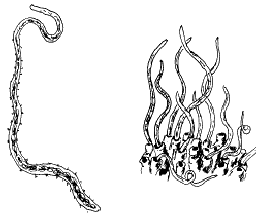
The common tubule ( Latin Tubifex tubifex ) is a species of small- bristled worms of the Tubificidae family. Tubules - thin pinkish threadlike worms up to 40 mm long. 4 bristles on each body segment. They feed on decaying particles, swallowing and passing sludge through the intestines.
| Common tubular |
 |
| Scientific classification |
|---|
| No rank : | Bilateral symmetrical |
|
| International scientific name |
|---|
Tubifex tubifex
( OF Müller , 1774) |
|
It lives at the bottom of silted standing reservoirs, in polluted streams and rivers . It forms huge accumulations in the silt of heavily polluted rivers, but is also found on sandy and rocky soils of cleaner rivers (in small quantities). They live in tubular minks made of silt, from which the posterior end of the body (with gills) is exposed above the surface of the soil, which constantly moves, making undulating breathing movements. The pipe maker is found at the bottom year-round.
Reproduction is only sexual. Lays eggs (several pieces) in cocoons.
Widely used in feeding aquarium fish as live food . But, compared with the related auloforus , it is less efficiently cultivated at home.
Store the tubule in a low bowl with a layer of water 3-5 mm at a low temperature (5-10 ° C). Freshly caught worms do not feed fish, since there is a great danger of introducing pathogens with them, such as Caryophyllosis . Usually they are kept during daily washing for 3-7 days, separating living individuals from the dead through a fine sieve. The pollutants accumulated by the tubulo from the native habitat are also dangerous.
In an aquarium, an un eaten tubule burrows into the ground and often begins to multiply.
The shortest subspecies, the usual length of 9.25-10 mm, consists of 31-42 segments. Intestinal coloration characteristic red-brown. The head lobe is elongated and pointed. Nephridia with 6/7 dissipation . Hearts in the 9th segment.
The vas deferens is a little looped, much longer than the atrium. Atrium 1.5 times wider than the vas deferens, length about 90 microns. The penis is equal in length to the prostate. The prostate is ovoid oval, its width is about 70 microns. Seed receptacles with a short and not very wide ampoule, the duct of the ampoule is three times longer than it and 2-1.5 times narrower.
The abdominal bundles contain 6–5 setae in the anterior segments (7th segment each) and 2–4 setae in the rest. The lower tooth of the setae is longer than the upper one in a 4: 3 ratio; this is a rare feature among Tubificidae. Dorsal bundles consist of 1 or 2 in the anterior segments (2) of hair-like setae and 1–4 dentate. Hairy bristles exhibit cirrus only with immersion. In dentate bristles with immersion, 1-3 cloves are observed between almost equal teeth.
This species is common in the coastal soil of Lake Plescheeva .
Professor Dmitry Alexandrovich Lastochkin gave this specific name in honor of the historian M.I.Smirnov , who did a lot to study the Pereslavl Territory.
