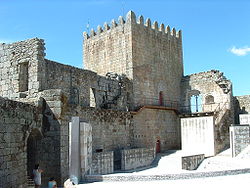
Belmonte Castle ( port. Castelo de Belmonte ) - a medieval castle in the village of Belmonte , Castelo Branco Portugal . It is located on a hill on the left bank of the Zezere River, in the Serra da Estrela region . The castle's alcaldes were members of the Cabral family, from which Brazil's discoverer Pedro Alvarez Cabral came from.
| Castle | |
| Belmonte Castle | |
|---|---|
| Castelo de belmonte | |
 | |
| A country |  Portugal Portugal |
| Village | Belmonte , Castelo Branco |
| Founder | Afonso III |
| Status | National monument |
| condition | good |
| Website | monumentos.pt/Site/APP_P... |
Content
- 1 History
- 2 Architecture
- 3 notes
- 4 References
History
Mastering a given area by a person is most likely , began during the period of the Roman invasion of the Iberian Peninsula . A Roman road passed through the vicinity of Belmonte , connecting Bracara ( Braga ) and Emeritu ( Merida ).
The first historical information about these areas dates back to the reign of King Afonso Enriques ( 1112 - 1185 ), when the vicinity of Belmonte was presented to the Bishop of Coimbra ( May 6, 1168 ). Later, Afonso III ( 1248 - 1279 ) ordered Bishop Egash Fafesh to begin construction of a tower and a castle. During this period, the bishop of Guarda bought and sold houses on the territory of the castle ( 1253 ), and three years later, on April 27 , Pope Alexander IV donated the castle of Belmonte and the settlements of Ingish and Olash-Godim of the diocese of Guarda . The tower and castle were probably strengthened and expanded during the reign of King Dinis I ( 1279 - 1325 ). This is evidenced by archaeological finds left after the demolition of houses in the village for the construction of the castle and the donjon .
After the conclusion of the treaty in Alcanises ( 1297 ), with the subsequent expansion of the borders of Portugal in the west, Belmonte Castle lost its strategic importance, while the village is developing quite actively.
In the context of the crisis of 1383-1385, the castle lost some of its walls. A little later, the bishop of Coimbra exchanged the village of Belmonte for the city of Arganil , which was owned by aristocrat Antonio Martin Vazquez da Cugna ( 1392 ). During the reign of Juan I ( 1385 - 1433 ), Alcald Belmonte supported the enemy of the king, Infanta Dinis, because of which the king confiscated the village and the castle, passing them to his general, Luis Alvarez Cabral. Since then, the Cabral family has settled in the castle. The new owner reconstructed the northern part of the wall and built a new barbican .
In the 15th century, Belmonte and his castle were handed over by King Afonso V ( 1438 - 1481 ) to Fernan Cabral ( 1466 ), the father of Pedro Alvarez Cabral , who initiated the rebuilding of the castle for civilian needs.
In the context of the war for the restoration of Portuguese independence, the fortifications of the castle were modernized through the construction of several bastions . In addition, at the end of the XVII century the interior of the castle was damaged by fire ( 1694 ). In the next century, on the initiative of the last lord Belmonte, Caetan Francisco Cabral, who died in 1762 , the main gate was rebuilt.
The military historian Pinyu Leal described the ruins of the castle in this way, having visited Belmont in the 18th century:
| The castle consists of a high square tower with two large windows - one to the east, the other to the west ... the citadel, fortified with a stone wall, and the ruins of the ramparts are still intact ... [1] |
At the beginning of the XX century, the citadel of the castle began to be used as a prison. October 15, 1927 the castle was declared a national monument. Between 1940 and 1960 , various measures were taken to preserve and restore the monument, under the auspices of the Directorate General for National Buildings and Monuments (DGEMN).
In 1992 , at the initiative of the Archaeological Institute, an amphitheater was erected inside the walls for historical performances. Between 1992 and 1994 , archaeological excavations were carried out in the castle, during which artifacts from the period of Roman rule were found.
Today the castle is open to the public. The old key to the Belmonte castle is in the collection of the House Museum of Juan Suarez in Cortes ( Leiria ).
Architecture
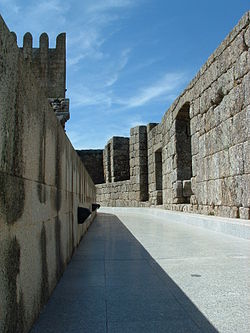
The castle is located at an altitude of 615 meters above sea level and has an incorrect oval layout. Built of granite stones. The main facade of the castle, oriented to the south, has an arch-shaped gate decorated with the coat of arms of the Kabral clan.
Near the southwestern wall is a Romanesque dungeon with three floors and topped with battlements. On the southeast side of the castle fortifications, the ruins of residential buildings and a small medieval tower in the mannerism style have been preserved. In the western sector are also the ruins of a palace expanded by the father of Pedro Alvarez Cabral.
Notes
- ↑ Luís Cardoso . Dicionário Geográfico. apud: Pinho Leal. Portugal Antigo e Moderno (12 v). Lisboa: 1872