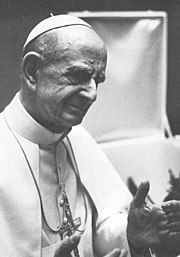
“Humanae vitae” (full name Humanae vitae tradendae munus gravissimum ... - “ The most important gift of transmitting human life ... ”) is the encyclical of Pope Paul VI of July 25, 1968 , devoted to questions of birth control and caused great resonance among modernists and the liberal stratum of believers . The content of the encyclical echoes the document of Pius XI Casti Connubii .
The immediate reason for writing the encyclical was the decision of the UN and WHO to consider the problem of birth control, where it was supposed to justify the need for such control, since the world economy, according to organizations, could be unable to provide humanity with a "living wage". Pope John XXIII considered the issue to be a matter of principle and in March 1963 established a commission, which was to deal with determining the point of view of the Holy See. It consisted of 6 people: three priests and three lay people, among them were sociologists, doctors and one economist. The commission was headed by the Dominican , father Heinrich de Reidmatten from Switzerland. After the death of John XXIII, Paul VI expanded the commission, introducing theologians, new priests and laity, including married couples, and other consultants. The main issues addressed were abortion , sterilization and the use of contraceptives . In the course of the work, the commission came to the conclusion that marriage cannot be considered only as an agreement necessary for the continuation of the human race, since marriage is primarily a mutual love of spouses, expressed not only in sexual relations. The result of the commission's activity was an uncertain report submitted to the Roman Curia in 1966 , so the work was continued by other successive commissions. Paul VI undertook independent research and expressed the final position of the Church in the encyclical. The use of contraceptives has officially become recognized as "essentially evil" ("malum intrinsecum").
"Humanae vitae" consists of three parts, which are preceded by a brief introduction. The first part contains a statement of the question and discussion about the competence of the Church’s teaching. The issue essentially consisted in the power and freedom of man, which is gradually acquiring an increasingly significant power - over the forces of nature and over himself. The solution of the question of whether the time has come to regulate birth by the human mind and will, as the encyclical explained, is impossible without resorting to the moral teaching of the Church on marriage - “a teaching based on natural law, enlightened and enriched by Divine Revelation” (4). The encyclical affirmed that the Church has the right to interpret this natural law: “Let no one in the Catholic Church say that natural law lies outside the competence of the Church’s teaching. Undoubtedly ... that Jesus Christ , passing the Divine authority to Peter and the other apostles, ... made them protectors and interpreters ... not only of the law of the Gospel , but also of the natural law in which the will of God is manifested ”(ibid.).
The second part of the encyclical is doctrinal. Since, according to church doctrine, marriage is primarily a sacrament , it cannot be considered the result of evolution or the action of natural forces, it is “a wise and prudent establishment of the Creator God, whose goal is the realization in man of his plan of love”, which “is not limited to communication between the husband and his wife - she is destined to continue in the creation of new lives ”(9). This principle implies the so-called “responsible parenthood”, which is an integral part of any family relationship, and the husband and wife are not entitled “to rely solely on their will in the transfer of life, but must coordinate their actions with the creative intention of God ...” Thus, the only legitimate way birth control Church began to officially consider the use of natural biological rhythms , because there is no violence against nature. The document was completed by the head of the pastoral content, addressed to believers who want to live in harmony with the doctrine of the sacrament of marriage.
Text
- http://w2.vatican.va/content/paul-vi/en/encyclicals/documents/hf_p-vi_enc_25071968_humanae-vitae.html (official text in Latin, Italian, English, Spanish, French, German, Hungarian and Portuguese)
- http://www.unavoce.ru/library/humanae_vitae.html (unofficial translation into Russian)