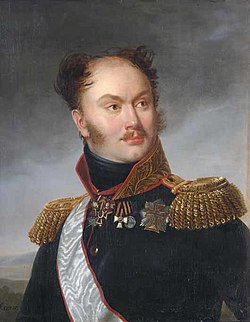
Mikhail Fedorovich Orlov ( March 25 [ April 5 ], 1788 - March 19 [31], 1842 ) was a major general, participant in the Napoleonic Wars , who made up the conditions for the surrender of the Allied army in Paris . In the 1820s He gained fame as a public figure in the liberal direction, the Decembrist , a frequent interlocutor of A.S. Pushkin . The younger brother of Prince A.F. Orlov .
| Mikhail Fedorovich Orlov | |||||||||
|---|---|---|---|---|---|---|---|---|---|
| |||||||||
| Date of Birth | March 25 ( April 5 ) 1788 | ||||||||
| Place of Birth | |||||||||
| Date of death | March 19 (31), 1842 (53 years old) | ||||||||
| Place of death | |||||||||
| Affiliation |  Russia Russia | ||||||||
| Type of army | cavalry | ||||||||
| Years of service | 1805 - 1826 | ||||||||
| Rank | major general | ||||||||
| Part | Cavalry regiment | ||||||||
| Commanded | 4th Infantry Corps (Chief of Staff) 16th Infantry Division | ||||||||
| Battles / wars | Third Coalition War War of the fourth coalition Patriotic War of 1812 War of the sixth coalition | ||||||||
| Awards and prizes |
| ||||||||
| Communications | brother of Alexei Fedorovich Orlov | ||||||||


Content
Military Service
The illegitimate son ("pupil") of Count Fedor Grigorievich Orlov and Colonel Tatyana Fedorovna Yaroslavova [1] . He was legalized with two brothers after the death of his bachelor father by decree of Catherine II of April 27, 1796 (but without a title). He was brought up in the private boarding house of Abbot Nicolas . According to contemporaries, he was “handsome and distinguished by Herculean strength” [2] .
On August 27, 1801, he was enrolled as a “student” in the College of Foreign Affairs, and transferred to military service on July 15, 1805, with enrollment in the Cavalier Guard Regiment as a standard-cadet . The Cornets produced January 9, 1806 for the difference in the battle of Austerlitz . In 1807 he fought at Guttstadt , Heilsberg and Friedland and was awarded the golden sword.
By the beginning of World War II, 1812 was a lieutenant in the Cavalier Guard regiment. He was accompanied by the Adjutant General Alexander Balashov in Vilna to Napoleon shortly after the outbreak of war, for which he was appointed annexe to Emperor Alexander I on July 2 . He participated in the defense of Smolensk and in the battles of Shevardin and Borodin , then he was in the partisan detachment of General Ivan Dorokhov and for the difference in the liberation of Verea was awarded the Order of St. George of the 4th class on November 16, 1812 . He fought at Maloyaroslavets , Vyazma and Red , for which he received the rank of captain .
In 1813 he was in the "flying" detachment and, for the difference near Kalisz, was promoted to colonel on March 25 of the same year. After the Pleswitz truce, he was assigned to the detachment of General Thielemann and participated in the siege and capture of Merseburg and in the battle of Leipzig . In 1814 , being in the detachment of General Vasily Orlov-Denisov , he fought at Champobert , Troyes , Arsi-sur-Oba .
During the capture of Paris , being held hostage in the camp of Marshal Marmont for the night, he drew up the terms and "concluded an agreement on the surrender of this capital of the French Empire to the Allied forces" [3] , for which he was granted major general on April 2, 1814 . In view of this diplomatic success, he was sent to Denmark to negotiate an assignment to the Swedish crown of Norway . In 1815 he participated in the second campaign to France. He was appointed June 13, 1817 as the chief of staff of the 4th Infantry Corps, and on June 3, 1820 he was given command of the 16th Infantry Division, stationed in Chisinau .
Chisinau period
From the overseas campaign Orlov returned with oppositional views on the tsarist government. Alexander I five times rejected proposals to give up a division under Orlov’s command and generally showed suspicion towards him [1] . Once in Chisinau, Orlov set himself the goal of spreading education among the soldiers and introducing a more humane attitude towards them: he organized Lancaster schools for the lower ranks, and destroyed corporal punishment in his division.
In 1817, Orlov met with Alexander Pushkin and joined the literary society "Arzamas" with the nickname "Rhine". Thought to transform it, expanding the circle of activities. The History of the Russian State, published at that time, disappointed him with its earthliness. According to Pushkin [4] :
Some of the secular people criticized Karamzin in writing. Mic. Orlov, in a letter to Vyazemsky, blamed Karamzin, why at the beginning of the History he did not put any brilliant hypothesis on the origin of the Slavs , that is, he demanded a novel in history.
In 1821, Orlov married Yekaterina Raevskaya , the daughter of the famous general N. N. Raevsky . Pushkin talked a lot with spouses during the southern exile , both in Odessa and in Chisinau. According to his wife, the Orlovs' house in Kishinev was in full swing of “constantly noisy debates - philosophical, political, literary” [5] . The young poet then wrote to Petersburg:
All the same I - as I was before;
With a bow I don’t go to the ignoramus,
I argue with Orlov, I drink a little,
Octavia - in blind hope -
I do not sing prayers of flattery.
“We very often see Pushkin, who comes to argue with her husband about all kinds of subjects,” said Ekaterina Orlova in November 1821. Later, the poet and Orlov had a quarrel. “Orlov is an intelligent man and a very kind fellow, but I’m somehow not a hunter for our old relations,” he wrote to his wife in 1836.
Mikhail Orlov is one of the founders of the pre-Decembrist organization “ Order of Russian Knights ”. He developed a broad program of liberal reforms (constitution, abolition of serfdom, jury trial, freedom of the press), combining in the English manner with the power of the aristocracy and the emerging bourgeoisie. He led the Chisinau administration of the Union of Welfare . Secret surveillance was established for Orlov, since the 16th division had a reputation among the authorities with no discipline and lagging behind the frunt [2] .
In 1822, unrest occurred in the Orlov division. One of the commanders, Captain Bryukhanov, angered by the actions of the Captenarmus, who prevented him from profiting from provisions, took advantage of the first minor mistake of the latter, ordered to punish him with sticks. Rota, outraged by the apparent injustice of punishment, wrested a comrade from the hands of non-commissioned non-commissioned officers, taking away the sticks from the latter as well. M.F. Orlov, having examined the case, recognized the claims of the soldiers as correct and put Captain Bryukhanov on trial.
Its head , I.V. Sabaneev , who himself had previously issued orders prohibiting ill-treatment of lower ranks, this time took all measures to curb dangerous moods. He reviewed the case, as a result of which Bruchanov was released from court, and the perpetrators of the "riots" were punished with a whip and exiled to hard labor. The punishment was carried out in such a way that it had the character of torture. Sabaneev declared "the main spring of the weakened discipline" in the 16th division of V.F. Raevsky , who led the Lancaster schools, and ordered to be taken into custody.
Opal
As a result of the investigation, Orlov was released from the command of the division and appointed to "consist in the army" (April 18, 1823). On the eve of the Decembrist uprising, he visited Crimea, where he met with A. S. Griboedov , who was subsequently accused of involvement in the events on Senate Square [7] . He did not take part in the preparation of the armed uprising, but after December 14, 1825 he was still arrested and put in the Peter and Paul Fortress , where he spent six months.
Thanks to the intercession of his brother, the royal favorite of A.F. Orlov , Mikhail Orlov did not suffer heavy punishment - and he could even be among the hanged ones - but was only completely dismissed from service. He was ordered to live in his village Milyatino, Mosalsky district, Kaluga province under police supervision.
In the Milyatinsky confinement, Mikhail Fedorovich, constantly experiencing financial difficulties, tried not to indulge in idleness. He devoted a lot of time to work on the book “On State Credit ”, and tried to delve into the affairs of the glass factory [8] , which he inherited. The factory of M.F. Orlov at the I Manufactory Exhibition of 1829 presented the glass "colored gilt and rich facets of crystal." Active Orlov, through Prince P.A. Vyazemsky, handed over a letter and a parcel with painted glass to the Minister of Finance E.F. Kankrin . In a letter, he asked the Ministry for order and permission to build a painted glass factory in Moscow. However, neither the publication of the book, nor the colored glass factory, which, due to the lack of orders, brought only losses, did not correct the financial situation of Orlov.
In 1831 he was allowed to live in Moscow, where he occupied a house on 1/7 Malaya Dmitrovka Street. Orlov’s position in those years was just as difficult: on the one hand, his superiors looked askance at him as a liberal and subjected him to gendarme surveillance, on the other hand, liberals compared his relatively privileged position with the deplorable fate of the other Decembrists. Nevertheless, the man who accepted the surrender of Paris, managed to become a respected member of Moscow society [2] . Freethinking university youth honored in Orlov one of the few Decembrists who remained in Moscow and with whom it was possible to make acquaintance without difficulty.
Orlov was a man of outstanding intellect, with an exalted soul and a noble character, “a knight of love and honor”, as expressed by Prince Vyazemsky. His personality was so attractive that, having met him, it was impossible not to love him. But extremely keen and passionate, he often was not restrained in words and acted under the influence of the first impression.
- Grand Duke Nikolai Mikhailovich [2]
Deprived of the opportunity to participate in public activities, the youngest of the Orlov brothers, according to Herzen , “looked like a lion sitting in a cage and not even daring to growl: something ruin was killed in it” [6] . The last years of his life he devoted to the organization in Moscow of the School of Painting, Sculpture and Architecture . He was buried in the Novodevichy Convent . Herzen responded to the news of Orlov’s death with the words: “I send a sincere and bitter sigh after him to the grave: the unfortunate existence was only because chance wanted him to be born in this era and in this country” [6] .
Family
Wife since 1821 - Ekaterina Nikolaevna , nee Raevskaya (1797-1885), daughter of General N.N. Raevsky .
Two children were born in the marriage:
- Nikolai (1822-1886) - married since 1857 to Olga Pavlovna Krivtsova (1838-1926), granddaughter of Prince N. G. Repnin-Volkonsky .
- Anna (1826-1887) - married to Major General Prince Vladimir Vladimirovich Yashville (1813-1864).
Compositions
- Obituary of the general from the cavalry N. N. Raevsky. - SPb., 1829
- The surrender of Paris. Political writings. Letters. - M.: Publishing House of the Academy of Sciences of the USSR, 1963. ( Literary Monuments ).
- About the state loan. - M .: type. August Seeds, 1833 (Ueber den Staatskredit. - Leipzig: O. Wigand, 1840)
- "Thoughts on the current state of credit institutions in Russia."
Notes
- ↑ 1 2 Leah Pavlova. Decembrist M.F. Orlov. Science, 1964. pp. 5, 108.
- ↑ 1 2 3 4 Russian portraits of the 18th and 19th centuries. Edition of Grand Duke Nikolai Mikhailovich . Volume II Portrait No. 156.
- ↑ Rise of the Decembrists: documents. Volume 20. Moscow, 2001. ISBN 5-8243-0190-5 . Page 149.
- ↑ FEB: Pushkin. Karamzin. - 1978 (text)
- ↑ Chereysky L.A. Pushkin and his entourage. L .: Science. Leningra. Department, 1989.S. 311.
- ↑ 1 2 3 Lib.ru/ Classics: Herzen Alexander Ivanovich. Diary 1842-1845
- ↑ Munchik S. S. Griboedov and Crimea. - Simferopol: Business Inform, 2011. - P. 31–33 ..
- ↑ The plant was founded by Yakov Nemchinov in the village of Bogorodsky, Mosalsky district, Kaluga province. In the 1790s, it was bought by Count Orlov F.G., then passed to his son - M.F. Orlov. The plant produced dishes from colorless, blue and cherry glass, decorated with engraving, polishing, and painting. After the fire of 1798, he moved to the village of Milyatino. In 1842, after the death of Orlov, the plant was sold and ceased to exist until 1862.
Literature
- The investigation of M.F. Orlov // "The Decembrist Uprising", T.XX, S. 145-188; 509-516, PDF
- Bazhanov V.G. Decembrists in Chisinau. M.F. Orlov and V.F. Raevsky. - Chisinau: State Publishing House of Moldova, 1951
- Kolpakidi A., North A. Special Forces GRU. - M .: Yauza, Eksmo, 2008 .-- S. 85-86. - 864 s. - ISBN 978-5-699-28983-7 .
- Pavlova, Lia Yakovlevna Decembrist M.F. Orlov. - M .: Nauka, 1964 .-- 144 p.
- Decembrists. Biographical reference book / Edited by M.V. Nechkina. - M .: Nauka, 1988 .-- S. 135-136, 295-296. - 448 p. - 50,000 copies.
- Dictionary of Russian generals, participants in the hostilities against the army of Napoleon Bonaparte in 1812-1815. // Russian archive. The history of the Fatherland in the evidence and documents of the XVIII — XX centuries. : Collection. - M .: TRITE studio N. Mikhalkova , 1996. - T. VII . - S. 499-500 . - ISSN 0869-20011 . (Comm. A. A. Podmazo )
- Bondarenko A. Mikhail Orlov. - M .: Young Guard, 2014.