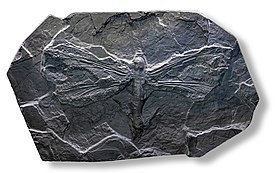
Meganeuvers ( Latin Meganeura ) are a genus of extinct dragonfly-like insects that lived in the Carboniferous period (303.4-298.8.9 million years ago [1] ). Includes Meganeura monyi , which had a wingspan of up to 65 cm and is, along with Meganeuropsis permiana, one of the largest insects of all time. They hunted primitive herbivorous insects dictioneurids . The larvae led a terrestrial lifestyle and were also predators.
| † Meganeuvers |
 |
| Scientific classification |
|---|
| No rank : | Bilateral symmetrical |
| Subtype : | Tracheo-breathing |
| Infraclass : | Ancient winged insects |
|
| International scientific name |
|---|
Meganeura , 1885 |
| Synonyms |
|---|
- Meganeurella Handlirsch, 1919 [1]
|
| Kinds |
|---|
- † Meganeura monyi
(Brongniart, 1884) - † ? Meganeura vischerae
Zalessky, 1950
|
Geochronology303.4—298.9 Ma | million years | Period | Era | Aeon |
|---|
| 2,588 | Even | | | Ka | F
but
n
e
R
about
s
about
th | | 23.03 | Neogene | | 66.0 | Paleogen | | 145.5 | a piece of chalk | M
e
s
about
s
about
th | | 199.6 | Yura | | 251 | Triassic | | 299 | Permian | P
but
l
e
about
s
about
th | | 359.2 | Carbon | | 416 | Devonian | | 443.7 | Silur | | 488.3 | Ordovician | | 542 | Cambrian | | 4570 | Precambrian |
◄ Nowadays◄ Cretaceous-Paleogene extinction◄ Triassic extinction◄ Mass Permian Extinction◄ Devonian extinction◄ Ordovician-Silurian extinction◄ Cambrian explosion |
|---|
|
The fossil remains of a mega-maneuver were discovered in 1880 in Commentmenty ( France ) and described in 1884. Another well-preserved mega-maneuver was found in the English county of Derbyshire in 1979.
The question of why giant insects existed in the Paleozoic and do not exist now, has worried researchers since the discovery of the mega-maneuver. The hemolymph of insects does not carry out oxygen transfer, it is delivered to the tissues by the trachea system. Including because of this, insects can not reach large sizes. In 1911, it was suggested that the atmosphere of the Carboniferous period contained more oxygen than the modern one, which made supplying their tissues more efficient.
Content
