Cartagena de Indias ( Spanish: Cartagena de Indias - Cartagena Indian ), or simply Cartagena, is Colombia’s fifth largest city, the administrative center of the Bolivar department, a major port on the Caribbean .
| City | |||||
| Cartagena de Indias | |||||
|---|---|---|---|---|---|
| Spanish Cartagena de indias | |||||
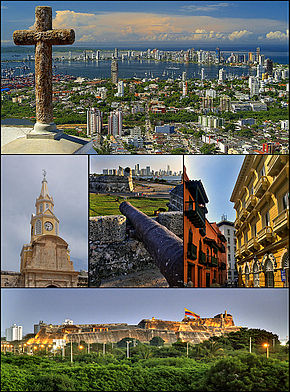 | |||||
| A country |  Colombia Colombia | ||||
| the department | Bolivar | ||||
| The mayor | Dionisio Veles | ||||
| History and Geography | |||||
| Based | 1533 | ||||
| Square | 572 km² | ||||
| Center height | 2 m | ||||
| Climate type | savannah | ||||
| Timezone | UTC − 5 | ||||
| Population | |||||
| Population | 978,600 [1] people ( 2005 ) | ||||
| Agglomeration | 1.3 million people | ||||
| Digital identifiers | |||||
| Telephone code | +57 5 | ||||
| Postcode | |||||
| cartagena.gov.co | |||||


Content
History
XVI — XVII centuries
Prior to the arrival of the Spaniards, the area of today's Cartagena was inhabited by Native American tribes who spoke Caribbean and Arawak languages, engaged in fishing, gathering and primitive agriculture.
The first whites who stepped ashore in these places were in 1509 the Spaniards from the expedition Alonso de Ojeda . The Spaniards who landed on land were attacked by aggressive natives, and, having lost several people, retreated to the ship. In 1510, the participant of the same expedition, Vasco Nunez de Balboa , founded the city of Santa Maria la Antigua del Darien (150 kilometers west of Cartagena), but already in 1515 it was burned by the Indians, and most of the inhabitants were killed. After that, the Spaniards lost interest in colonizing the southern Caribbean for two decades, focusing their efforts on Cuba and Haiti . The only visit to the region by Europeans during this period occurred in 1527, when, on the instructions of the Spanish colonization and research agency Casa de Contratación , conquistador Rodrigo de Bastidas examined the coast and drew its map.
The intensified activity of other European powers (primarily England and Holland) in the Caribbean, as well as rumors of "golden cities" in the jungle, prompted the Spanish government to pay closer attention to the previously considered unpromising region, and on June 1, 1533, 200 settlers under the leadership of Pedro de Jereida landed on a swampy shore, founding the city of Cartagena de Indias, named after the Spanish city of Cartagena .
Due to its favorable location and convenient bay, Cartagena quickly became one of the most important transshipment points in trade between the Old and New Worlds and the main port for exporting gold and silver mined in America to Spain. The population of the city was growing rapidly and by 1540 amounted to 2,000 people.
The riches of Cartagena attracted many pirates hunting for “silver galleons” leaving the port. More than once attempts were made to sack Cartagena itself, five of them were successful, the first time the city was sacked by the French corsair Jean-Francis da Roberval in 1546. The most successful and shameless robber was forty years later, the famous English pirate and traveler - Sir Francis Drake . He managed to get from Cartagena an unheard-of ransom of 107,000 gold pesos at that time (to strengthen his position in the negotiations, Drake first burned about a quarter of the city), which greatly pleased Queen Elizabeth . The Spanish government, seriously frightened and angered by the success of the pirates, over the next two decades invested about 10 million pesos in the construction of defenses of Cartagena.
As the events of the spring of 1697 showed, these huge investments were unsuccessful due to the small number and low morale of the garrison, as well as the weakness of the command. During the raid on Cartagena , the French detachment under the command of Baron Pointis not only easily captured and plundered the city, but also destroyed a significant part of the fortifications built by the Spaniards with such difficulty, taking away fortress guns with them.
XVIII — XXI centuries
By the start of the next Anglo-Spanish War in 1739, Cartagena was one of the largest ports in the New World with a population of over 10,000 and a thriving economy. The fortifications of the city, destroyed by the French, were not only rebuilt again, but also significantly strengthened. Nevertheless, the British, having studied the experience of the raid of Baron Pointis, did not consider the garrison of the city a serious opponent and began to prepare for the capture of Cartagena. The fall of the city inevitably led to the destruction of the cohesion of the Spanish positions in the southern Caribbean, the most serious problems in the supply of troops in the north-west of South America and was considered by the British command as the first and obligatory step to establish control over the Spanish colonial possessions in America.
An English squadron under the command of Admiral Vernon arrived in Cartagena in early March 1741, delivering more than 12,000 expeditionary force soldiers (plus about 11,600 crews), the squadron ships carried about 2,000 guns on board. The forces of the invasion were opposed by the four thousandth Spanish garrison under the command of one of the best admirals in the history of Spain, Don Blas de Leso . Fortifications of Cartagena numbered about 500 guns. The siege of Cartagena lasted three months, the British made several attempts to storm, but the Spaniards managed to defend the city. The defeat at Cartagena predetermined the generally unsuccessful outcome of the war for the British, plans for the expansion of the British Empire on the South American continent were frustrated. The famous British historian and philosopher Arnold Toynbee said on this subject “ Cartagena is the reason why South America does not speak English ” [2] .
After repulsing the British attack in the history of Cartagena, the so-called The “Silver Age” (1750-1808), characterized by the constant growth of the economy, the influx of many immigrants from both Europe and other parts of Latin America, rapid construction and significant investments in the improvement of the city. The prosperity period ended with the general decline of the Spanish Empire , aggravated by the occupation of the metropolis by Napoleonic France .
The growth of separatist sentiments in the Spanish colonial possessions, supported by the British, did not pass New Granada . On November 11, 1811, Cartagena was proclaimed the capital of the new independent state of the United Provinces of New Granada , part of the garrison loyal to Spain was partially killed, partially escaped from the city by ship. By this time, in the mountainous part of New Granada, for several months there had been a self-proclaimed Free State of Cundinamarca (with its capital in Bogota ). The rivalry of separatist neoplasms with each other led to the first civil war in the history of Colombia . The Spaniards also did not abandon attempts to regain control of New Granada, and in December 1815, after a 5-month siege, they again occupied the city. Separatists were only able to knock them out in October 1821, also after a 5-month siege. Military action, famine, epidemics and the cessation of trade led to the utter decline of Cartagena. In the mid-1820s, the city's population was less than 500 people (mostly former slaves), and almost all of its buildings were in ruins.
Some restoration of the city began only in the 1880s, after the construction of the railway connecting the port with the interior of Colombia. Sustained economic growth began in the 1920s, due to the discovery of oil fields and the construction of an oil pipeline to Cartagena. Since then, the city has become a major oil port. In the second half of the 20th century, tourism began to play an increasingly significant role in the urban economy.
In 1980, the historical monuments of Cartagena (fortress, main square with a cathedral, St. Peter's Church, the Inquisition Palace, the university building) were declared a UNESCO World Heritage Site .
On September 26, 2016, a peace treaty was signed between the Colombian government and the rebels in the city, ending the Civil War in Colombia .
Geography and climate
Cartagena is located on the Caribbean Sea. The city lies in a tropical savannah , with rainy summers and dry winters.
| Climate Cartagena | |||||||||||||
|---|---|---|---|---|---|---|---|---|---|---|---|---|---|
| Indicator | Jan | Feb | March | Apr | May | June | July | Aug | Sep | Oct | Nov | Dec | Year |
| Average maximum, ° C | 31,2 | 31,2 | 31.3 | 31.5 | 31.7 | 31.8 | 31.9 | 31.9 | 31.6 | 31,2 | 31.3 | 31,4 | 31.5 |
| Average temperature, ° C | 26.6 | 26.7 | 27.0 | 27.5 | 28.0 | 28,2 | 28.1 | 28.0 | 27.9 | 27.6 | 27.6 | 27.0 | 27.5 |
| Average minimum ° C | 23,2 | 23,4 | 23.9 | 24.8 | 25.3 | 25.3 | 25.0 | 25.0 | 24.9 | 24.6 | 24.7 | 23.8 | 24.4 |
| Precipitation rate, mm | eight | one | one | 31 | 92 | 115 | 94 | 124 | 144 | 244 | 132 | 37 | 1023 |
| Source: World Climate | |||||||||||||
Population
According to the 2005 census, 978,600 people lived in Cartagena, about 1.3 million lived in the metropolitan area. The modern ethnic composition of the townspeople was formed as a result of a mixture of immigrants from Spain (and later from the Middle East) with the local Native American population and black slaves brought from Africa. Racial composition of the population:
- white - 22.9%
- mestizos - 38.9%
- blacks and mulattoes - 36.1%
- Indians - 1.2%
Cartagena is the “blackest” of the major cities of Colombia. About 3/4 of the townspeople are Catholics . The level of street crime is quite high, which is typical for large cities in Latin America. Foreign tourists often become victims of robberies.
Economics
Cartagena has a modern diversified economy, being the third most important (after Bogotá and Medellin) economic center of the country. The main industries are:
- Tourism (Colombia's main tourist destination)
- Industry (primarily petrochemicals, oil refining, production of building materials)
- Service and trade
- Logistics (main port of Colombia)
- Building
In the city and its environs there are several free economic zones with a preferential tax regime and customs administration.
Transport
Cartagena is served by the International Airport. Rafael Nunez ( IATA : CTG , ICAO : SKCG ) with a passenger turnover of about 3 million people a year. The airport operates flights to all major cities in Colombia, as well as to New York , Montreal , Quito , Toronto and Panama City .
National Highway 90, also known as the Central Caribbean Road, connects the city with Barranquilla and further with Caracas , and Highway 45 (Magdalena Road) connects with the central regions of Colombia and further with Ecuador .
Public transport is represented by 35 bus routes. Currently (February 2015), work is underway to launch a centralized transport system (express buses traveling in dedicated lanes) Transcaribe .
The port of Cartagena hosts dozens of cruise ships annually.
Previously, the city had a railway.
Education
- University of Technology named after Bolivar
Gallery
Twin Cities
- Istanbul , Turkey [3]
- Viña del Mar , Chile
- Valparaiso , Chile
- Santiago de Cuba , Cuba
- Manila , Philippines
- San Francisco de Campeche , Mexico
- Veracruz , Mexico
- Seville , Spain
- Cartagena , Spain
- San Cristobal de la Laguna , Spain
- Cadiz , Spain [4]
- Naples , Italy [5]
- Matera , Italy
- St. Augustine , USA
- Riohacha , Colombia
Literature
- Simon Bolivar . The manifesto of Cartagena (1812). . www.bloknot.info (A. Skromnitsky) (September 6, 2010). Date of treatment September 6, 2010. Archived August 24, 2011.
Notes
- ↑ "Perfil Municipal CARTAGENA" , DANE 09/13/2010. 2012. Consultado el 16 de agosto de 2012
- ↑ Four Faces of Cartagena
- ↑ Cartagena, en los planes de inversionistas turcos . Archived on August 17, 2012.
- ↑ Hermanamiento de Cádiz y Cartagena de Indias . Diario de Cádiz. Date of treatment January 6, 2009. Archived August 17, 2012.
- ↑ Se entablan lazos de hermandad entre Cartagena y Nápoles (Italia) . Diario El Universal de Cartagena. Date of treatment March 3, 2010. Archived on August 17, 2012.