A whip-elovik [1] , or an ordinary crossbill [1] ( lat. Loxia curvirostra ), is a forest songbird from the family finch ( Fringillidae ), a order of passerines ( Passeriformes ). It is characterized by a powerful beak with crossed tips and feeding on the seeds of spruce and other conifers (hence the Russian name of the species ).
| Klest-elovik | |||||||||||||||||||||||||||||||||||||||||||
|---|---|---|---|---|---|---|---|---|---|---|---|---|---|---|---|---|---|---|---|---|---|---|---|---|---|---|---|---|---|---|---|---|---|---|---|---|---|---|---|---|---|---|---|
Crossbill male in , Oregon ( USA ) | |||||||||||||||||||||||||||||||||||||||||||
| Scientific classification | |||||||||||||||||||||||||||||||||||||||||||
| |||||||||||||||||||||||||||||||||||||||||||
| International scientific name | |||||||||||||||||||||||||||||||||||||||||||
Loxia curvirostra Linnaeus , 1758 | |||||||||||||||||||||||||||||||||||||||||||
| Subspecies | |||||||||||||||||||||||||||||||||||||||||||
Includes 8 Subspecies | |||||||||||||||||||||||||||||||||||||||||||
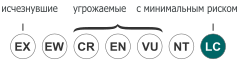
| Security status | |||||||||||||||||||||||||||||||||||||||||||
Content
- 1 General characteristics
- 2 Lifestyle
- 3 Reproduction
- 4 Distribution
- 5 Classification
- 6 Genetics
- 7 Notes
- 8 Literature
- 9 References
General characteristics
The bird is slightly larger than a sparrow , but smaller than a starling . Body length up to 17 cm, weight 43-57 g.
It is notable for the peculiar structure of the beak. The beak and the beak are crossed between themselves, and their sharp ends protrude along the sides of the beak. Like parrots , it uses a beak for climbing.
Males are red or red-crimson, the lower part of the belly is grayish-white. Females are greenish-gray with yellow-green feather edges. Young birds are gray in streaks, first-year male males are orange-yellow. The wings and tail are brown.
The beak is not very thick, more elongated, less bent, weaker than intersecting ends, its longer and thinner compared to the related species of pine crossbill.
It has a large head, tenacious paws, allowing you to hang upside down from the cones, a short, deeply carved tail.
Lifestyle
Daytime, noisy and moving bird. He spends almost all the time on trees. It flies fast along a wavy path. In flight, a flock of crossbones echoes, issuing "cap-cap-cap."
There is an interesting feature in the lifestyle of all types of crossbills. Since crossbills feed almost exclusively on coniferous seeds, the yield of which is not every year, annual fluctuations can be seen in the seasonal phenomena of these birds.
At any time of the year, crossbills make roosting, leaving the area with crop failures and accumulating in large numbers in the harvested areas of coniferous forests.
In addition to conifers, crossbills feed on weeds and sunflower seeds, sometimes insects .
Reproduction
Crossbills can nest in summer and winter, depending on the yield of coniferous seeds, more often nesting occurs in March. One of the striking features of these birds is that the nesting period can begin even in winter. Known images of a female crossbill on a nest in early March, when there are still snowdrifts and sub-zero temperatures. This feature directly depends on the abundance of the harvest of spruce and pine seeds. If present, crossbills can begin nesting very early.
Birds build nests close to each other.
When mating, the male occupies the upper branch of the tree, sings a lot, whistling while alternating with creaks and chirping, running and spinning.
The female builds the nest in thick spruce branches, using thin branches outside and lining the inside with moss , wool and feathers. In the clutch there are 3-5 bluish eggs with brown spots. The female incubates eggs for two weeks.
After hatching, the chicks remain in the nest for another two weeks. Fledglings (chicks not able to fly) are fed by parents for a long time.
Distribution
Klest-elovik inhabits the coniferous forests of Europe , North-West Africa , North and Central Asia , the Philippines , North and Central America (in the south to Guatemala ). Presented on the territory of the former USSR .
Lives in coniferous and mixed, but mainly in spruce, less often pine and larch forests, but not in cedar forests.
Classification
The view is divided into eight subspecies :
- Loxia curvirostra bendirei
- Loxia curvirostra benti
- Loxia curvirostra curvirostra Linnaeus, 1758
- Loxia curvirostra grinnelli
- Loxia curvirostra minor
- Loxia curvirostra pusilla
- Loxia curvirostra sitkensis
- Loxia curvirostra stricklandi
Genetics
- Molecular genetics
Notes
- ↑ 1 2 Boehme R. L. , Flint V. E. The Bilingual Dictionary of Animal Names. Birds. Latin, Russian, English, German, French / Ed. ed. Acad. V. E. Sokolova . - M .: Rus. lang., "RUSSO", 1994. - S. 435. - 2030 copies. - ISBN 5-200-00643-0 .
- ↑ Drawing from a book: Naumann JF Naturgeschichte der Vögel Mitteleuropas. - Gera, 1900. - Bd. III. - Tafel 27. (German) [Natural history of the birds of Central Europe.]
- ↑ Drawing by (1805-1868) from the book: Svenska fåglar, efter naturen och på sten ritade (2nd edition).
Literature
- Bogolyubov A.S., Zhdanova O. V., Kravchenko M.V. Key to birds and bird nests of central Russia. - M .: Ecosystem, 2006.
- Vladimirov R. Chicks in the winter // Philately of the USSR . - 1976. - No. 1. - S. 53.
- Klest-elovik - article from the Great Soviet Encyclopedia .
- Knipovich N.M. Klest // Brockhaus and Efron Encyclopedic Dictionary : in 86 volumes (82 volumes and 4 additional). - SPb. , 1890-1907.
Links
- Vertebrate Animals of Russia: Common Crossbill
- Klest-elovik on the site of the Ecosystem® environmental center
- Crossbills on the site "Zooclub.com.ua - Club of Elite Animals"