OPE1A (Single phase, Industrial Electric locomotive, A non-rotary) is a traction unit consisting of an industrial electric locomotive, a diesel section of autonomous power supply and one motor dump car. Designed to operate on opencast mining railways, electrified on a single-phase alternating current industrial frequency of 50 Hz at a voltage in the contact network of 10 kV, with the possibility of autonomous operation with reduced power in non-electrified areas. The traction unit is based on the traction unit OPE2 , which differs from it by the presence of a diesel engine section instead of one of the dump cars. [one]
| OPE1A / OPE1AM | |
|---|---|
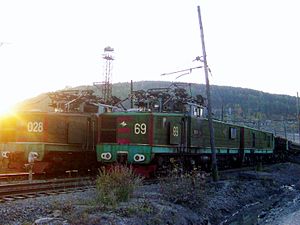 OPE1A-069 and 028 at the quarry of Korshunovsky GOK | |
| Production | |
| Country of construction |  Ukrainian SSR (until 1991) Ukrainian SSR (until 1991)  Ukraine Ukraine |
| Factory | DEVZ |
| Years of construction | since 1973 |
| Total built | OPE1A : 132 OPE1AM : 180 |
| Technical details | |
| Kind of service | industrial |
| Type of current and voltage in the contact network | alternating current 50 Hz, 10 kV |
| Axial formula | 3 x (2 o —2 o ) |
| Adhesion weight | 372 ± 11 t. (With 45 t. Cargo) |
| Empty weight | 327 ± 11 t. |
| Estimated weight | 372 tons |
| Rail axle load | 31 t. (Electric locomotive, diesel section, loaded dumpcar) 19.75 t. (Empty dumpcar) |
| Locomotive length | 19032 mm (electric locomotive) 15500 mm (diesel section) 15830 mm (dumpcar) |
| Width | 3280 mm |
| Distance between trolley pivots | 10380 mm (electric locomotive) 7280 mm (diesel section) 7280 mm (dumpcar) |
| Wheelbase trolleys | 2750 mm |
| Wheel diameter | 1250 mm |
| Smallest radius of curves | 80 m |
| Track width | 1520 mm |
| Regulatory system | smooth thyristor, 8-speed |
| Type TED | DT-9N |
| Gear ratio | 91:17 |
| Hour power of TED | 3 x (4 x 455) kW |
| Hourly pull | 650 kN |
| Clock Speed | 29.5 km / h |
| Continuous power TED | 3 x (4 x 418) kW |
| Continuous traction | 580 kN |
| Continuous Speed | 30.4 km / h |
| Construction speed | 65 km / h |
| Electric braking | rheostat , magnetic rail |
| Exploitation | |
| A country |  the USSR the USSR Russia Ukraine Russia Ukraine Kazakhstan Kazakhstan |
| Period | 1973 - present |
Traction units OPE1A were produced by the Dnepropetrovsk Electric Locomotive Plant from 1973 to 1988 ; From 1988 to the present, the plant has been producing a modernized version of OPE1AM. Subsequently, the plant also produced units consisting of an electric locomotive and two motor dumpcars, similar to OPE2 . [2] In total, more than 300 traction units were produced, which went to the quarries of various mining and processing plants in Russia ( Karelian pellet , Kachkanarsky GOK , Korshunovsky GOK , Lebedinsky GOK , Stoilensky GOK , Mikhailovsky GOK ), Ukraine (Dokuchaevsky flux-dolomite combine, Inguletsky GOK , Poltava GOK , Northern GOK ) and Kazakhstan (Sokolovsko-Sarbaiskoye GPO).
Content
General Information
| External video files | |
|---|---|
| OPE1AM-149 at SGOK | |
| OPE1AM-023 follows with a freight train | |
The basic aggregate traction unit is formed of an electric control locomotive, an autonomous diesel engine section and one motor dump car according to the scheme of an electric locomotive + diesel section + dump car . If necessary, the control electric locomotive can be operated either alone or with one or two diesel sections or one or two dumpcars. The control electric locomotive is similar to the electric locomotive of the traction unit OPE2 , but has differences associated with the management of the autonomous section. Dumpcars are unified with motor dumpcars of traction units OPE2 , as well as units of direct current PE2M . [one]
The main parameters for the traction unit OPE1A, consisting of a control electric locomotive, a diesel section and one motor dump car: [3] [1]
- towing mass - 372 ± 11 t, including:
- mass of electric locomotive - 124 ± 3.6 t
- mass of diesel section - 124 ± 3.7 t
- weight of loaded dumpcar - 124 ± 3.7 t
- empty dump car weight - 79 ± 3.7 t
- length along the axes of automatic couplings - 50362 mm, including:
- electric locomotive length - 19032 mm
- diesel section length - 15500 mm
- dump car length - 15830 mm
- width - 3280 mm
- voltage and current type - 10 kV AC frequency of 50 Hz
- diesel power - 1500 hp
- total hourly power of TED - 5325 kW;
- design speed - 65 km / h;
- axle load - 31 tf;
- the minimum radius of passable curves is 80 m.
Design
Mechanical equipment
Body
The body of the electric locomotive for controlling traction units OPE1A is completely analogous to OPE2 constructed on the basis of the body of electric locomotives for direct current traction units of the PE2 and PE2M series with slight differences due to the external shape, size and heavy weight of the electrical equipment. The body of the diesel section is similar in height to the rear hood of an electric locomotive. The body has a frame consisting of two longitudinal beams, interconnected by two pivot beams, buffer bars, podkabinnye beams and beams for installing equipment. The driver’s cab is double-sided booth type, located asymmetrically in the middle of the body closer to the front side of the electric locomotive and made wider than the bonnet parts of the body. The body rests on two biaxial bogies through central flat supports, and from the side of the buffer bars - through side supports with rubber cones (four on an electric locomotive). [3]
Carts
Carts of the traction unit are unified with carts of units OPE2 , PE2 and PE2M. Balancers are suspended from the axle-type axle boxes, on which the trolley frame is supported on one side through coil springs, and the leaf spring-balancer on the other. The frame of the trolley also relies on the middle parts of the spring balancers. The gear drive from the traction electric motors is double-sided, rigid, helical; the gear ratio is 91:17 = 5.353. The diameter of the wheels is 1250 mm. Each trolley has two brake cylinders with a diameter of 10 inches. The cylinder acts on four pads on one side of the trolley (double-clicking the pads on the wheels). The cart is also equipped with two rail electromagnetic brakes, the shoes of which are lowered during emergency braking under the action of pistons of pneumatic cylinders. [3]
Electrical equipment
All the main electrical equipment is located inside the body under the hoods of the control electric locomotive, mainly under the large hood in the rear of the electric locomotive. [3]
Roof equipment
Two types of current collectors are located on the roof of the electric locomotive cab: the main pantograph ТЛ-14М for current collection from the upper contact wire and side TB-2M for current collection from the side wire at the loading points. The current collector support insulators are partially located above the hoods. The working height of the main current collector from the level of the rail head is 5500 - 7000 mm, side - 4500 - 5300 mm; the working width of the side of the path axis is 3200 - 4000 mm. [1] A single-pole air circuit breaker of the VOV-10/1000 type, used as the main switch for operational and emergency shutdowns of the unit’s electrical equipment, is installed on the large hood above the transformer. [3]
Energy Converters
An electric locomotive has an ODTsE-8000/10 transformer with a mass of 9000 kg and a nominal power of 7338 kilovolt-amperes. Two traction windings, each of which is divided into four sections, are designed for a nominal voltage of 1900 V, windings of their own needs - for voltages of 250, 400 and 625 V. For a currentless switching of the secondary winding of the power transformer, the main ECG-21D controller located above it is used. Two rectifier-converter units VPB-6000-U2 with B2-320 diodes and T2-320 thyristors allow you to smoothly change the rectified voltage using the BU39D control unit. [3] Smooth thyristor regulation of the voltage within each of the four zones is carried out by changing the opening angle of the thyristors included in the split arms of the bridges of the rectifier-converter installation. Forward and backward transitions between zones are made with a current-free switching of the contacts of the main controller. The electric locomotive also provides an automatic transition to self-excitation during emergency removal of the supply voltage. [one]
Traction motors
On the electric locomotive, diesel section and motor dumpcars, the four-pole traction electric motors DT-9N, which, in addition to additional poles, have compensation windings, are installed on the units OPE2 and PE2M. The windings of the poles of the traction electric motors have insulation class F, the armature windings and compensation windings are class B. The mass of the motor is 4600 kg, the flow rate of cooling air is 95 m³ / min. Since on the OPE1A and OPE2 units these motors operate on a pulsating current and with 98% excitation, their parameters have slightly changed compared to PE2M. At a clamp voltage of 1500 V in hourly mode, the electric motor power is 455 kW at a current of 330 amperes and a rotation speed of 665 rpm; in continuous - 418 kW at a current of 300 amperes and a frequency of 685 rpm . [3]
Electric braking
On traction aggregates OPE1A, rheostatic braking is used in addition to magneto- rail braking ; to suppress energy during rheostatic braking, a block of braking resistors BTR-170D is installed, which is maximally unified with a block of start-up braking resistors PE2M and a block of start-up braking resistors BPRT-200D and differs from it by the number sections. Since there is a possibility of current-free voltage regulation on traction electric motors on AC electric locomotives due to switching transformer windings, resistors are not used as starting resistors in comparison with DC electric locomotives PE2 . [3] Regulation of the excitation current is carried out smoothly from the rectifier-converter installation within the first zone similar to the traction mode, while the excitation windings of all electric motors are connected in series, and the armature windings are connected to individual unregulated resistors. [one]
Auxiliary machines
The electric locomotive of the traction unit OPE1A has two motor-compressors , four motor- fans for cooling brake resistors and six motor-fans for cooling traction motors . One motor-compressor is also available on the diesel section. The motor-compressor consists of a pulsating current motor DT-53 (power - 50 kW, voltage - 550 V, current - 105 A, rotation speed - 800 rpm ) and a compressor KT-6El. Fans for cooling brake resistors are driven by ETV-20M2 pulsating electric motors, as on PE2 traction units; fans of traction electric motors - asynchronous three-phase electric motors AE-92-4, also used on traction units OPE1 and some main AC electric locomotives. [3]
Management
| External media files | |
|---|---|
| Electric locomotive cab | |
| Images | |
| Operator control panel | |
| View from the control cabin | |
| Video files | |
| Cabin interior OPE1AM | |
The control of the traction unit is carried out from the driver's cab of an electric locomotive control. The electric circuits of the traction unit allow, if necessary, the control electric locomotive to work independently or with one motor dump car. To control the electric locomotive is the KME-8D driver's controller with the main and reversing switches. The main switch, driven by the helm on the driver’s console, has nine fixed positions from 0 to 8, corresponding to the beginning or end of one of the four voltage control zones. When the helm rotates from the beginning to the end of the zone, the voltage on the traction motors gradually increases. [3]
Diesel Generator
A diesel engine ZA- 6D49 (8CHN 26/26) with a rated power of 1103 kW (1,500 hp) is installed on the diesel section of autonomous power. The diesel engine drives the GP-319A DC generator with a rated power of 955 kW (current - 1845/1100 A, voltage - 516/870 V, rated speed - 1000 rpm), V-600A exciter (10.8 kW, 120 V, 90 A, 2030 rpm) for powering the excitation winding GP-319A and an auxiliary generator GP-405 (15 kW, 75 V, 136 A, 700/2030 rpm), which powers the control, lighting circuits and charges the battery 32TN-450 battery. In stand-alone mode, when starting up to a speed of 7.2 km / h, the traction unit develops a traction force of 373 kN (38 tf), and at a speed of 20 km / h - 147 kN (15 tf). [3]
Notes
- ↑ 1 2 3 4 5 6 Bratash, 1977 .
- ↑ OPE1AM on the DEVZ website
- ↑ 1 2 3 4 5 6 7 8 9 10 11 Cancers, 1999 .
Literature
- Bratash V.A. Electric locomotives and traction units of alternating current // Electric locomotives and traction units of industrial transport. - M .: Transport , 1977 .-- S. 24 - 31.
- Rakov V. A. Traction units OPE2 and OPE1A // Locomotives and motor-car rolling stock of the railways of the Soviet Union 1976-1985. - M .: Transport, 1990. - S. 200-203. - ISBN 5-277-00933-7 .
- Rakov V. A. Traction units of the OPE2 series // Locomotives of domestic railways 1956 - 1975. - 2nd. - M .: Transport , 1999. - S. 425 - 427. - ISBN 5-277-02012-8 .
Links
- Photos of OPE1A on Trainpix
- Photos of OPE1AM on Trainpix
- Photos of OPE1A on Parovoz.com
- Design Study: Shunting Electric Locomotives
- Modernization of traction units OPE1AM
- Assessment of the strength indicators of the elements of the supporting structures of the traction units OPE1A and the extension of their service life
- SevGOK increases production efficiency
See also
- OPE2
- OPE1