ISA (pronounced Industry Standard Architecture, ISA bus , pronounced ISI ) is an 8- or 16-bit I / O bus for IBM PC- compatible computers . Used to connect ISA expansion cards. Structurally performed in the form of a 62- or 98-pin connector on the motherboard .
| ISA Industry standard architecture | |
| Supports hot plugging ? | not |
| External bus? | not |
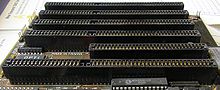

With the release of PC99 Specification , which declared a complete rejection of the ISA bus, its role in computers began to decline. With the advent of ATX motherboards and corresponding adapter cards, the ISA bus has ceased to be widely used in computers, although it is found in industrial computers (usually as a "mezzanine bus" in a special expansion basket).
For embedded systems, there is an ISA bus layout option - PC / 104 bus. Electrically, it is fully compatible with the ISA bus, but differs from it in the design of the connectors.
Content
History
The ISA bus first appeared on IBM PC computers in 1981 . It was an 8-bit bus with a frequency of up to 8 MHz and a data transfer rate of up to 4 MB / s (transfer of each byte required a minimum of two bus clocks ). The connector consisted of 62 contacts, of which 8 were used for data, 20 for the address, the rest for control signals, as well as supply voltage (GND, +5 V, −5 V, +12 V and −12 V).
In 1984, the tire was improved. The data capacity was doubled (which caused a doubling of throughput) and four bits of the address were added; in addition, the number of interrupt request lines and direct memory access (DMA) requests has increased. Also, in the 16-bit ISA bus, any device connected to it could act as a master, that is, initiate a data exchange operation (in the 8-bit bus, only the processor and the DMA controller were the master). For connecting 16-bit devices, two-part connectors are used: fully compatible with the 8-bit 62-pin bus and the new 36-pin.
With a move toward the proprietary Micro Channel Architecture (MCA) bus, IBM then virtually stopped supporting ISA in its products.
In contrast to IBM’s efforts to create the MCA, in 1988 a consortium of nine major computer manufacturers announced the 32-bit EISA system bus architecture, which, with similar capabilities and development prospects, was just an add-on to the “classic ISA”.
In 1993, Intel and Microsoft improved the bus by adding boards the ability to support Plug and Play technology [1] , which allowed the BIOS 'and / or operating system to automatically automatically determine the resources assigned to the device ( interruption , range of input ports) I / O, memory addresses for exchange with the system, etc.).
The ISA interface was the main one on AT -type systems; later on, from the mid-1990s, on ATX form factor motherboards , it began to be replaced by a promising PCI . The latest home-use chipset using the ISA bus was the VIA KT133 A, manufactured in 2000-2001.
See also
- EISA
- Lpc bus
- PS / 2
Literature
- Guk M. PC hardware interfaces. Encyclopedia. - SPb. : Peter, 2002. ISBN 5-94723-180-8 .