The Years of Wilhelm Meisters Lehrjahre ’s Teaching ( Wilhelm Meisters Lehrjahre ) is Johann Wolfgang Goethe’s second and longest [1] novel. Its publication in 1795-1796. marked the emergence of a new literary genre - the novel of education .
| The student years of William Meister | |
|---|---|
| Wilhelm meisters lehrjahre | |
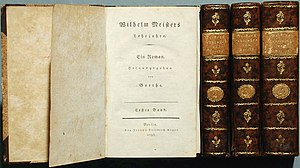 First edition of the novel | |
| Genre | parenting romance |
| Author | I.V. von Goethe |
| Original language | Deutsch |
| Date of first publication | 1795 |
| Previous | The suffering of young Werther |
| Following | Selective affinity |
Content
Story
Wilhelm Meister - a talented young man from the third estate - considers his true vocation not the continuation of his father’s (prosperous burgher's) business, but theatrical art. Inspired by his love for the actress idealized by him, he writes poetry and dreams of the bohemian world of theater.
The contrast to William is his neighbor Werner with his characteristic cold, prudent practicalism. A love note accidentally caught my eye convinces William of the betrayal of her beloved. He breaks off all relations with her and, finally recognizing Werner's case, is taken for "apprenticeship" in the field of commerce.
The main action begins three years later, when in the inn Meister meets a troupe of stray comedians. An indelible impression is made on him by the 13-year-old cable dancer Mignon . Strange songs of the savage captivate the hero who gives her his protection. He helps the troupe organize a performance in the nearby castle of the Baron, where the mysterious sage Jarno first introduces him to the brilliant works of Shakespeare .
Wilhelm’s long recovery after the attack of the bandits separates these scenes from the subsequent ones, which are associated with the Zerlo city theater, where the actors of the vagrant troupe rush. In this part of the novel, Wilhelm’s production of the translated Hamlet is narrated. Impressed by his talent, the theater director prophesies a great future for William and offers to sign a contract, while a mysterious performer of the role of the shadow of Hamlet's father warns him against this. The sudden fire of the theater turns into another interlude in the action of the novel and leads to a new regrouping of the main characters.
The next scene is the castle of Lothario, the beloved of the late sister of Zerlo, where Wilhelm, under the influence of Jarno, enters into a pious order like a Masonic one , calling itself the Tower Society. Having received a scroll of his fate, William begins to understand that life should be for others, and not for himself, that art (including theater) is only a cast from life, but not life itself. One after another, secrets are revealed, the characters of the characters connecting with each other, who weave their fates into a tight knot, are unknown [2] .
Summarizing the years of “apprenticeship”, Wilhelm concludes that life is much richer and more diverse than the bohemian world of art, and marries a noble lady who was his good angel when he did not know about it. From now on, he sees his future in “practical economic activity in the spirit of free enterprise” [3] .
Creation History
For many years, the figure of William Meister (whose last name translates as “master”) served Goethe as a kind of alter ego . The general concept of an essay on Meister dates from 1777 [4] . The existing novel in 8 books grew from the early manuscript "Theatrical Calling of William Meister" (1777-1785, accidentally discovered only in 1910) [5] . The songs of the Minions and the harper, included in the final version, were written in 1782-1785.
On the advice of his friend Schiller in the early 1790s. Goethe returned to the story of William Meister and completely revised it. The theatrical part of the book was mainly reduced. The author tried to distance himself as much as possible from the figure of Meister, softening the autobiographical beginning characteristic of the original manuscript. Four volumes of the novel were published in Berlin in 1795 and 1796 (circulation of 3,000 copies).
The long-term ripening of “William Meister” in prose and “ Faust ” in verses occurred in parallel. The continuation of both works became for the aging Goethe “the main feat of his last era, outwardly and generally smooth and happy, like a slow, almost cloudless sunset of a magnificent Roman day in a transparent golden melt” ( Vyach. Ivanov ) [6] . In the 1820s Goethe is working on a loosely structured continuation of Wilhelm’s adventures, entitled “The Years of Wilhelm Meister's Wanderings ” [7] .
Influence on the Romantics
In the wake of pre-romanticism at the turn of the 18th and 19th centuries, the “Years of the teachings of Wilhelm Meister” were explosive success, mainly in Germany itself. Schopenhauer declared him one of the four greatest accomplishments in the field of the novel [8] . Schlegel saw in him one of the sources of the literature of romanticism and in this respect compared its significance with the Great French Revolution [9] . Schiller wrote about Wilhelm Meister: “Calm and deep, clear and yet incomprehensible, like nature” [10] . Particularly attracted contemporaries was the central part of the novel, which was perceived as an apology for the theater in general and Shakespeare in particular.
The young romantic Novalis , who was initially fascinated by Goethe’s novel, eventually began to perceive him as a description of the main character’s “pilgrimage” up the social ladder [11] . Goethe's prose debunking of the cult of art seemed to him akin to preaching skepticism in Voltaire's Candide [11] . Goethe was outraged by the triumph of practicality over the ministry of art to Goethe. Both writers responded to the “Meisters” with their own artistic novels : “ Heinrich von Ofterdingen ” (1799) and “ The Wanderings of Franz Sternbald ” (1798), respectively.
The first English translation of the novel (approved, by the way, by the author himself) was made in 1824 by Thomas Carlyle . Under the influence of this translation and rogue novels of the 18th century, Bulwer-Lytton composed a string of books about the “adventures and adventures” of young people. On English soil, this tradition was developed in the educational novels of young Dickens (“The Life of David Copperfield ” and others).
Minions Image
The most memorable character of the novel turned out to be unrequitedly in love with the main character Mignon. According to the characteristics of Vyach. Ivanova
“The romantically captivating image of Mignon, an Italian girl in a masculine outfit accompanying the old harpist, clouded by life and guilt and melodiously yearning for her distant, beautiful and already unknown motherland herself, in marble buildings where, on the shores of a mountain lake she remembers herself as a child. The young Meister takes her to the adopted daughter; she is secretly in love with her named father; her early death is surrounded by mystical insight; in her glass coffin, she looks like a sleeping princess. In a charming fairy tale, some incomprehensible, indefinite music is heard, reminiscent of something native and infinitely beautiful, mourned and long forgotten ” [6] .
Songs of the Minions interspersed in the narration surpassed him in popularity. They were translated into Russian by B. Pasternak [12] , F. Tyutchev [13] , Ap. Maykov [14] , M. Mikhailov [15] . The image of the singing Minions, somewhat sentimental, inspired many prominent composers:
- The German composer Ludwig van Beethoven wrote The Song of the Minions for piano.
- Robert Schumann wrote the piano play The Minion. He also wrote The Requiem for the Mignon, for choir and orchestra (1849).
- The Austrian composer Franz Schubert composed songs for the piano (1815-1826).
- Hungarian composer Ferenc Liszt wrote the song “Song of the Minions” [16] .
- The French composer Ambroise Thoma wrote the opera Minion (1866); Meister's party in this opera was one of L. Sobinov 's favorites in the repertoire.
- The Russian composer Pyotr Tchaikovsky wrote the novel “No, Only He Who Knew” (1869), based on the song of Minions [17] .
Roman in Russia
In 1827, S. Shevyrev placed in the Moscow Bulletin the first translation of excerpts from Wilhelm Meister into Russian. A quarter of a century later, the editors of Moskvityanin represented by Ap. Grigoriev and L. Mei , having announced the translation of the whole novel, turned it down at the end of the third book. At that time, there was a prejudice that, in its naivety, Goethe's “Masonic” novel might not be interesting to a modern reader brought up on realistic narratives. Even A. Tolstoy , who was generally enthusiastic about Goethe, considered this work “murderously boring” and “meaningless” [18] . As a result, a full translation of all 8 books appeared only in 1870 (the author is Peter Polevoy ), and the first separate publication almost a century later [19] .
Of the Russian classics, Meister was most impressed with Dostoevsky , who even planned to name one of his works as Minion [20] . In the late 1850s. and later, when writing the novel The Idiot, Dostoevsky was almost obsessed with The Years of Learning, especially the image of the Minions [21] . Researchers of his work note the similarity of Minions and Nelly from the novel " Humiliated and Offended " [22] .
- Young Herzen (1834) fervently extols the elements of incipient romanticism in the novel: “Goethe sings another wonderful song for Werther - a song of youth in which everyone breathes the fresh breath of a young man, where all objects are visible through the prism of youth - these torn scenes, rhapsodies without external relationships, closely related to common life and poetry. And what kind of creatures fill him with “William Meister!” A minion, a bayadere who is barely able to speak, broken for gaery, dreaming of a country of lemon trees and oranges, of her bright sky, of her warm breath, Minion, pure, immaculate, like a dove; and, on the other hand, voluptuous, fiery Filena, luxurious as the country of the south, fiery, furious, like a youthful orgy, - Filena, who hates daylight and lives quite well under the secret, indefinite flickering of the lamp, glowing in his arms; and then a magnificent bas-relief of an old man, deprived of sight, a harper, for whom bread was bitter and whose tears flowed in the stillness of the night! ” [23]
- Alexander Druzhinin (1852), a proponent of a realistic trend, considered Goethe's novel naive and outdated: "The Russian reader ... will not restrain his smiles while reading Wilhelm Meister." Everything will seem ridiculous and wild to him: the philosophical debates of the actors, ending with dirty drunkenness, and the women of the novel, dressing up in men's dresses without any need, and the mystics treating the hero of the novel as their lackey, and the harper, who is like a madman, and stories a hundred pages about the puppet theater, and the final scenes in the castle of the prince, scenes completely similar to puppet comedy. Such a novel ... will not be popular anywhere other than Germany - all of these Laertes, Jarno and other persons with inhuman names will forever push themselves away from modern readers ... No matter how much the interpreters bother, the non-German public will not get along with this sea of mysticism and allegories, with these recognition of beautiful souls, with these events taking place not on earth, but somewhere outside of time and place, not in the human environment, but in some strange world of predawn dreams " [24] .
- Apollo Grigoriev (1854) lacked a satirical charge and a comic element in the novel: “When Gogol , for example, executes bribery, you are not afraid for the comedian to have something in common with bribery or debauchery, but Goethe, who is hostile to the philistine morality, and he often falls into it in his "Wilhelm Meister." <...> He went into his Weimar secluded little world and patiently, even with some favor, listened to the absurd exclamations of his fans, who called him Zeus . This is the true philistinism , from which even the greatest mind of Germany could not escape. <...> He subjugated his hero to a circle of gentlemen who had escaped from the yellow house, but meanwhile did not see anything comic in him. How is Meister taller than Laertes and Filina and various other acquaintances? He argues better than them (and even then not always) and dreams sweeter than them, i.e. they simply indulge in all animal instincts, and he artificially, dreaming and squinting his eyes, like Manilov ” [18] .
- Georg Lukacs (1939), arguing from the standpoint of Marxism , extols the book for the triumph of humanism : “Goethe creates his figures and positions with great ease and yet gives them plasticity and clarity of classical images. Figures such as Owl or Mignon, outlined with few touches and at the same time achieving high external and internal expressiveness, are difficult to find in world literature. Goethe creates several small, extremely saturated scenes in which all the richness of these characters is manifested. The protagonists of this novel are grouped in the struggle for the implementation of the humanistic ideal around two opposite trends: practicalism and daydreaming. Staying with special love on the images of Lothario and Natalia (representing overcoming these extremes), Goethe creates a whole gallery of "practitioners" from Jarno and Theresa to Werner and Melina. In this gallery, no one resembles another, and without any comment, a whole hierarchy of human dignity arises with complete ease, depending on the degree to which the individual approaches the humanistic ideal ” [4] .
- Vyacheslav Ivanov (1912) saw in the novel a premonition of a symbolism dear to his heart: “The lesson taught by the novel is the exposure and condemnation of amateurism . The artistic task is a life description of the environment, a broad picture of modernity, an attempt to create a narrative free from submission to one center of action, embracing the entire life of the whole society in its course. The main idea, the deepest motive of the book, undoubtedly, as the title itself indicates, is the image of a dark and winding path, the path of long wanderings that a person walks along, vaguely attracted to the right goal, but not seeing it for a long time ” [6] .
Films
The German director Wim Wenders in 1975 transferred part of the plot of the novel to modern Germany. The film was released under the name " False Movement "; the role of Mignon was played by 14-year-old Nastasya Kinsky .
Sources
- ↑ Nicholas Boyle. Goethe: The Poet and the Age . Oxford University Press, 1992. P. 365.
- ↑ Among other things, Wilhelm is convinced of the purity of the once rejected actress and incidentally finds out that the 3-year-old Felix, whom he has been taking care of all the last time, is none other than their common son.
- ↑ Turaev S.V. Goethe // Brief Literary Encyclopedia . M .: Sov. Encycl., 1962-1978. Volume 2
- ↑ 1 2 Georg Lukach . To the history of realism. M., 1939.S. 30-40.
- ↑ Goethe composed the first 6 books of this novel, the beginning of the 7th book and the plan for the next 6 books. Vyach. Ivanov notes that the final version of Meister is not free of certain lengths; "They are not in the initial draft, and therefore it seems more alive."
- ↑ 1 2 3 Vyach. Ivanov. Goethe at the Turn of the Century
- ↑ Like the other Goethe's senilia, his last novel is complete, as Ap. Grigoriev, “dry symbolism”; he had no success with the public.
- ↑ The Essays of Arthur Schopenhauer; The Art of Literature by Arthur Schopenhauer - Free Ebook
- ↑ History of world literature. T. 6. M .: Nauka, 1989.S. 36.
- ↑ F. Schiller. Collected works. Volume 7. State. publishing house Liters, 1957.P. 400.
- ↑ 1 2 The Cambridge Companion to German Romanticism - Google Books
- ↑ Minion (1785). Translation by B. Pasternak
- ↑ "You know the land where myrtle and laurel grows ..." , 1851
- ↑ Mignon (1866). A.N. Maykov. Selected works. Library of the poet. Big series. Leningrad, Soviet Writer, 1977 Archived December 15, 2011 on Wayback Machine
- ↑ Song of Minions (“Do you know the land where lemon groves bloom ...”) , 1859
- ↑ For voice and piano: Mignons Lied, first revision of 1842, second - circa 1856
- ↑ To the words of Leo May
- ↑ 1 2 V.M. Zhirmunsky Goethe in Russian literature. L .: Nauka, 1981. S. 318-321, 378-383.
- ↑ Perm: Perm Book Publishing House, 1959. - 547 p.
- ↑ I.Z. Serman. Comments: F. M. Dostoevsky. New ideas of novels, dramas, novels
- ↑ ア ー カ イ ブ さ れ た コ ピ ー . Date of treatment May 14, 2016. Archived June 16, 2015.
- ↑ F. M. Dostoevsky. New materials and research . Literary Heritage, Volume 86. M., Science, 1973.
- ↑ Lib.ru/ Classics: Herzen Alexander Ivanovich. Works of 1829-1841
- ↑ I. Sergievsky. Goethe in Russian criticism. // Literary inheritance. Prince 4-6. M., 1932. Archived on April 5, 2016 on the Wayback Machine
Links
- Original text of the novel (German)
- English translation of the novel (Eng.)