Fedor Andreevich Sergeyev (better known as “ Comrade Artyom ”; signed “ Artyom (Sergeyev) ” [3] ; also signed “Viktor (Sergeyev)” [4] 7 [19] March 18, 1883 - July 24, 1921 ) - Russian revolutionary, Soviet Political, state and party leader.
| Fedor Andreyevich Sergeev | |||||||
|---|---|---|---|---|---|---|---|
| Artyom (Fedor Andreyevich Sergeev) | |||||||
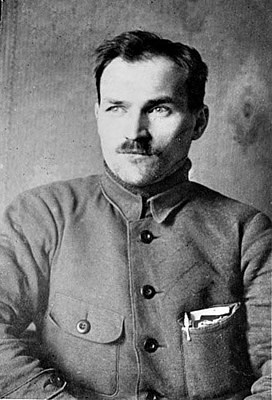 | |||||||
| Predecessor | position established | ||||||
| Successor | position abolished ; Yuri Khrisanfovich Lutovinov as Deputy Chairman of the Council of People's Commissars | ||||||
| |||||||
| Predecessor | Andrey Sergeevich Bubnov | ||||||
| Successor | Grigory Ivanovich Petrovsky | ||||||
| |||||||
| Predecessor | position reinstated ; Grigory Ivanovich Petrovsky as Chairman of the All-Ukrainian CVRK | ||||||
| Successor | Grigory Ivanovich Petrovsky | ||||||
| |||||||
| Predecessor | Georgy Leonidovich Pyatakov | ||||||
| Successor | Christian Georgievich Rakovsky | ||||||
| Birth | March 7 (19), 1883 | ||||||
| Death | |||||||
| Burial place | |||||||
| Spouse | Elizaveta Lvovna Repelskaya (? –1921) | ||||||
| Children | Artyom Fedorovich Sergeev (1921–2008) | ||||||
| The consignment | RSDLP (b) (since 1902 ) | ||||||
| Education | |||||||
| Military service | |||||||
| Years of service |  1918 - 1920 1918 - 1920 | ||||||
| Affiliation | RSFSR | ||||||
| Rank | Commanding | ||||||
| Commanded | The organizer of the struggle against the troops of the Central Council , the army of Kaledin , the Austro-German occupation forces (1918) Head of the Tsaritsyno campaign (1918) Commander of the January conflict in the BSR (1920) The authorized head of the Cheka for the suppression of the uprising "Black Eagle" (1920) | ||||||
| Battles | Civil war in Russia Civil war in Ukraine | ||||||


A member of the RSDLP (b) since 1902 , the founder and head of the Donetsk-Kryvyi Rih Soviet Republic , a close friend of Sergei Kirov and Joseph Stalin .
Content
- 1 Biography
- 1.1 Origin and education
- 1.2 Revolutionary
- 1.3 In exile
- 1.4 Civil war
- 2 family
- 3 Named after him
- 3.1 Cities and towns
- 3.2 Military equipment
- 3.3 Streets and organizations in Ukraine
- 3.4 Streets and organizations in other countries
- 4 In art and philately
- 5 Monuments
- 6 notes
- 7 Sources
- 8 References
Biography
Origin and education
He was born in 1883 in the village of Glebovo, Fatezh district, Kursk province [5] in the family of the state peasant Andrei Arefievich Sergeyev (d. 1918), who became a construction contractor and artisan. In 1888, he moved with his family to Yekaterinoslav , where in 1892 - 1901 he studied at the local real school , which he graduated from [6] .
Then since 1901 he studied at the Imperial Moscow Technical School (now MSTU named after Bauman ). In the same year he joined the RSDLP [6] . March 2, 1902 organized a student demonstration, was arrested, expelled from school and spent six months in a Voronezh prison [6] . Having received a “wolf ticket” (a ban on studying at Russian universities), he decided to continue his education abroad. In 1902 he emigrated to Paris , where he studied at the Russian Higher School of Social Sciences , listened to Lenin's lectures, and became close to the family of the famous scientist Mechnikov .
Revolutionary
March 15, 1903 returns to Russia and begins illegal revolutionary activity in the Donbass . In the village of Fedorovka in the Voskresensky volost of the Aleksandrovsky district of the Ekaterinoslav province, he creates the first large peasant social democratic organization in the region (about 400 people), with whom he conducts a May Day strike. Then, working as an assistant to the driver in Yekaterinoslav, he carries out propaganda work among railway workers and miners at the Berestovo-Bogodukhovsky mine near Yuzovka . In 1904 he was twice arrested - in Elizavetgrad and Nikolaev .
In January 1905 he arrived in Kharkov, working at the Kharkov Locomotive Plant , organized the Forward revolutionary group, preparing an armed uprising, and headed the Bolshevik organization. In December, he led an uprising in Kharkov , quickly crushed by troops. “The Bolsheviks, headed by F. A. Sergeev (Artyom), developed a plan for the preparation and conduct of an armed uprising in Kharkov. It was supposed to start at the Helferich Garden plant . The day of the speech was scheduled for December 12, 1905. But the tsarist secretary became aware of this, and the governor urgently ordered the arrest of 30 leaders of the uprising at night, and at 5 a.m. on December 12 the Gelferich-Sad plant was ringed by police and military units ” [7 ] .
After the suppression of the uprising, he went to St. Petersburg , and then to the Urals . In the spring of 1906 he was elected a delegate to the IV Congress of the RSDLP in Stockholm . Then at party work in Moscow and Perm , he headed the Perm Committee of the RSDLP. He was arrested, sat in Perm prison and Nikolaev arresting companies. In December 1909, the special presence of the Kharkov Trial Chamber sentenced him to life-long exile in Eastern Siberia. Sent to the village of Ipymanskoye on the Angara , Irkutsk province .
In exile
I will never, I think so, become a traitor to the movement of which I have become a part. I will never be patient with those who impede the success of this movement. I have been, am and will be a member of my party, no matter in what corner of the globe I may be. Not because I swore an Annibal oath, but because I couldn’t be not me.
- From a letter from Comrade Artyom on April 12, 1912
In 1910 he fled abroad through Japan , Korea , China to Australia . He lived in Harbin , Nagasaki , Hong Kong , and worked in Shanghai as a coolie for about a year.
By June 1911 he appeared in Australia, where he spent most of his time in Brisbane. By the end of 1911, he became an influential leader in the Brisbane Association of Russian Emigrants. Under his influence, the organization radicalized, began to position itself as representing the working class, and was later renamed the Union of Russian Workers, of which it joined the steering committee in 1913 [8] . He also organized English courses for Russian workers, joined the trade union organization, the Marxist circle. In June 1912 he organized and became the editor of the Russian newspaper Echo of Australia, which, however, soon closed due to unpopularity [9] . In the same year he participated in the organization of a general strike. He participated in the activities of the Australian Socialist Workers Party, for organizing unauthorized rallies he was in Brisbane Prison. For his efforts to unite Russian and Australian workers, in his words, “as a class, a single social group” [10] he is still remembered among the Queensland radicals. He was known under the pseudonym “Big Tom” and under the names Artyom, Artimon [11] . Episodes from his life form the basis of the novel by modern Australian writer Tom Kenilli "People's Train" (Tom Keneally, The People's Train ), published in 2009.
May 1, 1917 organized a May Day in the city of Darwin , after which he returned to Russia through Vladivostok .
Civil War
In July 1917 he arrived in Kharkov and soon headed the Bolshevik faction of the Kharkov Council; elected secretary of the bureau of the Donetsk regional committee of the RSDLP (b), then secretary of the Kharkov regional bureau of the metalworkers' union. In August, he was elected a delegate to the Sixth Congress of the RSDLP (b), where he was elected a member of the Presidium and became a member of the Central Committee. In October - one of the organizers of the armed uprising in Kharkov and the Donbass. On November 24, 1917 , Artyom was elected Chairman of the Executive Committee of the Kharkov Council and the Provincial Revolutionary Committee . He is also elected to the Constituent Assembly from the Bolsheviks. In December 1917, at the 1st All-Ukrainian Congress of Soviets, he was elected a member of the CEC of the Soviets of Ukraine , and the last elected People's Secretary for Trade and Industry.
An active supporter of the idea of Donetsk autonomy, in 1918 he founded and headed the Donetsk-Kryvyi Rih Soviet Republic , on February 14 he was elected chairman of the Council of People 's Commissars and People's Commissar of the National Economy of the DKR , then Commissar of Foreign Affairs of the Republic. He was a member of the Central Committee of the Communist Party (b) of Ukraine . One of the organizers of the struggle against the troops of the Central Council , the Cossacks of Ataman Kaledin , the Austro-German occupiers . Organizer of the First Donetsk Army . On March 21, he headed the evacuation commission at the Extraordinary Headquarters of the DKR, which did a great job of exporting material assets to Soviet Russia . Member and commander of the Tsaritsyno campaign . At the beginning of June he was sent to the North Caucasus to establish supply routes, visited Armavir , Maykop , Vladikavkaz , Tuapse . At the end of August he was sent to Ukraine, where he became a member of the All-Ukrainian Central Military Revolutionary Committee , which was preparing an uprising in Ukraine. In November, he headed the military department of the Provisional Workers 'and Peasants' Government of Ukraine .
On January 16, 1919 after the resignation of G. L. Pyatakov at a government meeting, he was elected chairman, but soon ( January 24 ) lost his post to Kh. G. Rakovsky sent from Moscow [2] . He was appointed Commissar of Soviet propaganda of the Ukrainian SSR . On March 23, in the city of Slavyansk , the First Provincial Congress of Soviets of the newly created Donetsk province was held , where Artyom was elected chairman of the executive committee . He prepared and carried out the administrative reorganization of the new territorial unit, instead of counties 12 districts were created, but the advance of the army of General Denikin did not make it possible to complete the administrative reform. During the retreat of the Red Army in August in Sumy, Artyom became seriously ill with typhus .
In 1919-1920, the Extraordinary Commissioner of the Central Committee of the RCP (B.) And the All-Russian Central Executive Committee under the Government of the BSR [12] [13] - the Bashkir Military Revolutionary Committee . From mid-December 1919 to June 1920, he was simultaneously the head of the Central Administration of Bashkir Help . A participant in the January conflict of 1920 in the BSR , according to the representative of T.I. Sidelnikov , "Bashkiria at the beginning of the year put Comrade Artyom on the" gentle calf "with his shallow and flat-bottomed policy along with almost complete business insanity . " In February-March 1920, as the authorized representative of the Cheka for the republic, he led the suppression of the Black Eagle uprising . He countered the Bashkir national movement , contributed to the deprivation of the Bashkir Republic of the political and economic rights of autonomy [12]
In April 1920, he was again elected Chairman of the Donetsk Provincial Executive Committee, was working to restore the coal mines of the basin. At the IX and X congresses, the RCP (b) is elected a member of the Central Committee. From November 1920 to January 1921 - Secretary of the Moscow Committee of the RCP (B.) , Then Chairman of the Central Committee of the All-Russian Union of Miners, member of the All-Russian Central Executive Committee .
He died during the test of the car , returning from Tula to Moscow . He was buried on Red Square in Moscow in a mass grave .
The son of Artyom, taken after the death of his father to be raised by Stalin , believed that the catastrophe was rigged, and called it the organizer of L. D. Trotsky [14] . At the same time, in another interview, he spoke of her as random.
Family
- Wife: Elizaveta Lvovna Sergeeva (Repelskaya nee), 1896-1983. She graduated from the medical faculty of Moscow University , was in party and military work. After her husband’s death, she worked as the head doctor of the anti-tuberculosis sanatorium she created near Nalchik , chairman of the regional health department of the Kabardino-Balkarian Autonomous Soviet Socialist Republic , then deputy director of the aircraft engine factory No. 24, director of the textile factory, head of the medical department of the All-Union Central Council of Trade Unions .
- Son: Artyom Fedorovich Sergeev ( March 5, 1921 - January 15, 2008 ), general, Stalin's adoptive son, participant in the Great Patriotic War , was captured, fled, participated in the partisan movement. After the war, he commanded the 9th Air Defense Division . Wrote a book [15] .
Father died after 1918, mother in 1936.
Named after him
Cities and towns
- 1921 - The Bobrovsky coal mine is named after Artyom, subsequently the mine settlement named after Artyom (since 1938 - the city of Artyomovsky ).
- 1921 - The Catherine mine was renamed the Artyomovsky mine, later - the city of Artyomovsk, Perevalsky district, Lugansk region . Simultaneously with the renaming of the mine, mine No. 16 of the Ekaterinovsky mine was renamed mine No. 10 named after Artyom.
- 1924 - the city of Bakhmut was renamed Artyomovsk (since 2016 it was renamed back to Bakhmut according to the law on decommunization).
- 1924 - the city of Artyom in the Primorsky Territory is named after Artyom.
- 1929 - the Feodosievsky mine of the Bodaibo district of the Irkutsk region, simultaneously with the assignment of the status of an urban-type settlement, was renamed into the town of Artyomovsky .
- 1936 - Pirallahi island in the Caspian Sea near Baku and the urban village Pirallahi located on it was renamed Artyom Ostrov (later it was renamed to its former name).
- 1938 - the village named after Artyom and the village of Yegorshino in the Sverdlovsk region formed the city of Artyomovsky , which since 1965 has been the administrative center of the Artyomovsky district of the Sverdlovsk region .
- 1939 - the city of Olkhovsky in the Krasnoyarsk Territory was renamed Artyomovsk .
Military equipment
- His name was known for participating in the defense of Kharkov in the Civil War, the Red Army armored car "Comrade Artyom . "
- 1928 - the destroyer of the Baltic Fleet Zinoviev (formerly Azard ) was renamed Artyom.
Streets and organizations in Ukraine
Since 2015, in accordance with the law on decommunization in Ukraine, objects named after Sergeyev are being renamed, including streets in Kiev , Dnieper , Kharkov , Zaporozhye , etc.
- Name of Comrade Artyom wore the Dnepropetrovsk Mining Institute .
- In Kharkov, in the 1930s, the Park of Culture and Rest named after Artyom (today the Machine-Building Park ) was opened.
- Many cities of Donetsk and Lugansk regions have streets, districts and schools named after Artyom.
- In Krivoy Rog there are: two Artyom mines (Artyom-1 and Artyom-2), Artyom Culture and Leisure Park, Artyom Culture House, Artyom Square, metro tram “Artyom Square” (since April 23, 2016 it has been called “ Evening Boulevard” "According to the law on decommunization).
- The name was given to the Donetsk Regional Ukrainian Music and Drama Theater .
- The central street of Donetsk is called - st. Artyom. Monument to Artyom stands at the intersection of st. Artyom and Prospect Mira
Streets and organizations in other countries
- In md. Firsanovka Khimki has a sanatorium named after Artyom [16] .
- In Alma-Ata , Minsk , Gomel , Grodno , Essentuki [17] , Voronezh , Perm , Ulyanovsk , Stavropol , Tver, Tomsk , Yoshkar-Ola , Fatezh , Sterlitamak , Murom , Chelyabinsk there are Artyom streets .
- In the city of Plast, Chelyabinsk region, since 1912, the Federal Center for the Protection of Natural Sciences named after Artyom (formerly - Antonovsky Plant, renamed after the Civil War)
- He named the microdistrict in the city of Shakhty, Rostov Region, and the Artyomovets sports complex in the same city .
- His name was the former Paramonovsky mine, and in Soviet times the coal mine them. Artem-1 and Artem-2 Glubokaya in the city of Shakhty, Rostov Region.
- In the city of Shakhty, Rostov Region, CHP named after Artyom.
In art and philately
- In 1963, the USSR postage stamp dedicated to Artyom was issued.
- In 1970, A. Khazin 's play “ Artyom ” was released. In the same year she was staged on the stage of the Leningrad State Academic Drama Theater. A.S. Pushkin . The music was written by Kara Karaev .
- In 1978, the television film "Artyom" was released at the Odessa film studio (starring Ivan Matskevich ). The image of a revolutionary is also present in the film “ Strokes to the Portrait of V.I. Lenin ” (in the role of Peter Shcherbakov ).
- 1981 - the story of Radiy Polonsky “If only there was enough life ...: a story about Artem” was published
- 2009 - the novel by Australian writer Thomas Kenilli “The People's Train” (Tom Keneally, The People's Train), based on facts from the life of Artyom [18], was released .
Monuments
In several cities, monuments to F. A. Sergeev were erected:
- 1924 - the first monument of the work of I.P. Kavaleridze was erected in Artyomovsk; not preserved: destroyed by the Nazis during the occupation. A new monument was erected in the same place in 1959. In addition, in Artyomovsk there are 3 more monuments to the revolutionary. July 10, 2015 the monument to Sergeyev in the city was dismantled.
- 1927 - a monument was erected in Svyatogorsk , by I.P. Kavaleridze.
- 1948 - a monument to Artyom was erected in Artyomovsk, Luhansk region , the author is unknown.
- 1958 - a monument was erected in Krivoy Rog, Dnipropetrovsk region , demolished on February 7, 2015.
- 1965 - a monument was erected in Fatezh, Kursk region .
- August 13, 1968 - a monument to Artyom was erected in the town of Shakhty, Rostov Region in the village named after Artyom. B. A. Akolzin, L. I. Ganshin, N. A. Karagodin, A. M. Demidovich
- Artyom village in the city of Shakhty, Rostov Region, now Artyomovsky District.
- 1967 - a monument was erected in Donetsk .
- 1983 - a monument was erected in the city of Artyom of the Primorsky Territory
- 1987 - in Kharkov, at the expense of enterprises of the Kiev region, a monument was erected in front of the rector’s building of the KhIMESK (now the Kharkov State Agrarian University ). To erect the monument, the bust of V.V. Dokuchaev , whose name the institute had at that time, was demolished. On September 24, 2014, he was knocked down by unknown persons and damaged.
Monument to Artyom in Donetsk
Bust in the Square of Glory of the Heroes of the Civil War in Lugansk
Monument to Artyom in the sanatorium named after him
Monument to Artyom in Kharkov (dismantled in 2014)
Monument to Artyom on Artyom Square in Krivoy Rog (destroyed in 2015) [19]
Notes
- ↑ January 19-24, Deputy Chairman of the Workers 'and Peasants' Government. On the 24th, Christian Rakovsky was appointed chairman.
- ↑ 1 2 Soldatenko V.F. People's Commissar Mikola Skrypnik // Ukrainian History Journal . - 2002. - No. 1 . - S. 86 . Archived on April 2, 2015.
- ↑ “ Artyom Khar'kovsky ” (see “Correspondence of the Secretariat of the Central Committee of the RSDLP (b) with local party organizations”, T.1 P.146, and “Bolshevik organizations of Ukraine during the preparation and conduct of the Great October Socialist Revolution” P.399, “Bolshevik organizations of Ukraine ”S.225); “Tom Sergeyev” (Tom Sergeyev, Tom Sergeieff, Artymon) - the pronunciation of the name “Artyom” in a foreign manner was entrenched to him in Australia (Pryvalenko M. “Bolshevik Artem”, Kursk Book Publishing House, 1964 - P.142 - 224 from.); " Big Tom " - characterized his massive physique; “ Fedya the Loud-voiced” - received in prison, for the timbre of his voice and a loud, infectious laugh (B. Zakharov; “Fedya the Loud-voiced: (About F. A. Sergeev, in whose honor Mr. Artyomovsk is named)” / B. Zakharov // Choice (Artyom ). - 2001. - Oct. 19 - S. 2.); " Comrade Artyom " - the latter began to be used in literature after his death; he himself usually signed as "Artyom (Sergeev)."
- ↑ Figures of the revolutionary movement in Russia: from the predecessors of the Decembrists to the fall of tsarism: a bio-bibliographic dictionary / All-Union Island of political convicts and exiled settlers; under the editorship of Felix Cohn [et al.]. - Moscow: Publishing House of the All-Union Island of Political Prisoners and Exiled Settlers, 1927-1933. - 25-27 cm. T. 5, issue. 1: Social Democrats 1880-1904. issue 1. A-B / comp. E.A. Korolchuk and Sh. M. Levin. - 1931. Page 131
- ↑ Nowadays - Glebovschina in Fatezhsky district (see: This place ).
- ↑ 1 2 3 Vavilov S.I. Great Soviet Encyclopedia - Volume 03, Second Edition . - Moscow: Soviet Encyclopedia . - T. 03. - (2). Archived July 11, 2015.
- ↑ Faithful sons of the working class . Archived November 30, 2012.
- ↑ Louise Curtis: Red Criminals (Censorship, Surveillance and Suppression of the radical Russian community in Brisbane during Worl War I), PhD Thesis, Griffith University, Brisbane, Australia, 2010. . Date of treatment April 10, 2014. Archived on April 13, 2014.
- ↑ RGASPI 495-94-2. April 30, 1920, AM Zuzenko: To the Third Communist International, Report on the work of the Union of Russian Workers in Australia. In Russian, manuscript and typescript copies; overwritten by hand: 'to Com. Radek ', A version of this document was published in Kommunisticheskii international , No. 11, 14 June 1920. Archived copy . Circulation date May 31, 2019. Archived April 18, 2019.
- ↑ Tom Poole and Eric Fried “Artem: A Bolshevik in Brisbane” Australian Journal of Politics & History, Vol. 31, Issue 2, pages 243–254, August 1985
- ↑ Bertha Walker: Solidarity Forever !, 1972
- ↑ 1 2 Sergeev Fedor Andreevich, // Bashkir Encyclopedia / ed. M.A. Ilgamov. - Ufa: GAUN “ Bashkir Encyclopedia ”, 2015—2019. - ISBN 978-5-88185-306-8 .
- ↑ Kasimov S.F. Bashkir Military Revolutionary Committee // Bashkir Encyclopedia / ed. M.A. Ilgamov. - Ufa: GAUN “ Bashkir Encyclopedia ”, 2015—2019. - ISBN 978-5-88185-306-8 .
- ↑ Donetsk communication resource . Archived November 30, 2012.
- ↑ Artyom Sergeev, Ekaterina Glushik. Conversations about Stalin. - M.: Crimean bridge-9D, 2006. . Archived November 30, 2012.
- ↑ Sanatorium named after Artyom . Archived on June 19, 2008.
- ↑ Yandex.Maps - a detailed map of Russia and the world . yandex.ru. Date of treatment November 4, 2016.
- ↑ Natalia Golitsyna. "People's Train" is a novel about Russian revolutionaries in Australia . Radio Liberty (04-02-2010). Archived on April 23, 2017.
- ↑ Monuments to Artem, Dzerzhinsky and Liebknecht were demolished in Krivoy Rog (photo) . Archived on June 30, 2015.
Sources
- Artyom in Ukraine. Documents and materials. - Kharkov, 1961.
- Artyom (Sergeev F.A.). Articles, speeches, letters. - M .: Politizdat, 1983.
- Anikanov P. Artem. - Kharkov: Young Bilshovik, 1930.
- Cool V. Bolshevik Artem. - M.: Gospolitizdat, 1947.
- Zagorsky P.S. Revolution of the Art of Artyom (F. Serguev). - К., 1949.
- Nasedkin V.M. Artyom. - Kharkiv: Region view., 1958.
- Mogilevsky B.L. Artyom (Fedor Sergeyev). - M .: Young Guard, 1960 ( ZhZL series). - 367 p.: Ill., Portr.
- Astakhova V.I. Revolutionary activity of Artyom in 1917-1918. - Kharkov, 1966.
- Kuzmin N.P. Dawn: The Story of Fyodor Sergeev (Artyom). - M .: Politizdat, 1979. - (Flaming revolutionaries). - 454 p., Ill.
- Mogilevsky B. L. Our Artyom. - Kharkov, 1982.
- Shikman A.P. Figures of Russian History. Biographical reference. - M., 1997.
- Tom Poole and Eric Fried Artem: A Bolshevik in Brisbane - Australian Journal of Politics & History, Vol. 31, Issue 2, pages 243–254, August 1985
Links
- Artyom during the Civil War . Archived November 30, 2012.
- Sergeev Fedor Andreyevich (Artyom) on infodon.org.ua . Archived November 30, 2012.
- MNIB - Artyom in Ukraine. Documents and materials. . Archived November 30, 2012.
- Comrade Artyom. Documents and photos on infodon.org.ua . Archived November 30, 2012.
- Saltan A. N. Comrade Artyom - the specific prince of Donkrivbassovsky?