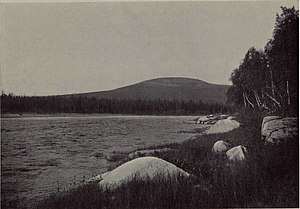
Parma is a flat-topped elevation or ridge overgrown with firs and firs [1] .
Content
Etymology
Translated from the languages of the Perm group of the Finno-Ugric languages, Parma means dark coniferous forest. In the Komi language, more than ten words to denote the forest, and Parma is one of them.
Parm Distribution
The area of distribution of Parma generally coincides with the growing area of the Kama-Pechersk-West Ural dark coniferous forests and looks like a huge isosceles triangle, the peak of which is in the Polar Urals. The eastern side of the triangle runs along the large watersheds of the Eastern slope of the Urals, the western - crosses the Vychegda River east of Syktyvkar and goes to the Vetluga River. The base of the triangle is limited by the line connecting the mouths of the Kama and Belaya rivers. Within this vast territory of dark coniferous forests, both pre-tundra woodlands and north-, middle- and south-taiga dark coniferous forests are enclosed.
Flora and Soil Parm
Boggy sedge and horsetail sphagnum coniferous forests, mostly spruce with a considerable admixture of cedar and fir dwarf (up to 30 - 40%), are spread on the gentle slopes of the foothills and the leveled peaks of the Pribechersky Parma. On the upper reaches of the Pechora, Vychegda and Kama rivers there passes a wide strip of mid-taiga, mainly green-moss spruce-fir forests on typical podzolic soils. The upper and lower parts of the Vyatka and Kama river basins are occupied by southern taiga dark coniferous forests on sod-podzolic soils with a dense and almost continuous grass cover.
Parma in Culture
- Heart of parma
See also
- Taiga
- Dark coniferous taiga
Notes
- ↑ [1] Parma. Great Encyclopedic Dictionary