
The Banner of the Kryvyi Rih is a red flag that was presented in 1929 by the Kryvyi Rih miners from the mine to them. Dzerzhinsky to German miners from the Mansfeld Mountain District.

Arrival of the Krivoy Rog Banner in Herbstedt

The banner that the communist Karl Schulz solemnly passed from Neukeln to Herbstedt was constantly used as a symbol of the communist labor movement in demonstrations and parades on Mansfeld land during the Weimar Republic . According to official East German historiography, Otto Brozovsky , the secretary of the KKE party, took the banner and hid it during the Nazi period. The banner was hidden first in the other Herbstedt family from the Nazis , but then it was taken into the house, not suspicious at that time, Brozovsky, for which he received a high risk. Otto Brozovsky’s wife, Minna Brozovskaya , sewed it between two tablecloths and placed it on a table in the living room. On March 30, 1933, Otto Brozovsky was captured and sent to the Lichtenburg concentration camp near Prettin. Throughout the arrest of Brozovsky, the banner was buried by friends under the arable land of the arable land of Herbstedt. After one year of detention, Otto Brozovsky rebuilt his rabbitry and hid the banner in thick clay walls, which is typical of Mansfeld lands.
By the end of World War II, the area of Mansfeld was occupied by American troops, which was transferred to the Red Army after the Yalta Conference . When Soviet soldiers entered Herbstedt, they were met by the Brozovsky family with the Banner of the Krivoy Rog. According to Rudolf Brozovsky, grandson of Otto Brozovsky, his grandfather hung a banner from the window and after that the Soviet commander was able to find the Brozovsky family.
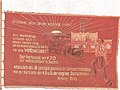
Front side of banner
In the days of the GDR, a banner or specially made duplicate was used as a symbol of the resistance of communism against fascism and as a symbol of an alliance with the USSR and was often shown at official events. Since 1964, the banner was exhibited at the German Historical Museum in Berlin and after the Peace Revolution in the GDR was stored in the museum’s warehouse. In 2007, the restored banner was shown at a special exhibition of the museum.
The moment of the meeting of Soviet soldiers-liberators was captured in the 1953 painting by the German artist Franz Karl Köthe. In 1960, Otto Gotchet 's novel, The Banner of the Horn, was published. In the same year, Heiner Müller considered the topic in the eponymous essay poem. Kurt Metzig’s Banner of the Horn was first shown in 1967.
Literature
- VEB Mansfeld Kombinat Wilhelm Pieck (Hrsg.): Die Fahne von Kriwoi Rog: Symbol unserer Freundschaft; Tradition und Gegenwart; [Mansfeld - Kriwoi Rog 1929 - 1989]. Mansfeld 1989
Links
- Birk Karsten Ecke Gerbstedt und die Fahne von Kriwoi Rog (German) (8. Dezember 2012). Date accessed August 27, 2015.