Sestroretsk ( Fin. Siestarjoki , Swede. Systerbäck ) is a city in Russia , an intracity municipality within the Kurortny district of the city of federal significance of St. Petersburg [3] . The seaside climatic balneo-mud resort with its mineral water and therapeutic mud on the northern shore of the Gulf of Finland of the Baltic Sea [4] .
| City [1] | |||||
| Sestroretsk | |||||
|---|---|---|---|---|---|
| |||||
| A country |  Russia Russia | ||||
| Subject of the federation | St. Petersburg | ||||
| Area | Resort | ||||
| History and geography | |||||
| Based | in 1714 | ||||
| City [1] s | 1925 | ||||
| Timezone | UTC + 3 | ||||
| Population | |||||
| Population | 42,189 [2] people ( 2019 ) | ||||
| Katoykonim | sister woman | ||||
| Digital identifiers | |||||
| Telephone code | +7 812 | ||||
| Zip Codes | 197701,197704,197706 | ||||
| OKATO code | 40281520 | ||||
| OKTMO code | |||||
| sestroretsk.spb.ru | |||||
Located in the south of the Karelian Isthmus . Several watercourses flow through the city, connecting the lake Sestroretsky Spill and the bay (the Sestra river, Gagarinsky stream, the so-called Rusty ditch). On the territory of the city are located the historic districts of Gorskaya , Aleksandrovskaya , Tarkhovka , Razliv, Resort and Dunes.
Sestroretsk railway station and stopping points Gorskaya , Aleksandrovskaya , Tarkhovka , Razliv and Resort on the St. Petersburg line ( Finnish Station ) - Beloostrov . The distance from the station of the city ( Sestroretsk ) to the Finland Station of St. Petersburg is 34 kilometers [5] .
The population of the city is 41,160 inhabitants, which makes it the largest settlement of the Kurortny district.
Physical-geographical characteristic
Relief and geology
The city on the eastern shore is shallow (2.5–3.5 m depth, only 200 m from the shore) of Sestroretsk Bay of the Gulf of Finland of the Baltic Sea. Along the coast - covered with forest ridge of dunes and hills, which is interrupted by river valleys and small lakes, ponds and stretches of naked moraine. A sandy (“golden”) beach with a width of up to 50 m. Near the resort is Lake Razliv, created during the construction of a dam on the Sestra River [4] .
In the Paleozoic 300-400 million years ago, this whole territory was covered by the sea. Sedimentary deposits of that time — sand , sandy loam , clay with lenses of silt or peat — cover with a thick layer (over 200 meters) a crystalline basement consisting of granites , gneisses and diabases . The modern relief was formed as a result of the activity of the ice cover (the last Valdai glaciation was 12 thousand years ago). After the retreat of the glacier, the Litorina Sea was formed , the level of which was 7–9 m higher than the present. 4 thousand years ago, the sea retreated, and the shoals of the Gulf of Finland turned into islands. The valley is composed of glacial and post-glacial deposits. The last 2.5 thousand years, the relief has hardly changed [6] .
Climate
Sestroretsk's climate is temperate and humid, transitional from maritime to continental. Day length varies from 5 hours 51 minutes December 22 to 18 hours 50 minutes June 22. The city is characterized by frequent changes of air masses , due to the activity of cyclones that pass along the Gulf of Finland, which leads to great variability of weather, especially in autumn and winter. The winter is moderately mild, with a predominance of moderately frosty, mostly cloudy weather. Snow cover is established in the second half of November and lasts until mid-April. Spring is late and protracted. Summer is moderately warm, with the change of sunny and rainy days. Autumn is cloudy and foggy. Precipitations are about 650 mm per year, mostly in June and August. The average annual relative humidity of air is about 80%, the highest in December (90%). In the summer, westerly and northwesterly winds predominate, in winter westerly and southwesterly [4] [6] . The climate of Sestroretsk is close to the climate of St. Petersburg located nearby. The Gulf of Finland, despite its shallow water, has some influence on the temperature regime of the city. In summer, especially in August — September, the average air temperature here is slightly higher than in St. Petersburg (by 0.5–0.8 °), and in winter - lower (by 0.5–0.6 °). Somewhat stronger on the coast and winds [7] [8] .
Annual indicators of air temperature and precipitation [7] [9] :
| Climate | |||||||||||||
|---|---|---|---|---|---|---|---|---|---|---|---|---|---|
| Indicator | Jan. | Feb | March | Apr | May | June | July | Aug | Sen | Oct. | Nov. | Dec | Year |
| Absolute Maximum, ° C | 8.6 | 10.2 | 14.9 | 25.3 | 30.9 | 34.6 | 35.3 | 33.5 | 30.4 | 21.0 | 12.3 | 10.9 | 35.3 |
| Average maximum, ° C | −2,3 | −1,4 | 4.1 | 9.2 | 16,1 | 20.5 | 22.2 | 20.6 | 14.6 | 8.5 | 1.8 | −0.7 | 9.4 |
| Average temperature, ° C | −6,1 | −6 | −1,4 | 4.4 | 10.9 | 15.8 | 18.1 | 16.4 | 11.0 | 5.6 | −0,1 | −3.9 | 5.4 |
| Average minimum, ° C | −7.9 | −7.7 | −2.9 | 1.6 | 7.1 | 11.9 | 14.0 | 13.0 | 8.0 | 3.7 | −2,1 | −5,5 | 2.8 |
| Absolute minimum, ° C | −35,9 | −35,2 | −29,9 | −21,8 | −6,6 | 0.1 | 4.9 | 1,3 | −3,1 | −12.9 | −22,2 | −34,4 | −35,9 |
| Precipitation rate, mm | 40 | 31 | 35 | 33 | 38 | 64 | 78 | 77 | 67 | 65 | 56 | 49 | 633 |
Soils, vegetation and wildlife
Prior to the founding of the city, the territory was covered with coniferous forests ( pine and spruce ) mixed with broad-leaved species and lowland marshes . Now, in the area of the city, large coniferous arrays (dominated by pine ) alternate with deciduous groves ( birch , alder , aspen , willow ). Sandy, lake-based and alluvial sands are dominated by surface-podzolic soils combined with peaty-podzolic-gley soils [10] .
In the vicinity of the city sometimes there are fox and muskrat . The city has a large number of birds , reptiles and invertebrates [11] .
On the territory of Sestroretsk, as well as the villages of Beloostrov and Pesochny, there is the state natural reserve “Sestroretsk marsh” with a total area of 1900 hectares. The reserve is a single hydrological system associated with the Gulf of Finland - this is the lake Razliv , the Sister and Chernaya rivers, and numerous swamps . In the reserve there are deposits of healing gittyevyh clay, ancient marine terraces, various species of flora and fauna. Any construction is prohibited in the reserve [12] .
Spa Factors
Pure ionized sea air, air saturated with pine aroma, pine forests , sea bathing, sandy beaches are favorable for climate and thalassotherapy for diseases of the circulatory organs, respiration , and the nervous system . Coniferous forests, sand hills and dunes create a natural barrier to the winds and provide shade, which allows for helio- and aerotherapy on the beaches. Deep warming of the sand in the area of the dunes makes it possible to hold sand baths. The flat seabed forms a sandy shallow water for several tens and even hundreds of meters, convenient for bathing children. The swimming season is from mid-June to the end of August (the average water temperature in July is +19.3 ° C). Along with this, sapropelic mud is used for the treatment - the so-called gitium, used at the spa for mud therapy . The field is located in the western part of the swamp adjacent to the lake Sestroretsky Spill (mud reserves over 1 million tons). The mineral water is sodium chloride in composition with a mineralization of 1.12 g / liter and radon content (7 nCi / l). Daily production rate of 400 cubic meters. Used for balneotherapy (drinking cures, baths) [4] .
| Sestroretsk Resort Beach | Winter buer on the lake Sestroretsky spill | Factory dam after reconstruction on the lake Sestroretsky spill | The main alley of the park "Dubki" overlooking the Gulf of Finland | At the lake Sestroretsky spill |
Population
| Population | ||||||
|---|---|---|---|---|---|---|
| 1897 [13] | 1920 [14] | 1926 [15] | 1937 [16] | 1939 [17] | 1942 [18] | 1945 [19] |
| 9674 | ↘ 4692 | 026 11 026 | ↗ 26,178 | ↗ 28,212 | ↘ 2743 | ↘ 2415 |
| 1959 [20] | 1970 [21] | 1979 [22] | 1989 [23] | 2002 [24] | 2010 [25] | 2012 [26] |
| ↗ 25,205 | ↗ 31,605 | ↘ 29,441 | ↗ 35,498 | ↗ 40,287 | ↘ 37,248 | ↗ 37,832 |
| 2013 [27] | 2014 [28] | 2015 [29] | 2016 [30] | 2017 [31] | 2018 [32] | 2019 [2] |
| ↗ 37,966 | ↗ 38,812 | ↗ 39,394 | ↗ 40,090 | ↗ 40 570 | 160 41,160 | ↗ 42,189 |

Authorities
The representative body of local self-government, the municipal council, has been functioning since September 28, 1997 . As a result of the elections of September 14 , 2014, a new composition of the V convocation was elected (out of 10 deputies: 9 from United Russia , 1 - self-nominated candidate).
- The head of the municipality - Chairman of the Municipal Council of the city of Sestroretsk - Alexander Belsky.
- The head of the local administration of the municipal entity of the city of Sestroretsk is Tatyana Semyonovna Ovsyannikova.
- Deputies of the municipal council of the city of Sestroretsk - Anisimov Vladimir Nikolaevich, Babushkina Valentina Ivanovna, Belsky Alexander Nikolaevich, Weimer Alexander Alexandrovich, Vasilyev Viktor Mikhailovich, Grechishnikov Ilya Alexandrovich, Dokish Yuri Mikhailovich, Zaborovsky Nikolai Nikolaevich, Kozyrev Yury Yuryevich, Matveev Vladimir Vitalevich.
History
The territory of the city in the Stone Age
About 3000–3500 years ago, a prehistoric man appeared at the mouth of the Sister River. This is evidenced by the archaeological finds in the foundations of the dunes near the western shore of Lake Sestroretsky Razliv, first found in 1905 . Now in this area found eleven sites of the ancient man of the Neolithic era (the new stone age). The inventory of sites represented by tools made of quartz - arrowheads , scrapers for processing hides. There are many shards from the ancient dishes, decorated with a patch-comb pattern , typical of the Neolithic tribes who lived in the III-II millennium BC throughout the forest belt of Eastern Europe . Next to the crockery, remains of foci (burnt stones and ashes) are found. Scientists believe that these sites belonged to wandering communities of hunters . They did not know agriculture and did not have domestic animals [33] .
Russian-Swedish Wars
The coast of the Gulf of Finland more than once became the object of Russian military conflicts with the Swedes. The first document that established the border in this region was the Orekhovsky Peace of 1323 , concluded by the prince of Novgorod Yuri Daniilovich and the Norwegian-Swedish king Magnus . According to it, the border of the Novgorod Republic with the Swedish Kingdom was established along the Sestra River. Contrary to the text of the document, this world did not become "eternal", and later, as a result of the Russian-Swedish war of 1614-1617, the Stolbovsky peace was concluded, according to which Russia completely lost access to the Baltic Sea [34] .
The first mention of the trade fair Systerbäck at the mouth of the Sister River is found in Swedish chronicles of 1643.
As a result of the Northern War, Peter I managed to win back these lands, including the mouth of the Sestra River. Here in May 1703, Russian troops routed the twelve-thousandth army of the Swedish general Kroniort [34] .
The emergence of the city
To gain a foothold on these lands, in 1706 a harbor was built near the mouth of the Sestra River. In 1710, an expedition was sent to these places in order to find iron ores and map the area [35] .
A new story begins with a visit by Peter I on September 20 ( October 1 ), 1714 , to the Sestra River. The emperor ordered a summer palace to be built on the shore of the Gulf of Finland, and a garden next to it. The palace was built in 1719-1724 from local brick (later, in 1781, it was demolished) [35] . About 2000 young oakes were planted near this palace. A few years later they decided to build a dam on the Sestra River. The dam was used for another purpose, since the long Northern War caused the need to strengthen the production of weapons. In June 1721, the construction of an arms factory began under the direction of the commander of the Olonets factories, Colonel Wilhelm Gennin . In 1723, he was sent to Siberian factories, and work at the Sestroretsk Arms Factory was completed by Colonel Matvey Vyrubov [36] . After the dam was built on the Sestra River, an extensive reservoir was formed - the Sestroretsky Spill . January 27 ( February 7 ), 1724 the plant was opened. The plant provided the army with pistols , muskets and cannons , and also produced civilian things (hinges, door handles, copper buttons necessary for the uniform), and lattices for the Fontanka River , the Catherine Canal . When the plant also operated 15 powder workshops (in 1740, their equipment was transferred to Okhta powder factories). [37] The Sestroretsk masters made the famous “Dad's Car” on the basis of the drawings of M. V. Lomonosov , as well as a silver shrine intended for the relics of Alexander Nevsky [38] .
In 1721 , simultaneously with the construction of the arms factory, a wooden Peter and Paul Church was erected on its territory, after the fire of 1730 it was rebuilt elsewhere [39] .
In 1735, the Chernorechensky Iron Foundry, which smelted metal from local ore, was built on the Dibun-swamp, near the mansion “Aspen Grove”. He gave the first smelting in the autumn of the same year and continued to supply raw materials to the Sestroretsky Arms Plant for more than fifty years [40] .
During the Russian-Swedish war of 1741-1743, fortifications were built in Sestroretsk. The earthworks were renewed during the Crimean War of 1853-1856 , in June 1855 the city survived the bombardment by the Anglo - French fleet [41] .
In 1809, the Grand Duchy of Finland was formed as part of the Russian Empire, and in 1811 the Vyborg gubernia was included along with Sestroretsk, after which the border of Finland with the St. Petersburg gubernia passed along the Sestra river [42] .
In 1847, a line of a connorhe line was laid from Dubkovoj Wharf on the coast of the Gulf of Finland to the Arms Plant. From June 1849 to September 1852, Ivan Ovsov and Dmitry Zubov, in agreement with the Department of Military Settlements, built a highway from Dubkovoj Wharf to the main entrance of the plant with a length of 1,410 running fathoms (about 3 km). On September 21 ( October 3 ), 1853 , as a result of a strong hurricane by the waves of the Gulf of Finland, the road was destroyed [43] .
By decree of Emperor Alexander II of February 1 ( 13 ), 1864 , the plant with the adjacent territory was separated from the Vyborg province and attached to the Petersburg province. [42] It was promised that in return Finland would be transferred “or the coastal strip near the Arctic Sea to the west of the r. Jacobs-Elf [means of Voriem and further Pechenga ], <...> or, according to proper deployment and evaluation, free lands of the St. Petersburg province, located along the border.
On July 15 ( 27 ), 1868 , a large fire broke out that destroyed about 800 houses and a cemetery. In the village survived no more than 50 houses [44] .
On July 12 ( 24 ), 1871 , a new stone Peter and Paul Church was built in the center of the city (now Freedom Square), built according to the design of the architect G. I. Karpov . Its solemn consecration was performed on 9 ( 21 ) June 1874 by the metropolitan of Novgorod, St. Petersburg, and Finland, Isidore (Nikolsky) [45] .
On November 2 ( 14 ), 1871 , the movement along the Beloostrov — Sestroretsk branch line with a length of 6 versts was opened. But due to unprofitability from January 1 ( 13 ), 1886 , the movement on it was completely stopped. At the end of the 1880s, the question of building a horse-drawn railroad from Old Village along an existing unpaved road was considered, but in the end it was decided to build a road on a steam train.
On July 23 ( August 4 ), 1893 , the first section of the new Primorskaya Railway, from Novaya Derevnya to Ozerkov , was opened, on July 12 ( 24 ), 1894 , the road was extended to Lakhta , October 31 ( November 12 ) of that same year - to Separate (now - station Fox Nose ), and on November 26 ( December 8 ) - and to Sestroretsk [46] .
In 1889, engineer Petr Alexandrovich Avenarius became chairman of the newly established Joint Stock Company of the Primorye Petersburg-Sestroretsk Railway. In the village of Tarkhovka, Avenarius is building an estate for better management of a joint-stock company and construction. In 1894, the road went into operation.
Prices for travel and baggage, as well as the need to service the pier in Lisy Nosu made the work of society unprofitable. For the purpose of economic development, P.A. Avenarius asked the government to allocate a plot of land on the shore of the Gulf of Finland at the mouth of the Sister river for the construction of the Resort, which corresponded to the charter of the company.
Sanatorium "Sestroretsky Resort"
On June 9, 1898, the Cabinet of Ministers authorized the construction of the Resort, allocating 54 tithes for free rent for a period of 60 years and an obligation to build the Sestroretsk-Resort railway.
June 10, 1900 the opening of the sanatorium "Sestroretsky Resort". Around the sanatorium there was an intensive development of land for dacha and sanatorium buildings. On the shore of the Rusty ditch appeared Dune village. The railway was extended from the station. Resort to n. Dunes (Art. School, Art. Dunes). At the end of the railway, with the assistance of P.A. Avenarius , the Dune Church of Christ the Savior was built. On December 4, 1909, Peter Alexandrovich was buried near this church.
Subsequently, the church was on the front line of the Second World War and was destroyed, along with the graves. In the 1970s, it was still possible to see for some time the remains of the foundation of the church and the broken pedestal for the grave cross, on which it was possible to read the inscription: "To the creator of this temple, to the converter of the remote area to Sestroretsky Resort P. A. Avenarius ." The fragments of the monument to P.Avenarius were stored for some time in the regional museum of 434 schools of the village of Razl, and later transferred to the Sestroretsky resort sanatorium [47] .
After the construction of the Seaside Railway, Sestroretsk became the largest recreation center on the entire coast of the Gulf of Finland. In 1898, the joint-stock company of the Primorskaya Railway established a Sestroretsk resort , one of the first sanatoriums in the north-west of Russia, in a forest park on the bay. In 1903, the resort received the highest award at the international exhibition in Spa in Belgium [4] .
Sestroretsk electrification began on October 2, 1896 , when the power plant of P. Vetter and E. Henkel, who gave electricity to illuminate the factory premises (she worked until mid- 1897 ). The second power plant was built in 1899, the energy generated by it was also used to light the plant’s workshops, but since 1901 , when new dynamos were added, electricity was already flowing not only to the plant, but also to other facilities. By 1903, 1954 incandescent bulbs had been installed in Sestroretsk (including 298 in private apartments) and 131 lanterns operating on the volt arc principle; Electric lighting was used at the factory, Tsemyannaya Street, Dubkovskoye Highway, in the courtyards of factory buildings, the infirmary, the barracks of the military artillery team and some private apartments. In 1908, a private power station of merchant Olaf was built on the marsh near the plant, and in April 1913 electricity began to flow to Sestroretsk through a line from a substation in Old Village owned by the Russian Electric Lighting Society . [48]
From 1894 to 1902, the master gunsmith Sergei Ivanovich Mosin , the author of the famous three-line rifle of the sample of 1891 , was the head of the Sestroretsk plant. During the First World War, the plant functioned in full power [38] .
In July — August 1917, V.I. Lenin and G.Ye. Zinoviev were hiding in a hut from the persecution of the Provisional Government on the lake Sestroretsky [41] .
| Plant management Sestroretsk Arms Plant | Train Station Sestroretsk | Peter and Paul Church at the Sestroretsky Armory (not preserved) | On the beach Sestroretsk Resort |
Soviet period
In 1918–1940, the state border with Finland passed 2 km north of the city [38] .
Beginning in 1922 , the Sestroretsky plant turned into an instrumental plant [41] .
In 1923, by the order of the People's Commissariat of Health N. A. Semashko, the “Sestroretsk resort” was defined as cardiological according to its recovery profile. In 1924, the physiotherapy department was partially restored here and the laboratory was expanded, therapeutic physical culture was widely used in the treatment, dental and x-ray rooms , a dressing room, a pharmacy, and a polyclinic were operating. In only three months of 1924, the sanatorium received 1,435 patients. In 1937, the sanatorium was transferred to the military department [49] .
By a decree of the Presidium of the All-Russian Central Executive Committee on June 16, 1925, the villages of Dune, Yermolovskaya, Resort, Razliv, Tarkhovka and Aleksandrovskaya were attached to Sestroretsk, and he received city status [50] .
On July 15, 1928, a granite monument "Hut" was opened according to the design of architect A.I. Gegello [38] .
In 1931, the Peter and Paul Cathedral was closed and demolished in 1932-1933. In its place built a school building [45] .
During the Great Patriotic War , the front line was located next to Sestroretsk. In September 1941, at the approaches to Sestroretsk, Finnish troops stopped their offensive. The resistance frontier ran along the Rusty Ditch at the 39th kilometer of the Primorsky highway, the tank breakthrough of the Finnish army was stopped here and the line of the Nestrorek defense was here. From this point in June 1944, Soviet troops launched a counteroffensive [41] .
During World War II, the wooden kurzal of the Sestroretsk Resort was completely destroyed. In 1954, after a major overhaul, the medical complex of the sanatorium opened [51] . In 1960-1980-ies in Sestroretsk mass housing construction, mainly high-rise buildings [38] .
In 1969, they built a new mud bath “Sestroretsk Resort”. In 1978, a 10-storey building was built with more than 500 seats. The building also housed a dance hall, a conference room, and a library [49] .
Modern Period
In 2000, a monument to Peter I by sculptor V.A. Petrov and architect V.S. Vasilyev was erected in Sestroretsk. In 2001, a monument was opened to the Russian designer and organizer of the production of small arms S. I. Mosin (sculptor B. A. Petrov, architect A. G. Bakusov) [38] .
In 2001, after the overhaul, the only mineral water swimming pool in St. Petersburg was opened in the Sestroretsky Resort sanatorium. In 2008, at the All-Russian Forum “Zdravnitsa-2008”, the sanatorium became the winner in the nomination “The best balneological hospital” [49] .
On June 14, 2004, a solemn laying of the Church of Saints Peter and Paul was made at a new place. The new temple was erected in memory of the Russian submariners. Торжественное освящение совершил 11 октября 2009 года патриарх Московский и Всея Руси Кирилл в присутствии министра обороны Российской Федерации и главнокомандующего военно-морским флотом [52] .
В декабре 2004 года на гранты Швеции и Финляндии завершена реконструкция канализационных очистных сооружений в Сестрорецке. В ходе очистки сточных вод удаляются безреагентным способом азот и фосфор , что существенно снизит нагрузку на экосистему Балтики. Ещё одним новшеством стало обеззараживание канализационных стоков ультрафиолетом перед сбросом их в водоём [53] .
Постановлением правительства Санкт-Петербурга от 15 февраля 2011 года на территории Сестрорецка, а также поселков Белоостров и Песочный , образован государственный природный заказник «Сестрорецкое болото» [12] .
Название города
Первое упоминание о торговом поселении-ярмарке Сюстербэк ( швед. Systerbäck ) в устье реки Сестры обнаруживается в шведских хрониках 1643 года [54] . В основу названия города положен гидроним Сестра (от фин. Siestarjoki — «черносмородиновая река») [55] . Финская ( Siestarjoki ) и шведская ( Systerbäck ) формы названия города и сейчас совпадают с названием реки.
Герб города
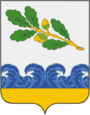
- Герб Сестрорецка и Положение о нём утверждены Постановлением муниципального совета города Сестрорецка от 23 февраля 2000 года № 148. Официальное описание герба муниципального образования «город Сестрорецк» [56] :
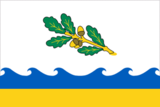
«В серебряном поле золотая дубовая ветвь с зелёными листьями и золотыми желудями в зелёных чашечках в косвенный пояс, золотая оконечность окаймлена лазурью (синим, голубым) в виде бурных волн, бегущих от середины в стороны».
Две волны на гербе символизируют Финский залив и озеро Сестрорецкий Разлив, между которыми расположен Сестрорецк. Дубовые листья напоминают, что городской парк «Дубки» — ровесник города — и символизируют основание Сестрорецка Петром I в 1714 году.
Архитектура и достопримечательности
Парк «Дубки»
На выступающем в Финский залив мысу расположены Сестрорецкие «Дубки» (1719, архитектор С. ван Звитен, садовый мастер О. Удельфельт) — парк с голландским садом, гидротехническими сооружениями и оборонительным валом.
В начале XVIII века здесь находилась одна из загородных резиденций Петра I . К 1722 году на длинной песчаной косе был построен каменный трёхэтажный дворец, соединённый галереями с деревянными павильонами, к дворцу примыкали фруктовые сады и большой пруд. Во время русско-шведской войны 1741—1743 годов в «Дубках» были построены фортификационные валы для защиты от возможного десанта. Сильная буря в 1743 году повредила сооружения гавани и дворец, который был разобран в 1782 году на хозяйственные нужды. Крепостные валы использовались во время Крымской войны — 14 июня 1855 года , когда соединённый англо - французский флот в течение нескольких часов обстреливал Сестрорецк, но на высадку десанта так и не решился.
В парке организована благоустроенная зона отдыха.
| Дубовая роща Петра I в парке. Фото 1900-х годов | Дубовая роща. Фото 1900-х годов | Мост над дренажом в парке зимой | Оборонительный вал в парке |
Другие достопримечательности
- Разрушенная туберкулёзная больница — рядом с платформой Разлив. Она была построена в конце XIX века , и там до революции располагался дом призрения. Затем здание было переоборудовано для лечения открытых форм туберкулёза . В 1980 году больница была закрыта в связи со снижением количества туберкулёзных больных. На развалинах этой больницы снимался фильм « Чистилище ». Комплекс снесён в 2010 г. На его месте строится жилой «Дом у Разлива».
- Особняк в Сестрорецке (XX век, улица Григорьева, 4) — деревянный особняк. Снесён в 2014 году.
- Беседка Сестрорецка — деревянная беседка, являлась долгие годы визитной карточкой, символом города, сейчас в руинах. Сейчас по улице Токарева у дома № 1 установлена точная копия беседки.
- Дача Е. Ф. Важевской (1907, улица Андреева, 12) — деревянная дача, в традициях русского народного зодчества с элементами модерна . По состоянию на 2014 год руинирована.
- Дача Я. М. Гольденова (1908, архитектор С. Г. Гингер , проспект М. Горького, 20). В 2010 году снесена, к 2014 году построен похожий новодел.
- Дача Клячко (1908, архитектор С. Г. Гингер, Лесная улица,7).
- Дача С. И. Дворжецкого (1909, архитектор С. Г. Гингер, Оранжерейная улица,3)
- Нудистский пляж Дюны
- Шалаш Ленина (1927, архитектор А. И. Гегелло ) — гранитный памятник-шалаш, музей, посвящённый событиям лета 1917 года , когда В. И. Ленин был вынужден скрываться от преследований Временного правительства .
- Музей «Сарай» — на чердаке этого сарая от полиции Временного правительства в июле 1917 года скрывался В. И. Ленин.
| Беседка Сестрорецка . Фото 1900-х годов | Дача Клячко | Гранитный памятник-шалаш | Музей «Сарай» |
- Горское кладбище — с братскими могилами советских воинов, погибших в Великой Отечественной войне.
- Мемориальное военное захоронение — братская могила времён Великой отечественной войны на Сестрорецком кладбище.
- Могила М. М. Зощенко (1960-е, скульптор надгробия В. Ф. Онежко) — на Сестрорецком кладбище . Писатель-сатирик Михаил Зощенко жил в Сестрорецке с начала 1930-х по 1958 год .
- Мемориал «Сестра» (1966, архитекторы М. Е. Колосовский, Л. М. Берлинерблау) — мемориал в память обороны города в 1941—1944 годы в Зелёном поясе Славы .
- Памятник (малая архитектурная форма) Петру I (2000, скульптор В. А. Петров, архитектор В. С. Василевский) — памятник основателю города.
- Памятник С. И. Мосину (малая архитектурная форма)(2001, скульптор Б. А. Петров , архитектор А. Г. Бакусов ) — памятник известному оружейнику, работавшему и возглавлявшему Сестрорецком оружейном заводе
- Церковь Святых равноапостольных Петра и Павла (2009, архитектор Е. Ф. Шаповалова) — действующая православная церковь в неорусском стиле .
- Сестрорецкий рубеж — выставочный комплекс М. П. К. « Сестрорецкий рубеж »: артиллерийский полукапонир и малые огневые точки вокруг него. [57] .
- Памятник В. М. Боброву — памятник (малая архитектурная форма)выдающемуся советскому футболисту и хоккеисту (скульптор А. Г. Дема; памятник открыт 7 декабря 2002 года, находится в сквере на Дубковском шоссе).
- Кирха Святого Николая в Сестрорецке — лютеранская церковь в городе Сестрорецк, центр бывшего капельного прихода фин. Евангелическо-лютеранской Церкви Ингрии (не сохранилась).
| Памятник С. И. Мосину в Сестрорецке | Мемориал «Сестра» | Памятник Петру I | Церковь Петра и Павла . Иордань на берегу Сестрорецкого Разлива | Памятник Боброву в Сестрорецке в сквере на Дубковском шоссе |
Планировка города
Город Сестрорецк расположен на перешейке между Финским заливом и озером Сестрорецкий Разлив. Осью города являются Приморское шоссе ( автомагистраль «Скандинавия» ) и железная дорога, идущие с севера на юг. На север они ведут к Белоострову и далее на Выборг и к финляндской границе, на юге — к Санкт-Петербургу. Через юг Сестрорецка (в Горской) проходит Санкт-Петербургская КАД , идущая с востока на запад, на дамбу и далее в Кронштадт .
Economy
Рекреационные учреждения
В городе 23 учреждения рекреационного обслуживания: санатории «Сестрорецк», «Сестрорецкий Курорт», «Белые Ночи», «Дюны», детские санатории (бывшие пионерские лагеря) « Детские Дюны », «Юный Связист», базы отдыха «Александровская», «Лагуна», «Северо-западный СГЭМ», военный санаторий «Тарховский», туристская база «Разлив», дом отдыха Северо-западного пограничного округа, отель-санаторий «Скандинавия», пансионат «Дюны», гостиницы «Ретур», «Белое и чёрное», «Тайм-Аут», гольф-клуб «Дюны», Яхт-клуб и другие.
| Главное здание санатория « Сестрорецкий Курорт » | Санаторий «Скандинавия» | Военный санаторий | Тренировочный городок гольф-клуба «Дюны» |
Промышленность и транспорт
В городе несколько промышленных предприятий: Сестрорецкий автомобильный завод «Хёндэ» , Хлебозавод, Швейная фабрика «Салют» [58] . Сестрорецкий инструментальный завод , ранее являвшийся центральным предприятием города, в 2008 году был закрыт.
В городе развитая сеть социальных автобусов (12 маршрутов) и коммерческих маршрутных такси (9 маршрутов).
Пригородные маршруты соединяют город Сестрорецк с Санкт-Петербургом (станции метро Чёрная речка , Старая Деревня , Площадь Ленина , Парнас, Проспект Просвещения, Гражданский Проспект), Кронштадтом , Зеленогорском , населёнными пунктами Курортного района .
Через Сестрорецк проходит железнодорожная линия Санкт-Петербург ( Финляндский вокзал ) — Белоостров . В городе одна железнодорожная станция — Сестрорецк , пять железнодорожных платформ — Горская , Александровская , Тарховка , Разлив и Курорт [59] .
Торговля и сфера услуг
Сегодня Сестрорецк насыщен объектами социальной и торговой инфраструктуры. Город активно осваивают крупные торговые сети, такие как « Пятёрочка », « О'Кей » и другие [58] .
Входит в зону покрытия всех основных сотовых сетей.
Social Sector
Учреждения культуры и образования
В Сестрорецке действуют Центральная библиотека имени М. М. Зощенко , Центральная детская библиотека , Народный литературный музей Остапа Бендера , Дом культуры города Сестрорецка, Дом детского и юношеского творчества «На реке Сестре» [58] .
Среди учреждений образования: 6 средних общеобразовательных школ , гимназия № 433, 8 детских садов и яслей, Вечерняя (сменная) общеобразовательная школа № 669, Специальная (коррекционная) школа № 656, Колледж экономики и управления Национального открытого института России [58] .
Healthcare
В настоящее время в Сестрорецке работают следующие медицинские учреждения: городская больница № 40, поликлиника № 68, детская поликлиника, санаторий «Сестрорецкий курорт», санаторий «Белые ночи», санаторий «Дюны», детский санаторий « Детские Дюны », а также большое количество частных медицинских учреждений разного профиля [58] .
Sports
В городе работают общеобразовательная школа-интернат по велоспорту «Олимпийский резерв», Детско-юношеская спортивная школа олимпийского резерва имени В. Коренькова, Конно-спортивная база и гольф-клуб при санатории «Дюны», конно-спортивный клуб «Дибуны» [58] .
Особенности побережья делают Сестрорецкие пляжи очень популярными для кайтсерфинга.
С 1998 года проходит « Ралли Сестрорецк», один из этапов Чемпионата России. Трасса проходит по дачным местам Санкт-Петербурга [60] . В 2016 году в Сестрорецке впервые прошел трейл «Белая ночь» . Трасса соревнований (дистанции 10 и 20 км) проложена по кромке Финского залива.
В литературе и искусстве
Упоминается в повести Н. С. Лескова « Левша » под шведским названием Сестербек.
See also
- Сестрорецкий рубль
- Флаг Сестрорецка
Notes
- ↑ город Сестрорецк является внутригородским муниципальным образованием Санкт-Петербурга
- ↑ 1 2 Численность постоянного населения в разрезе муниципальных образований Санкт-Петербурга по состоянию на 1 января 2019 года . Дата обращения 27 апреля 2019.
- ↑ О территориальном устройстве Санкт-Петербурга (с изменениями на 15 октября 2015 года) .
- ↑ 1 2 3 4 5 Курорты. Encyclopedic Dictionary. Главный редактор Е. И. Чазов. — М.: Советская энциклопедия, 1983. С.309
- ↑ С.-Петербург-Фин.- Белоостров
- ↑ 1 2 Даринский А. В. География Ленинграда. — Л. : Лениздат, 1982. — С. 12—18.
- ↑ 1 2 Даринский А. В. География Ленинграда. — Л. : Лениздат, 1982. — С. 21—29.
- ↑ Метеорологическая карта // Атлас Ленинградской области. — М. : ГУГК при СМ СССР, 1967. — С. 20—24.
- ↑ Погода и климат
- ↑ Даринский А. В. География Ленинграда. — Л. : Лениздат, 1982. — С. 45—49.
- ↑ Охотничье-промысловые звери, птицы и рыбы // Атлас Ленинградской области. — М. : ГУГК при СМ СССР, 1967. — С. 36—37.
- ↑ 1 2 Росбалт. RU. «Сестрорецкое болото» стало самой большой особо охраняемой территорией Петербурга (недоступная ссылка)
- ↑ Населённые места Российской империи в 500 и более жителей с указанием всего наличного в них населения и числа жителей преобладающих вероисповеданий, по данным первой всеобщей переписи населения 1897 года / предисл.: Н. Тройницкий. - Санкт-Петербург : типография «Общественная польза», 1905. - X, 270, 120 с. ; 27. - (Первая всеобщая перепись населения Российской империи 1897 года / под ред. Н. А. Тройницкого) . The appeal date is August 17, 2013. Archived August 17, 2013.
- ↑ Города Союза ССР / НКВД РСФСР, Стат. отдел. — М., 1927
- ↑ Всесоюзная перепись населения 1926 года = Recensement de la population de L'URSS 1926 / Центральное статистическое управление СССР; Отд. переписи. T.2. Западный район. Центрально-Промышленный район: народность, родной язык, возраст, грамотность. — М.: Изд. ЦСУ СССР, 1928
- ↑ Всесоюзная перепись населения 1937 года: Общие итоги. Сборник документов и материалов — М., 2007, с. 69
- ↑ РГАЭ, ф. 1562, оп. 336, д. 1248, лл. 83—96.
- ↑ ЦГА СПб., ф. 95, оп. 6, д. 5, л. nineteen.
- ↑ ЦГА СПб., ф. 95, оп. 6, д. 10, л. 25
- All-Union census of the population in 1959 . Archived August 23, 2011.
- ↑ All-Union Population Census 1970 . Архивировано 24 августа 2011 года.
- ↑ 1979 All-Union Population Census . Архивировано 24 августа 2011 года.
- All-Union Population Census 1989. Urban population . Archived August 22, 2011.
- ↑ All-Russian census of 2002. Tom. 1, table 4. The population of Russia, federal districts, constituent entities of the Russian Federation, districts, urban settlements, rural settlements — regional centers and rural settlements with a population of 3,000 or more . Archived on February 3, 2012.
- ↑ 2010 All-Russian Population Census. Санкт-Петербург . Дата обращения 14 августа 2014. Архивировано 14 августа 2014 года.
- Population of the Russian Federation by municipalities. Table 35. Estimated number of resident population on January 1, 2012 . The date of circulation is May 31, 2014. Archived May 31, 2014.
- ↑ Population of the Russian Federation by municipalities as of January 1, 2013. - M .: Federal State Statistics Service Rosstat, 2013. - 528 p. (Table 33. Population of urban districts, municipal districts, urban and rural settlements, urban settlements, rural settlements) . The appeal date is November 16, 2013. Archived November 16, 2013.
- ↑ Table 33. The population of the Russian Federation by municipalities as of January 1, 2014 . Circulation date August 2, 2014. Archived August 2, 2014.
- ↑ Population of the Russian Federation by municipalities as of January 1, 2015 . Circulation date August 6, 2015. Archived August 6, 2015.
- Population of the Russian Federation by municipalities as of January 1, 2016
- ↑ Population of the Russian Federation by municipalities as of January 1, 2017 (July 31, 2017). The date of circulation is July 31, 2017. Archived July 31, 2017.
- ↑ Population of the Russian Federation by municipalities as of January 1, 2018 . The appeal date was July 25, 2018. Archived July 26, 2018.
- ↑ Хазанович К. К. Геологические памятники Ленинградской области. — Л.: Лениздат, 1982.
- ↑ 1 2 Давиденко А. И. Сестрорецк. — Л. : Лениздат, 1962. — С. 10—11. — (Города Ленинградской области).
- ↑ 1 2 Давиденко А. И. Сестрорецк. — Л. : Лениздат, 1962. — С. 11—12. — (Города Ленинградской области).
- ↑ Давиденко А. И. Сестрорецк. — Л. : Лениздат, 1962. — С. 17. — (Города Ленинградской области).
- ↑ Давиденко А. И. Сестрорецк. — Л. : Лениздат, 1962. — С. 19. — (Города Ленинградской области).
- ↑ 1 2 3 4 5 6 Санкт-Петербург: Энциклопедия. - SPb. : Бизнес-Пресса, 2006.
- ↑ Муниципальное образование город Сестрорецк
- ↑ Давиденко А. И. Сестрорецк. — Л. : Лениздат, 1962. — С. 19—20. — (Города Ленинградской области).
- ↑ 1 2 3 4 Города России: энциклопедия / Гл.ред. Г. М. Лаппо. — М.: Научное издательство «Большая Российская энциклопедия»; ТЕРРА-Книжный клуб, 1998
- ↑ 1 2 Сестрорецкий Разлив: История формирования ландшафтов — Река Сестра как устойчивый пограничный рубеж Окрестности Петербурга
- ↑ Давиденко А. И. Сестрорецк. — Л. : Лениздат, 1962. — С. 23—24. — (Города Ленинградской области).
- ↑ Давиденко А. И. Сестрорецк. — Л. : Лениздат, 1962. — С. 27—28. — (Города Ленинградской области).
- ↑ 1 2 САНКТ-ПЕТЕРБУРГСКАЯ ЕПАРХИЯ. Петропавловская церковь
- ↑ Железные дороги Сестрорецка. Страницы истории (недоступная ссылка) . Дата обращения 7 января 2010. Архивировано 16 октября 2008 года.
- ↑ Информация получена от директора музея Сестрорецкого Курорта Ривкина Бориса Еремеевича
- ↑ Давиденко А. И. Сестрорецк. — Л. : Лениздат, 1962. — С. 32—33. — (Города Ленинградской области).
- ↑ 1 2 3 Санаторий «Сестрорецкий курорт»
- ↑ Давиденко А. И. Сестрорецк. — Л. : Лениздат, 1962. — С. 122. — (Города Ленинградской области).
- ↑ ИСТОРИЯ ГОРОДА СЕСТРОРЕЦКА
- ↑ «Вода живая». Патриарх Кирилл освятил храм святых апостолов Петра и Павла в Сестрорецке
- ↑ 25 декабря 2004 года. Торжественная церемония по случаю приемки очистных сооружений в Сестрорецке (недоступная ссылка) . Дата обращения 13 декабря 2009. Архивировано 21 февраля 2005 года.
- ↑ Сестрорецк Жемчужина Края
- ↑ Поспелов Е. М. Географические названия мира: Топонимический словарь.— 2-е изд., стереотип.— М.: Русские словари, ООО «Издательство Астрель», ООО «Издательство АСТ», 2001
- ↑ Геральдикум
- ↑ Сестрорецкий рубеж
- ↑ 1 2 3 4 5 6 Жёлтые страницы Санкт-Петербург
- ↑ Маршруты общественного транспорта Санкт-Петербурга
- ↑ История ралли Сестрорецк (недоступная ссылка) . Дата обращения 22 ноября 2009. Архивировано 21 мая 2008 года.
Literature
- «Сестрорецк». Серия: В помощь экскурсанту. — Издательство «Прибой», 1930. — Мягкая обложка, 18 с. — Тираж 25000 экз.
- А. И. Давиденко . «Сестрорецк. Очерки по истории города». — Л. : Лениздат, 1962. — (Города Ленинградской области). , Суперобложка, 212 с., тираж: 25000 экз.
- М. К. Олейников. «Сестрорецк».- Л.: Лениздат, 1965 г.- 51 с.: ил. (Туристу о Ленинграде).
- Л. И. Амирханов , Р. Н. Гараева , В. А. Дорогин, О. Г. Растворова «История Сестрорецка и его окрестностей (комплект из 4 книг)». Ed. Остров, 880 с., тираж 2000 экз., 2006 г. ISBN 5-94500-047-7 , ISBN 978-5-94500-054-4 , ISBN 978-5-94500-063-6 , ISBN 978-5-94500-065-0 ;
- В. Д. Яковлев «Мой Сестрорецк» Изд. Муниципальный Совет города Сестрорецка, 144 с., тираж 2000 экз., 2006 г., ISBN 5-94500-041 (ошибоч.) ;