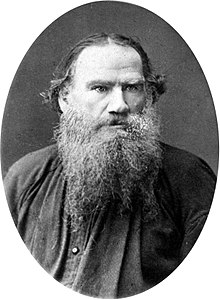
Fatigue is a religious - ethical social movement in Russia in the late XIX - early XX centuries. It arose in the 1880s under the influence of the religious and philosophical teachings of Leo Tolstoy . The foundations of Tolstoy are laid out by Tolstoy in the works Confession , What is My Belief? ”,“ About Life ”,“ Christian Doctrine ”, etc. Followers - Tolstoyans [1] .
Content
History
Tolstoyism arose in the Russian Empire in the 1880s on the basis of the teachings of Leo Tolstoy . He outlined the basics of Tolstoyan Confession , “ What is my faith? ", As well as in the" Kreutzer sonata ". Then colonies of Tolstoyans began to arise in the Tver , Simbirsk , Kharkov provinces and in the Caucasus . These colonies were called "cultural monasteries ." Tolstoyanism found followers in Western Europe , Japan , and India . The supporter of Tolstoyism was, in particular, Mahatma Gandhi . In the 1880-1900s, Tolstoy colonies were created in England and South Africa.
Believers- Dukhobors found Tolstoy’s ideas akin to their own traditions and in 1895 brought them to life, renouncing military service and destroying their weapons, for which they were severely repressed. [2] Subsequently, they also, according to Tolstoy's ideas, refused to use meat, alcohol and tobacco.
The main principles are: non-resistance to evil by violence, universal love and moral self-improvement of a person, simplification (a word invented by Tolstoy himself).
For religious beliefs within the framework of Tolstoyism, syncretism is characteristic. A variety of ideological trends influenced Tolstoy’s life study, but the idea of considering Christianity as a doctrine of non-resistance to evil is independent. Tolstoyans reject the dogmas of an organized church, are anti-Trinitarians [3] .
Vegetarianism , which was followed by the Tolstoyans, was considered deeply unhealthy in the science of that time (after the German dietetics of that time).
The Tolstoyans were actively engaged in the education and dissemination of Tolstoy's views. Tolstoyans V. G. Chertkov and P. I. Biryukov founded the publishing house “ Mediator ”, which published books for the people in mass editions: works by L. N. Tolstoy, G. I. Uspensky , A. P. Chekhov and other writers, manuals on agronomy, veterinary medicine, hygiene. In 1901 - 1905 in London, the Tolstoyans published the newspaper Svobodnoe Slovo .
In the USSR in the 1920s – 1930s, the agricultural communes of the Tolstoyans were mostly liquidated, their participants were repressed [4] , however, some of them existed until the start of World War II.
Now the followers of Tolstoyism survived in Western Europe , North America , Japan , India , Bulgaria and other countries. In Russia, the Tolstoyans religious organization is officially registered, whose members are representatives of the so-called "New Tolstoyans" - a movement that arose relatively recently and significantly differs from the original Tolstoyans. Their number is about 500 people [5] .
An important source on the history of Tolstoyism is the Tolstoyan recollections of L. Tolstoy.
Movement Composition
Already during the life of Tolstoy, this movement was distinguished not by negation, but by freedom from estate and religious frameworks and other formal signs. The princes came to Leo Tolstoy in the same company with the peasants, and the wife of Tolstoy regularly took children to church during the most severe conflicts between Leo Tolstoy and the Synod .
Tolstoy personally or through his works influenced a number of his contemporaries, who are not described as Tolstoyans, but are inconceivable without the influence of Tolstoy, his works and his entourage.
Religion
Tolstoy’s life science was influenced by various ideological trends: Brahmanism, Buddhism , Taoism , Confucianism , Islam , Quakerism , and also the teachings of moral philosophers ( Socrates , late Stoics , Kant , Schopenhauer ) [6] . The idea of considering Christianity as a doctrine of non-resistance to evil is independent. Tolstoy denied the resurrection of Christ, Christianity is perceived by him only as an ethical teaching . Tolstoyans reject the dogma of an organized church, public worship, do not recognize the church hierarchy, clergy , but place high on the moral principles of Christianity. Tolstoyans criticized the Orthodox Church and the official religion in general, as well as state violence and social inequality [6] .
For religious beliefs within the framework of Tolstoyism, syncretism is characteristic. Tolstoy believed that "essentially all the definitions of the meaning of life, open to people by the greatest minds of mankind, are the same." Having proposed his interpretations of the Gospel, he believed that he was purifying the teachings of Christ from historical distortions. [6] The Tolstoyans rejected the dogmas of the Christian church, professed anti-Trinitarianism .
Moral, Ethical, and Social Ideology
The main principles are: forgiveness, non-resistance to evil by violence , renunciation of hostility with any people (“love your enemies”), proclaimed by Christ in the Sermon on the Mount, as well as “love for one's neighbor”, moral self-improvement, and simplification . [7] [8] [9]
According to the doctrine, spiritual values are more important than material ones.
... All five commandments have only this one goal - peace between people. It is worth people to believe the teachings of Christ and to fulfill it, and the world will be on earth, and the world is not what people arrange, temporary, random, but the world is general, indestructible, eternal.
The first commandment says: be at peace with everyone, do not allow yourself to consider the other person as insignificant or insane (Matt., V, 22). If the world is broken, then use all your strength to restore it. Serving God is the destruction of hostility (23-24). Make peace at the slightest discord so as not to lose the true life (26). This commandment says it all; but Christ foresees the temptations of the world that violate the world between people, and gives the second commandment - against the temptation of sexual relations that violates the world. Do not look at the beauty of the carnal as fun, avoid this temptation forward (28-30); take a husband one wife, and a wife one husband, and do not leave each other under any pretext (32). Another temptation is the oaths that lead people to sin. Know ahead that it is evil, and do not take any vows (34-37). The third temptation is revenge called human justice; Do not take revenge and do not dissuade yourself from being offended - bear grievances, and do not do evil for evil (38-42). The fourth temptation is the difference of peoples, the enmity of tribes and states. Know that all people are brothers and sons of one God, and do not break the peace with anyone in the name of national goals (43-48). People will not fulfill one of these commandments - the world will be broken. People will fulfill all the commandments, and the kingdom of the world will be on earth. These commandments exclude all evil from human life.
- L. N. Tolstoy, “ What is my faith? "
The implementation of these principles implies the possibility of a moral transformation of society (that is, Tolstoyism includes the idea of attainability of a utopian perspective). It was supposed to create a hostel of free and equal peasants on the site of the existing society and state.
Being consistent pacifists , Tolstoyans refused to perform military service .
In the early period, Tolstoyism had much in common with anarchism , since both movements denied the need for a military-state machine and appealed in return for the mind of the individual, the natural desire for mutual assistance and labor fraternity. However, after the positive reaction of Prince Kropotkin to the beginning of World War I, contacts between the movements were interrupted.
Food Inhibitions
Fasting, if he [the person] is seriously and sincerely seeking a good life, the first thing a person will refrain from will always be eating animal food, because, not to mention the excitement of the passions produced by this food, eating it is directly immoral, since it requires a nasty moral sense of the act - murder, and is caused only by greed, the desire for goodies.
Tolstoyans, as a rule, adhere to vegetarianism , do not drink alcohol and tobacco (these prohibitions are not absolute: for example, Valentin Bulgakov , being arrested by the SS men in Prague , gave the meat of his meager rations to his fellow inmates for the first weeks of his imprisonment, but then, noticing that he was rapidly losing his strength , was forced to abandon vegetarianism). Given the enthusiasm of the Tolstoyans for agriculture, they sought to exclude the possible agricultural exploitation of animals.
Criticism
Church journalist and public figure V. M. Skvortsov raised the issue of “Tolstoyism” at the 3rd All-Russian Missionary Congress in 1897 in Kazan [10] ; “According to the study of Tolstoy’s heretical philosophies scattered in many of his religious treatises <...>, the congress of missionary experts already recognized the Tolstoy religious movement as a religious and social sect , extremely harmful not only in church but also in political terms.” [ten]
The official (unofficial) public-church edition of the Missionary Review in 1906, after the Decree of the Holy Synod on the "Departure" of Count Tolstoy from the Church in 1901, printed in an article signed by priest E. Zubarev, lengthy extracts from the newly published full collection of religious -philosophical writings of Leo Tolstoy, concluding: "Under the evidence of Leo Tolstoy from the Gospel, it would be entirely possible to sign if he understood the true, not his gospel, under him." [eleven]
- The Russian poet Innokenty Annensky wrote in the “Books of Reflections”: “You can’t always subordinate nature and human life to fiction. The gospel created Christianity, that is, the whole world. Tolstoy created thick-neckedness that is certainly lower than even his fiction ...”
See also
Famous TolstoyansFor an extended list, see Wikipedia: To Creation / List of Tolstoyans
| Components of sweatshirt
Influenced by the Tolstoy movement
Templates
|
Notes
- ↑ Vorobyeva M.V. Christian Difference: Vocabulary. - St. Petersburg: Publishing House of St. Petersburg. University, 2004 .-- 96 s.
- ↑ Questions of L. N. Tolstoy to Dukhobor , with comments by O. A. Golinenko
- ↑ Anti-Trinitarians .
- ↑ Source?
- ↑ Taevsky D. Sects of the world .. - Rostov-on-Don, St. Petersburg.: Phoenix, 2007. - 571 p. - ISBN 978-5-222-11854-2 .
- ↑ 1 2 3 A. A. Huseynov TOLSTVITY // New Philosophical Encyclopedia: In 4 vols. / Ed. V. S. Styopina . - M.: Thought, 2001.
- ↑ Tolstoyanism // Great Soviet Encyclopedia : [in 30 vol.] / Ch. ed. A.M. Prokhorov . - 3rd ed. - M .: Soviet Encyclopedia, 1969-1978.
- ↑ Tolstoyanism (inaccessible link from 06/14/2016 [1180 days]) // Explanatory dictionary of the Russian language Ushakov
- ↑ Tolstoyanism (unavailable link from 14-06-2016 [1180 days]) // Dictionary of Social Sciences. Glossary.ru
- ↑ 1 2 Skvortsov V.M. Foreword of the publisher // Regarding the falling away from the Orthodox Church of Count Leo Tolstoy. Collection of articles "Missionary Review". St. Petersburg, 1904, p. III.
- ↑ L. N. Tolstoy on the revolution // "Missionary Review", 1906, No. 11, p. 697.
- ↑ See Buddhism in Japan about it, Moscow, 1993; Tolstoy's doctrine and socio-religious movement Ittoen: an unknown letter from Nisida Tenko L.N. to Tolstoy // 『言語 文化』 12 巻 1 号 167-190 頁 2009 大学 ・ 研究所 等 紀要 (2) (link not available) ; A. L. Tolstaya. Part III. 13. The sect of Ittoen // Daughter *. Canada, 1979; M., 1992, 2000, 2001
- ↑ Vietnamese Masons and St. Lenin , Leo Tolstoy as a mirror of Vietnamese spiritualism (about the Kaodai religion)
Literature
- Krivenko S.N. At the Crossroads. - 2nd ed. - M., 1901.
- Sventitsky V.P. Religion of "common sense" // Living Life. - 1907. - No. 1. S. 47-56.
- Prugavin A. S. About Leo Tolstoy and the Tolstoyans. - M., 1911.
- Bulgakov V. F. Come to your senses, people-brothers! The history of the appeal of like-minded Leo Tolstoy against the world war of 1914-1918 . T. 1. - M., Zadruga, 1922.
- Klibanov A. I. "Religious sectarianism and modernity." M., "Science", 1969
- Bulgakov V.F. About Tolstoy. Memories and stories. (unavailable link from 11-05-2013 [2310 days]) Compilation, introductory article and notes by A. I. Shifman, Doctor of Philology. Tula, Priok. Prince Publishing House, 1978. 479 + 8 p.
- Popovsky M. A. Russian men tell. The followers of Leo Tolstoy in the Soviet Union 1918-1977 . L., 1983
- Mazurin B.V. A story and reflection on the history of a Tolstoyan commune, "Life and Labor." - New world. 1988, No. 9
- Sinyavsky B. According to the precepts of Leo Tolstoy. - News. 01/07/1989.
- Roginsky A. B. Memoirs of Tolstoyan Peasants. 1910s - 1930s - M .: Book, 1989.
- Edgerton W. Tolstoy and the Tolstoyans / Per. from English D.A. Karelsky // New World . - 1989. - No. 3.
- Materials about Tolstoyans from sb. "Return of memory." (Return of memory. Historical and journalistic almanac. Issue 1-3. Novosibirsk, 1991-1997.)
- M. A. Rashkovskaya, E. B. Rashkovsky “Dear brothers and sisters ...” // Religions of the world. History and modernity. 1989-1990, M., "Oriental literature", 1993
- Lurie, Y. S. After Leo Tolstoy. Tolstoy's historical views and problems of the 20th century , St. Petersburg, “Dmitry Bulanin”, 1993 - chapters: Tolstoyans and Bolsheviks , Conclusion. Tolstoy on the threshold of the 21st century .
- Shentalinsky V. The denunciation of Socrates // "New World" 1996, No. 11
- Edgerton W. The mystery of the influence of the teachings of L. Tolstoy on the world community // "Non-violence as a worldview and lifestyle", M., IVI RAS, 2000.
- Meleshko E. D. “The Christian Ethics of L. N. Tolstoy” , M., “Science”, 2006
- Yordanov Y. Collection of "Tolstoyism-divine abilities for a person" . Varna 2008 (Bulgarian)
- Petukhova T. V. "Commons and artels of the Tolstoyans in Soviet Russia (1917-1929) , Ulyanovsk, Ulyanovsk State Technical University, 2008
- Tolstoy L. N. Against the Trinity
- Tolstoy L.N. against the deification of Jesus.
- Tolstoy L.N. against 7 sacraments.
- Tolstoy L.N. denies Jesus as the Redeemer.
- Tolstoy L. N. Criticism of Orthodox worship
- Chudinovskikh E. N. The Society of True Freedom in Memory of L. N. Tolstoy in Urzhum , GOU Gaspiko, 2010
Links
- The site of close associates of Leo Tolstoy's “Green Stick”
- Section dedicated to Leo Tolstoy and his followers in the project “Beyond Violence”
- Official site of the Ural Tolstoy Society
- The site of the neotolstovets Marcel from Kazan
- Friends of Tolstoy Website - created by Canadian Doukhobors
- Nonresistance.org website - works by L. N. Tolstoy on the topic of non-violence with annotations
- Tolstoyanism / Journalism, publications of Tolstoyans