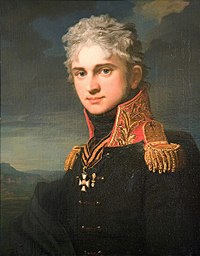
Count Pavel Aleksandrovich Stroganov ( June 7 [18], 1774 , Paris - June 10 [22], 1817 , near Copenhagen ) - Lieutenant General , Adjutant General of the Stroganovs . During the French Revolution, was listed as a member of the Jacobin club ("citizen Ocher"). Member of the Secret Committee . Hero of wars with Napoleon . The family was known by the name "Popo".
| Pavel Aleksandrovich Stroganov | ||||||||
|---|---|---|---|---|---|---|---|---|
 | ||||||||
| Date of Birth | June 7 (June 18 ) 1774 | |||||||
| Place of Birth | Paris , France | |||||||
| Date of death | June 10 (June 22 ) 1817 (43 years old) | |||||||
| Place of death | near Copenhagen , Denmark | |||||||
| Affiliation |  Russian empire Russian empire | |||||||
| Type of army | Infantry | |||||||
| Years of service | 1791 - 1817 | |||||||
| Rank | lieutenant general adjutant general | |||||||
| Commanded | Grenadier Life Guards Regiment | |||||||
| Battles / wars | Third Coalition War War of the fourth coalition Russian-Swedish war (1808-1809) Russian-Turkish war (1806-1812) Patriotic War of 1812 War of the sixth coalition | |||||||
| Awards and prizes |
| |||||||


Content
Dispute over date of birth and early years
The exact year of birth of Pavel Stroganov is unknown. N.M. Kolmakov claimed that Paul was born on June 7, 1774, the 1774 year of birth is also indicated on the tombstone of Paul [1] . Paul himself believed that he was born in 1772 [2]
In any case, Pavel was born in Paris in the family of the Count of the Holy Roman Empire, who later received the count title of the Russian Empire, Alexander Sergeyevich Stroganov and his second wife (since 1769) Ekaterina Petrovna Trubetskoy , who was the daughter of Prince Peter Nikitich Trubetskoy . The godfather of Pavel Alexandrovich Stroganov was the Russian emperor Pavel I , and the childhood friend - Tsarevich Alexander Pavlovich . After the death of Alexander Sergeevich Stroganov in 1811, his entire multi-million state passed into the hands of his only son - Pavel Alexandrovich.
Immediately after the wedding of Alexander Sergeyevich Stroganov with Ekaterina Petrovna Trubetskoy in July 1769, the couple left for Paris, where they were introduced to the court of Louis XVI and Marie Antoinette .
In 1779, after a ten-year stay in France, Paul's parents returned to St. Petersburg . In 1779, his father entrusted the education of his son to the educator Charles-Gilbert Romm , who had lived in Paris since 1774 and earned his living in mathematics [3] .
In 1779, Paul’s mother left his father for the sake of the favorite of Empress Catherine II Ivan Rimsky-Korsakov . His father was eventually forced to raise his son alone. To hide the family discord from the boy, his father decided to send him on a trip with his teacher.
In September 1779, the Stroganovs moved to Russia [4] . There Romm and Pavel Stroganov (“Popo,” as his family called him) lived until 1786 [5] . The young count made a long journey through Russia (1784), having visited the shores of Lake Ladoga and also visited the Grand Duchy of Finland , and having returned to Russia - Moscow , Kazan , Nizhny Novgorod , Perm . In 1785, together with the teacher, he visited Valday , Novgorod , Moscow and Tula . A year later, he embarked on a new trip: he went to Little Russia , New Russia and the Crimea . Stroganov and Romm also visited the Urals [6] .
Paul considered French his native language, but upon arrival in Russia he was taught the Orthodox faith and the Russian language [7] . Thus, in Russia, from 7 to 12 years old, Paul systematically studied only the Russian language and religion [8] . This was due to the fact that Romm was guided by the theory of Jean-Jacques Rousseau , which suggested that regular classes with a child should begin at the age of 12 years [9] . As a result, Paul became very religious. Romm wrote about him [10] :
He has a particularly keen interest in scripture. In those moments when we can read, I offer him various interesting works that he could listen to with pleasure, but he constantly prefers the Old or New Testament
As a result, there were constant skirmishes between Romm and Paul. Romm unsuccessfully tried to raise a “natural” person from Paul, complained about his “excessive liveliness”, “inertness and laziness” [11] . The teacher and student quarreled, did not talk for many days, communicated exclusively in writing [12] .
In 1786 he received the rank of second lieutenant of the Preobrazhensky regiment's Life Guard, and was enlisted even earlier - in 1779, as a cornet of the Horse Guards regiment . At that time, Stroganov served under Prince Grigory Alexandrovich Potemkin , who gave him permission to leave Russia to complete his education. In 1786, the young man left Russia accompanied by Romm, serf artist Andrei Voronikhin (who later became a famous architect) and his cousin, Grigory Alexandrovich Stroganov. In the period from 1786 to 1789, Pavel Stroganov traveled throughout Europe, visited many European countries, such as Switzerland , Italy , Austria , Prussia and France, and, according to some reports, even visited Great Britain . He initially visited Roma, the hometown of Romm, and from 1787 began studying botany at the University of Geneva . Later, Stroganov took up the study of theology, as well as chemistry and physics. In addition, he practiced in the German language and engaged in various sports, primarily fencing and horse riding. In his free time he went hiking in the mountains and was engaged in amateur mineralogy. At the end of May 1788, Romm and Count Paul left Switzerland, moving first to Auvergne, where the house belonged to Romm's mother, visited Creusot and Lyon , and then moved to Paris, where the revolution was just breaking out [13] . Paul wrote to his father that they went to Paris in connection with the upcoming convocation of the General States [14] .
French Revolution
Stroganov’s arrival in Paris coincided with the election of deputies to the Constituent Assembly . At the insistence of his teacher, Stroganov changed his name, never mentioned his title and became known as Paul Ocher (taking this name in honor of the Stroganov estate in the Perm province ; now Ocher ).
In Paris, Pavel continued to study actively: a German teacher was hired, and then the count attended martial arts classes with his brother Gregory [15] . Judging by the correspondence of Romm, until May 1789, the teacher and Pavel almost did not devote time to politics, but concentrated on studying the sciences [16] .
In May 1789, Romm and Paul began to regularly visit Versailles, where the States General met. [17] In Versailles, Romm rented an apartment where he lived with Paul until the National Assembly moved to Paris [18] .
On January 10, 1790, Romm created a small club, the Society of Friends of the Law, where Paul was registered as a librarian [19] . However, at all meetings of the club, Pavel was silent [20] . In a letter dated March 18, 1790, Alexander Stroganov recommended Romm to take Paul away from Paris [21] . Romm ignored the advice.
On June 19, 1790, Romm organized festivities to mark the anniversary of the oath in the ballroom [22] . They were attended by Pavel Stroganov, as well as later famous revolutionaries: A. Barnav , brothers Charles and Alexander Lamety, A. Duport , M. Robespierre , J. Danton [23] . Stroganov's signature appears under the appeal of the "Society of Oath Friends in the Ballroom", submitted July 3, 1790 to the National Assembly [24] .
On July 16, 1789, Romm received a letter from Alexander Stroganov (dated June 20, 1790) with a categorical demand to leave Paris [25] . However, before leaving, they managed to record Paul in the Jacobin club . On August 7, 1790, according to the certificate of the Jacobin Club, citizen Ocher became its member [26] . On August 10, 1790, the police issued a passport to Romm and Pavel for travel to Riom [27] . Romm himself enrolled in the Jacobin club only three years later - on May 3, 1793 [28] .
Romm and Stroganov moved to Jimot. There, Romm began to prepare for the elections, while Paul remained indifferent to the political activities of his teacher. Niece Romm Miett Tayan wrote to a friend [29] :
You know, my dear friend, they started talking about electing Mr. Romm as a deputy. Such a choice would honor the patriots. The people would receive in his person an ardent defender. In anticipation of the moment when his voice will sound from the rostrum, he uses it to educate fellow citizens. Every Sunday, he gathers around him many peasants, with whom he reads newspapers and explains new laws. <...> Mr. Graf, while his tutor speaks to the inhabitants of Jimot, takes a moment to have fun with the young villagers
Paul expressed his attitude to the revolution in a letter to Demishel in November 1790 [30] :
In a letter that I privately sent to my father and where I could open to him accordingly, I informed how I admire the Revolution, but at the same time let him know what I think
a similar revolution unsuitable for Russia
In November 1790, his cousin N.N. arrived in France for Paul. Novosiltsov , with whom Pavel left for Russia in December 1790 [31] .
Political career
Returning to Russia, the young count settled in the Brattsevo estate near Moscow, where his mother lived. This was not a reference: the authorities did not even prevent Pavel Stroganov from receiving letters from his friends in revolutionary France [32] .
Stroganov was not dismissed from military service, by 1791 he was a lieutenant of the Preobrazhensky regiment, and by 1792 - a junker chamber. There, in Brattsevo, in the spring of 1793, Count Pavel married Princess Sofya Vladimirovna Golitsyna. Stroganov returned to Petersburg at the end of the reign of Catherine.
In 1795, Stroganov met the future Emperor Alexander I , who informed him that he was an "enthusiastic admirer of the French Revolution" and considered himself also a "Jacobin" [33] . Stroganov was alarmed by such moods of the Grand Duke, the count considered that Alexander was in the grip of "dangerous errors" and turned to N.N. Novosiltsov, in order to protect Alexander from rash actions [34] .
After the coup on March 12, 1801, Count Pavel Stroganov was one of the favorites of the young emperor Alexander. In the same year, in July, he presented him with his project of creating a Secret Committee , which would develop plans for reform in the country. Having become the founder and member of this committee, he at one time supported the implementation of liberal reforms and stood at the head of the triumvirate ( Kochubey , Chartorysky and Stroganov). In addition, he was a supporter of the abolition of serfdom .
In 1798 he was promoted to acting chamberlain ; from 1802 to 1807 he was simultaneously secret adviser , senator , vice minister of foreign affairs, and comrade of the minister of internal affairs. In 1806, Alexander I appointed him head of the diplomatic mission to London [35] . His mission was to foster rapprochement between Russia and the United Kingdom. Pavel Alexandrovich began negotiations with the British, trying to form a coalition against Napoleon . During these negotiations, an event occurred that virtually destroyed all his efforts: his friend, Prince Adam Chartorysky , resigned from his post as Minister of Foreign Affairs, and Budberg became his successor. The latter had a deep hostility towards Stroganov, and as a result, Stroganov’s position became unbearable for him, so in August 1806 he left Britain, returning to Russia. In March 1807, he resigned from his post of vice minister of foreign affairs and the post of senator, but did not cease to play an important role in politics, as Emperor Alexander listened to him as a man who knew diplomacy and military affairs well.
Military career
He accompanied the emperor Alexander in the campaign against Napoleon as part of the 3rd coalition and became an involuntary participant in the battle of Austerlitz .
In 1807 he headed the Cossack regiment, joining the military service as a volunteer . August 22, 1807 Pavel Aleksandrovich Stroganov was awarded the Order of St. George 3rd class
in retaliation for the excellent courage and courage shown in the battle of May 24 against the French troops, where, of his own free will, he was under the light troops commanded by Lieutenant General Platov and, having under his command regiments Ataman and Major General Ilovaisky on the 5th, the rapprochement of troops to the river Alla, crossing them over the swim, hit the enemy in the rear, and put a significant number in place and captured 47 officers and 500 lower ranks; after seeing the following enemy convoy, he sent a detachment of Cossacks there, who destroyed the cover, which extended to 500 people, took it and after it attacked the enemy infantry with the regiment of Ilovaisky in the village of Bruzval, from where it forced it out and fled.
On December 21, 1807, he was granted the rank of Major General , which marked the beginning of his active military service. January 27, 1808 joined the ranks of the Life Guards of the Izmailovsky Regiment , as part of which he took part in the Russian-Swedish War of 1808-1809 ; served under the leadership of General Peter Bagration , took part in the capture of the Aland Islands .
[36] by George Dow of the Winter Palace Military Gallery
From 1809 to 1811 he served in the ranks of the Danube Army and showed courage in many battles with the Turks during the armed conflict between the Russian and Ottoman empires. For courage and bravery shown during the battles, he was awarded a gold sword with diamonds and the inscription “For Bravery” [37] , orders of St. Anna of the 1st degree and St. Vladimir of the 2nd degree (in 1809), diamond signs to the Order of St. Anna of 1- 1st degree (in 1810). May 28, 1809 was appointed commander of the Life-Grenadier Regiment and at the same time brigadier chief of the 1st Grenadier Division. November 15, 1811 was promoted to adjutant general .
September 7, 1812 during the Battle of Borodino, commanded the 1st Grenadier Division ; subsequently replaced General Nikolai Tuchkov , who was injured, as commander of the 3rd Infantry Corps. October 30, 1812 he was awarded the rank of lieutenant general . At the head of the 3rd Infantry Corps he participated in the battles of Tarutin (October 18, 1812), near Maloyaroslavets (October 24, 1812) and Krasny (November 15-18, 1812).
From October 16 to October 19, 1813 he participated and distinguished himself in the so-called Battle of the Peoples near Leipzig . For this battle he received the Order of St. Alexander Nevsky . He also led the Russian troops during the assault on the Stade fortress near Hamburg .
In 1814, during a campaign in France, he commanded a corps at the Battle of Craon . For this battle was April 23 (according to other sources - October 28), 1814 was awarded the Order of St. George 2nd class. September 3, 1814 led the 2nd Guards Infantry Division.
Recent years, the establishment of a majorate estate
On February 23, 1814, at the battle of Kraon, the head of the 19-year-old son of Count Paul, Alexander Pavlovich Stroganov , tore the core .
A. S. Pushkin in the draft stanza of the 6th chapter of “Eugene Onegin” wrote the following lines about this event.
But if the reaper is fatal,
Bloodied, blind
In the fire, in the smoke - in the eyes of the father
Slay a flying chick!
Oh fear! oh bitter moment!
O Stroganov, when your son
Fell, slain, and you alone
You forgot the glory and the battle
And betrayed the stranger to fame
Success encouraged by you.
After this tragedy, Count Stroganov plunged into deep melancholy and began to lose interest in life. For two days he searched for the body of his son on the battlefield; then a painful mission was to accompany the body of the young man back to Russia.
The Stroganovs had four daughters, the eldest of whom was Natalya. Not wanting to divide the family estate into a division between four daughters, Count Pavel Alexandrovich together with his wife asked Emperor Alexander I in 1816 to make their immovable possessions a majorate estate.
Shortly thereafter, on June 10, 1817, Count P. A. Stroganov died of consumption on a ship en route to Copenhagen . He was buried at the Lazarevsky cemetery in the Alexander Nevsky Lavra in St. Petersburg.
Спустя два месяца, 11 августа 1817 года, последовал именной, данный Сенату императорский указ, объявлявший, что все недвижимые владения покойного графа Строганова в Пермской, Нижегородской и Санкт-Петербургской губерниях должны «составлять нераздельное имение, и оставаться оному в фамилии графов Строгановых, так, чтобы сие имение навсегда переходило во всей целости от одного лица во владение к другому» [38] .
После кончины своего супруга майоратом Строгановых управляла его вдова. В 1833 году Пермский майорат Строгановых, составлявший 1 551 625 десятин земли, на которых числилось 57 778 душ мужского и 67312 душ женского пола крепостных людей, «был поделён на пять округов: Ильинский — площадью 397 638 дес., Новоусольский — 331 548 дес., Очёрский — 361 142 дес., Иньвенский — 390 179 дес. и Билимбаевский — площадью 71 118 дес.» [39]
После смерти Софьи Владимировны Строгановой в 1845 году Пермский майорат унаследовала старшая дочь Наталья Павловна, которая выдала доверенность на управление майоратом своему мужу Сергею Григорьевичу Строганову. Для другой дочери, Аглаиды, был учреждён майорат на базе имения « Марьино », который перешёл в род Голицыных .
Family
С 1793 года был женат на княжне Софье Владимировне Голицыной (1775—1845), сестре московского генерал-губернатора Д. В. Голицына , дочери «усатой княгини» Н. П. Голицыной . В семье было пятеро детей:
- Александр Павлович (1794 — 23 февраля 1814)
- Наталия Павловна (1796—1872) — единственная наследница строгановского состояния, жена с 1818 года четвероюродного брата барона С. Г. Строганова , которому перешёл графский титул Строгановых.
- Аглая Павловна ( Аделаида ; 1799—1882) — фрейлина, кавалерственная дама ордена св. Екатерины меньшего креста, с 1821 года жена князя В. С. Голицына (1794—1836); с 1845 году стала владелицей Марьино.
- Елизавета Павловна (1802—1863) — жена светлейшего князя Ивана Дмитриевича Салтыкова (1797—1832).
- Ольга Павловна (1808—1837), с 1829 года жена графа П. К. Ферзена (1800—1884).
Alexander
Natalya
Adelaide
Elizabeth
Olga
Notes
- ↑ Ржеуцкий В. С., Чудинов А. В. Русские «участники» Французской революции // Французский ежегодник 2010: Источники по истории Французской революции XVIII в. и эпохи Наполеона. — М., 2010. — С. 10 — 11.
- ↑ Ржеуцкий В. С., Чудинов А. В. Русские «участники» Французской революции // Французский ежегодник 2010: Источники по истории Французской революции XVIII в. и эпохи Наполеона. — М., 2010. — С. 11.
- ↑ Ржеуцкий В. С., Чудинов А. В. Русские «участники» Французской революции // Французский ежегодник 2010: Источники по истории Французской революции XVIII в. и эпохи Наполеона. — М., 2010. — С. 12.
- ↑ Ржеуцкий В. С., Чудинов А. В. Русские «участники» Французской революции // Французский ежегодник 2010: Источники по истории Французской революции XVIII в. и эпохи Наполеона. — М., 2010. — С. 12.
- ↑ Ржеуцкий В. С., Чудинов А. В. Русские «участники» Французской революции // Французский ежегодник 2010: Источники по истории Французской революции XVIII в. и эпохи Наполеона. — М., 2010. — С. 12.
- ↑ Ржеуцкий В. С., Чудинов А. В. Русские «участники» Французской революции // Французский ежегодник 2010: Источники по истории Французской революции XVIII в. и эпохи Наполеона. — М., 2010. — С. 12.
- ↑ Ржеуцкий В. С., Чудинов А. В. Русские «участники» Французской революции // Французский ежегодник 2010: Источники по истории Французской революции XVIII в. и эпохи Наполеона. — М., 2010. — С. 13.
- ↑ Ржеуцкий В. С., Чудинов А. В. Русские «участники» Французской революции // Французский ежегодник 2010: Источники по истории Французской революции XVIII в. и эпохи Наполеона. — М., 2010. — С. 13.
- ↑ Ржеуцкий В. С., Чудинов А. В. Русские «участники» Французской революции // Французский ежегодник 2010: Источники по истории Французской революции XVIII в. и эпохи Наполеона. — М., 2010. — С. 13.
- ↑ Ржеуцкий В. С., Чудинов А. В. Русские «участники» Французской революции // Французский ежегодник 2010: Источники по истории Французской революции XVIII в. и эпохи Наполеона. — М., 2010. — С. 14.
- ↑ Ржеуцкий В. С., Чудинов А. В. Русские «участники» Французской революции // Французский ежегодник 2010: Источники по истории Французской революции XVIII в. и эпохи Наполеона. — М., 2010. — С. 14.
- ↑ Ржеуцкий В. С., Чудинов А. В. Русские «участники» Французской революции // Французский ежегодник 2010: Источники по истории Французской революции XVIII в. и эпохи Наполеона. — М., 2010. — С. 14.
- ↑ Ржеуцкий В. С., Чудинов А. В. Русские «участники» Французской революции // Французский ежегодник 2010: Источники по истории Французской революции XVIII в. и эпохи Наполеона. — М., 2010. — С. 13 — 14.
- ↑ Ржеуцкий В. С., Чудинов А. В. Русские «участники» Французской революции // Французский ежегодник 2010: Источники по истории Французской революции XVIII в. и эпохи Наполеона. — М., 2010. — С. 15.
- ↑ Ржеуцкий В. С., Чудинов А. В. Русские «участники» Французской революции // Французский ежегодник 2010: Источники по истории Французской революции XVIII в. и эпохи Наполеона. — М., 2010. — С. 16.
- ↑ Ржеуцкий В. С., Чудинов А. В. Русские «участники» Французской революции // Французский ежегодник 2010: Источники по истории Французской революции XVIII в. и эпохи Наполеона. — М., 2010. — С. 13.
- ↑ Ржеуцкий В. С., Чудинов А.В. Русские «участники» Французской революции // Французский ежегодник 2010: Источники по истории Французской революции XVIII в. и эпохи Наполеона. - М., 2010. - С. 17.
- ↑ Ржеуцкий В. С., Чудинов А.в. Русские «участники» Французской революции // Французский ежегодник 2010: Источники по истории Французской революции XVIII в. и эпохи Наполеона. - М., 2010. - С. 18.
- ↑ Ржеуцкий В. С., Чудинов А.В. Русские «участники» Французской революции // Французский ежегодник 2010: Источники по истории Французской революции XVIII в. и эпохи Наполеона. - М., 2010. - С. 19.
- ↑ Ржеуцкий В. С., Чудинов А.В. Русские «участники» Французской революции // Французский ежегодник 2010: Источники по истории Французской революции XVIII в. и эпохи Наполеона. - М., 2010. - С. 19.
- ↑ Ржеуцкий В. С., Чудинов А.В. Русские «участники» Французской революции // Французский ежегодник 2010: Источники по истории Французской революции XVIII в. и эпохи Наполеона. - М., 2010. - С. 19 - 20.
- ↑ Ржеуцкий В. С., Чудинов А.В. Русские «участники» Французской революции // Французский ежегодник 2010: Источники по истории Французской революции XVIII в. и эпохи Наполеона. - М., 2010. - С. 20.
- ↑ Ржеуцкий В. С., Чудинов А.В. Русские «участники» Французской революции // Французский ежегодник 2010: Источники по истории Французской революции XVIII в. и эпохи Наполеона. - М., 2010. - С. 20.
- ↑ Ржеуцкий В. С., Чудинов А.В. Русские «участники» Французской революции // Французский ежегодник 2010: Источники по истории Французской революции XVIII в. и эпохи Наполеона. - М., 2010. - С. 20.
- ↑ Ржеуцкий В. С., Чудинов А.В. Русские «участники» Французской революции // Французский ежегодник 2010: Источники по истории Французской революции XVIII в. и эпохи Наполеона. - М., 2010. - С. 20 - 21.
- ↑ Ржеуцкий В. С., Чудинов а.В. Русские «участники» Французской революции // Французский ежегодник 2010: Источники по истории Французской революции XVIII в. и эпохи Наполеона. - М., 2010. - С. 21.
- ↑ Ржеуцкий В. С., Чудинов А.В. Русские «участники» Французской революции // Французский ежегодник 2010: Источники по истории Французской революции XVIII в. и эпохи Наполеона. - М., 2010. - С. 21.
- ↑ Ржеуцкий В. С., Чудинов А.В. Русские «участники» Французской революции // Французский ежегодник 2010: Источники по истории Французской революции XVIII в. и эпохи Наполеона. - М., 2010. - С. 22.
- ↑ Ржеуцкий В. С., Чудинов А.В. Русские «участники» Французской революции // Французский ежегодник 2010: Источники по истории Французской революции XVIII в. и эпохи Наполеона. - М., 2010. - С. 22.
- ↑ Ржеуцкий В. С., Чудинов А.В. Русские «участники» Французской революции // Французский ежегодник 2010: Источники по истории Французской революции XVIII в. и эпохи Наполеона. - М., 2010. - С. 23.
- ↑ Ржеуцкий В. С., Чудинов А.В. Русские «участники» Французской революции // Французский ежегодник 2010: Источники по истории Французской революции XVIII в. и эпохи Наполеона. - М., 2010. - С. 23.
- ↑ Ржеуцкий В. С., Чудинов А.В. Русские «участники» Французской революции // Французский ежегодник 2010: Источники по истории Французской революции XVIII в. и эпохи Наполеона. - М., 2010. - С. 43.
- ↑ Ржеуцкий В. С., Чудинов А.В. Русские «участники» Французской революции // Французский ежегодник 2010: Источники по истории Французской революции XVIII в. и эпохи Наполеона. - М., 2010. - С. 23.
- ↑ Ржеуцкий В. С., Чудинов А.В. Русские «участники» Французской революции // Французский ежегодник 2010: Источники по истории Французской революции XVIII в. и эпохи Наполеона. - М., 2010. - С. 23.
- ↑ Рудаков В. Е. Строгановы // Энциклопедический словарь Брокгауза и Ефрона : в 86 т. (82 т. и 4 доп.). - SPb. , 1890-1907.
- ↑ State Hermitage Museum. Western European painting. Catalog / Ed. V. F. Levinson-Lessing; ed. A. E. Krol , K. M. Semenova. - 2nd edition, revised and supplemented. — Л. : Искусство, 1981. — Т. 2. — С. 254, кат.№ 7872. — 360 с.
- ↑ Э. Э. Исмаилов. Золотое оружие с надписью «За храбрость». Списки кавалеров 1788—1913. — Москва, 2007, с. 94
- ↑ Alexander I. Об утверждении распоряжения в имении покойного графа Строгонова, по наследству в его имении // Полное собрание законов Российской империи с 1649 года. - SPb. : Типография II отделения Собственной Его Императорского Величества канцелярии , 1830. — Т. XXXIV, 1817, № 26995 . — С. 471—474 .
- ↑ Шустов С. Г. Земельные владения рода Строгановых на Урале (1558—1917 гг.) // Историческая и социально-образовательная мысль. — 2013. — Вып. № 6.
Literature
- В. кн. Николай Михаиловичъ Графъ Павелъ Александровичъ Строгановъ. — СПб., 1903 (в 3-х томах).
- Марк Алданов Юность Павла Строганова / Алданов М. Сочинения. Prince 2: Очерки. — М.: Изд-во «Новости», 1995. — С. 7—19.
- Dictionary of Russian generals, participants in the hostilities against the army of Napoleon Bonaparte in 1812-1815. // Russian archive. The history of the Fatherland in the evidence and documents of the XVIII — XX centuries. : Collection. - M .: TRITE studio N. Mikhalkova , 1996. - T. VII . — С. 561-562 . - ISSN 0869-20011 . (Comm. A. A. Podmazo )
- Документы о служебной деятельности гр. П. А. Строганова 1778—1817: в Сенате 1801—1807, по министерствам — Иностранных дел 1778—1809, Финансов 1786—1804, Внутренних дел 1798—1809, Морскому 1802—1805, Военному 1805—1814 (о войнах с Наполеоном I, об Отечественной войне 1812, о заграничном походе русской армии 1813—1815, о войне со Швецией).
- Kuznetsov S.O. Not worse than Thomon. State, philanthropic, collecting activity of the Strogonov clan in 1771-1817. and the formation of the imperial appearance of St. Petersburg. - St. Petersburg .: Nestor, 2006–447 p. - ISBN 5-303-00293-4
- Stroganov, Pavel Alexandrovich // Russian Biographical Dictionary : in 25 volumes. - SPb. - M. , 1896-1918.
- The Stroganovs // Brockhaus and Efron Encyclopedic Dictionary : in 86 volumes (82 volumes and 4 additional). - SPb. , 1890-1907.
- Chudinov A.V. Gilbert Romm and Pavel Stroganov: History of an unusual union . - M.: New Literary Review, 2010—344 p.
- Kuznetsov S.O. Strogonovs. 500 years of kind. Only kings are above. - M-SPb: Tsentrpoligraf, 2012 .-- 558 p. - ISBN 978-5-227-03730-5
Links
- Stroganov Pavel Aleksandrovich - local history encyclopedia of the Ochersky district
- Chudinov A. V. “Russian Jacobin” Pavel Stroganov. Legend and Reality // New and Contemporary History, No. 4/2001
- Chudinov A. V. "Again about Pavel Stroganov"