Amorites , Amorites (the self-name of " Sutia ", that is, the descendants of the legendary forefather Sutu; he is Seth in the synodal translation of the Bible, Shet in Jewish texts) - the nomadic West Semitic people of ancient Near East , who spoke the Amorean language .
Origin
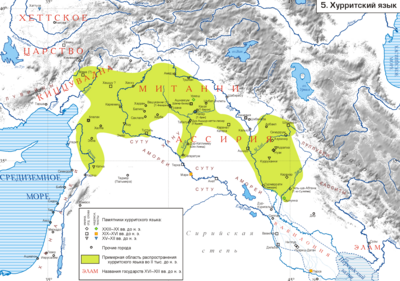
Amorites enter the arena of world history in the III millennium BC. e. as cattle breeders, the Semites wandering in the Syrian steppe between Canaan and Sumer . The oldest Amorean city is Ugarit [1] . According to one version, the Amorites came from Arabia, where they got from North Africa through the Red Sea in the 5th millennium BC. uh . In addition to the Amorites (northwestern Semites, ancestors of the Jews, Canaanites, and Phoenicians), the Akkadians, Proto-Arabs, and the Savites were isolated from the Prasemites [2] . The Amorites originally lived as patriarchal clans. Around the beginning of the XXII century. BC e. the essences are widely spread along the Euphrates to the northwest, occupying the highlands of Jebel Bishri (now their center) and the neighboring regions of Syria , where the local West Semitic people of the Eblaites, broken by Akkadian campaigns (see Akkad ), are assimilated by the campaigns of the previous century; after this, the Mesopotamian name "Amorites" (lit. "Western people") passes on the essence and, as the Eblaites used to call it. In the course of this resettlement, three tribal unions of essences were distinguished: the essence itself (they were Didans) in the northwest, the Canaanites in the center and the bin Yamin in the south and southeast (some researchers believe that the biblical tribe of Benjamin comes from the latter).
History
In the second half of the XXI century BC. e. one group of nomadic Amorite tribes invade Mesopotamia ( Akkad ) from the west [3] , and another invades Canaan [4] . The kings of the 3rd dynasty of Ur built a wall along the edge of the "gypsum" desert from the Euphrates to the Tigris, which was intended to protect Lower Mesopotamia from the north. But the Amorite shepherds, not trying to break south through this desert and the wall built by the tsarist workers, crossed Upper Mesopotamia across from west to east, crossed the Tigris, then through Diyala and began to invade the fields of Lower Mesopotamia from east to west.
It is not necessary to think that the tribes of the Western Semites (Amorites) in Mesopotamia formed some kind of unity. On the contrary, the so-called Amorites were divided into many completely independent from each other and often warring tribes. One part of the Idamaras tribe lived on the Khabur River, on the Middle Euphrates, their sheep were grazed among others - bin-sim'ala , Haneys ('Aneys) and bin-yamin , and their branches under special names were also kept much further south; Thus, between the Euphrates and the Tigris in the Southern Mesopotamia, the tribes of Amnanum, Yakhrurm, Rababum wandered, and maybe a number of others, and at the same time they were part of the Bini Yamin and Haneyans. A part of the Amnanum tribe grazed cattle even far in the south of the country, possibly in the steppes of An-Eden, between Uruk and Ummah , and north of them in the Central Mesopotamia, east and west of Nippur, the Numkhum tribe was kept. The pastures along the Tigris and beyond the Tigris were occupied below the valley of the Diyala River by the tribes of Mutiyabal and Yamambuta, and above Diyala, to the ridge of Jebel Hamrin, by the second part of the Idamaras tribe.
Amorite Kingdoms
In the XIX century BC e. Amorites create three kingdoms in Mesopotamia with centers in Babylon (founder of the Sumu-Abum dynasty), Issin , Aesnunn and Lars , which were united in the next century under the rule of King Hammurabi . Subsequently, the Mesopotamian Amorites repelled the onset of the Kassites from the east. A serious blow to the Amorites in the XVI century BC. e. the Hittites inflicted an invasion of Babylon and actually surrendered Mesopotamia to the rule of the old Kassite enemies [5] .
The creation of the Hammurabi empire and the expansion of the Hurrians in the 18th-17th centuries BC e. became a turning point in the fate of the Amorites. From now on, only Lower Mesopotamia, the Syrian steppe and Zaordanje (the kingdom of Vasan and the union of the “Sons of Shet”) remain the zones of their continuous habitation, while in the northern part, already inhabited mainly by the Hurrians, only individual Amorite tribes remain. Nevertheless, the territory of modern Lebanon and Syria west of the Euphrates was given the name Amurru (that is, the country of the Amorites). There the union of Yamhad is created.
In the XVIII century, the Amorites created a tribal union of the Hyksos , which carries out expansion into Egypt .
Decline
In the XVI century. BC e. the Hittites, together with the Kassites, put an end to Amorite Babylonia. At the same time, the Egyptians, under the leadership of the Theban pharaohs of the XVIII dynasty, put an end to the rule of the Hyksos , expelling them from Egypt and taking control of the territory of Canaan ( Palestine ) and Phenicia ( Lebanon ). Amorites who fled to the Syrian steppe form hapiru units. With the next weakening of Egypt and the beginning of the Aramaic settlement of the XIV century. BC e., Hapira form the unions of Ammon, Israel, Moab and Edom.
It is characteristic that Jebel Bishri is now referred to, not as the "Mountains of the Amorites", but "the Mountains of the Achlamaeans (Aramaic tribe)." At the end of the XIII-XII centuries. BC e. ( Bronze Age catastrophe ) Hebrew tribes destroyed or assimilated the Amorites of Canaan and Zaordan; the last isolated tribes of essences in Mesopotamia were absorbed into the Aramaic environment in the 7th century. BC e.
Amorites in the Bible
According to the Bible, Amorei was the fourth son of Canaan, the son of Ham , and brother of the Hittites and Jebusites ( Genesis 10:15 ). In the era of Abraham, they participated with the army of Sodom in repelling the invasion of the Elamites of Kedorlaomer ( Gen. 14: 7 ). By the time of the invasion of the Jews, the Amorites owned the eastern bank of the Jordan River (between the lands of Vasan and Moab - Num. 21: 13-25 ), as well as a number of cities in southern Canaan , including Jerusalem , Lachish and Hebron ( Nav. 10: 5 ). One of the famous kings of the Amorites was Sihon , who unsuccessfully tried to confront the Israelites ( Numbers 21:21, 24 ). Saul, the founder of the kingdom of Israel and Judea, achieved the complete subjugation of the Amorites ( 1 Sam. 7:14 ), including the inhabitants of Gibeon . Ezekiel calls Jerusalem the daughter of the Amorites ( Ezekiel 16: 4 )
List of Amorite States
In Syria / Levant:
| In Mesopotamia:
|
See also
- Amorean language
- History of Ancient Mesopotamia
Notes
Literature
- "Ancient world history. The origin of the oldest class societies and the first foci of slave civilization. " In 2 volumes. Part 1. "Mesopotamia." Ed. I.M.Dyakonova . Publishing House "Science". M., 1983.
- Assyriology and Egyptology. Collection of articles of St. Petersburg State University ed. prof. N.V. Kozyreva. St. Petersburg: “Scythia”, 2004. - 248 p. ISBN 5-98620-006-3
- Kupper JR Les nomades en Mesopotamie au temps des rois de Mari. Paris, 1957.
- Heltzer M. The Suteans. Naples, 1981.