The Ries – Torin theorem is a statement about the properties of interpolation spaces . It was formulated in 1926 by Marcel Rees [1] , and was formulated and proved in operator form by Olof Torin in 1939 [2] [3] .
According to the theorem, for two spaces and with measures and respectively, and two Banach spaces of complex-valued functions summable with i degree by measure , triple Banach spaces is a normal interpolation type regarding troika , if a:





- and ,
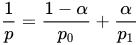
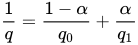
Where [4] . (Three Banach spaces is an interpolation type where relative to troika if it is interpolational and the inequality holds [5] .)



The proof of the theorem uses the theorem on three lines from the theory of analytic functions [6] .
Notes
- ↑ Riesz M., Sur les maxima des formes bilineares et sur les fonctionalles linearies, Acta Math., 49 (1926), 465-497
- ↑ Thorin GO, Anne of convexity Theorem Due to M. Riesz, Comm. Sem. Math Univ. Lund, 4 (1939), 1-5
- ↑ Thorin GO, Convexity theorems generalizing those of M. Riesz and Hadamard with some applications, Comm. Sem. Math Univ. Lund, 9 (1948), 1-58
- ↑ Crane, 1978 , p. 37.
- ↑ Crane, 1978 , p. 36
- ↑ Sigmund A. Trigonometric series, M., Mir, 1965, Vol. II, p. 144-148
Literature
- Kerin S. G. , Petunin Yu. I. , Semenov E. M. Interpolation of linear operators. - M .: Science, 1978. - 400 p.
- Berg J., Löfström J. Interpolation spaces. Introduction - M .: Mir, 1980. - 264 p.