The building of the Synodal Printing House is a building located in the Tverskoy District of the Central Administrative District of Moscow on Nikolskaya Street . It is an architectural monument, an object of cultural heritage of federal significance. It belongs to the printing house complex, which includes the building of the Synodal Printing House [1] , side buildings [2] and the Correct and Book-keeping Chamber [3] .
| Building | |
| The building of the Synodal Printing House | |
|---|---|
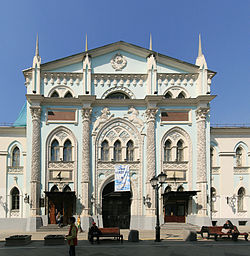 The central part of the building of the Synodal Printing House | |
| A country |  Russia Russia |
| City | Moscow |
| Architectural style | pseudo-gothic (street building), Baroque (side courtyard buildings), Pseudo-Russian (Teremok) |
| Project Author | Alexey Bakarev , Ivan Mironovsky (street building) |
| Building | 1811 - 1814 years |
| Status |  An object of cultural heritage of the peoples of the Russian Federation of federal significance. Reg. No. 771410722580026 ( ЕГРОКН ) An object of cultural heritage of the peoples of the Russian Federation of federal significance. Reg. No. 771410722580026 ( ЕГРОКН ) |
As of 2018, the building houses the Historical Archive Institute of the Russian State Humanitarian University [4] .
Content
History
The construction of the Synodal Printing House began in 1811 on the site of the dilapidated buildings of the Moscow Printing House . Initially, according to the idea of architect Selikhov, it was planned to build a building on the model of old buildings and save the gate. But by order of the head of the Kremlin expedition, Valuev, who was in charge of the printing houses, architects Alexey Bakaryov and Ivan Mironovsky were appointed to prepare the project for the house. Due to the Patriotic War of 1812, the construction of the printing house was completed only in 1814. The buildings of the printing yard complex were perceived as a single architectural ensemble with towers and a wall of Kitai Gorod . During the 19th century, they were completed or remodeled several times in the “ Russian style ”. The facades of the Printing House from the side of the courtyard retained the Baroque appearance [5] [6] [7] .
In 1870, Mikhail Pogodin made a proposal to the City Duma for the purchase and reconstruction of the Synodal Printing House complex for retail premises [8] . A year later, the architect Mikhail Chichagov prepared a project for the reconstruction of the buildings of the printing house’s courtyard, which Nikolay Artleben substantially modified in 1872–1875 [9] . At the same time, the Pravilnaya Chamber ( Teremok ) was rebuilt in the pseudo-Russian style of the 17th century, a new porch was erected. Palekh masters worked on the interior painting [6] . Archaeologist Alexander Veksler dated underground structures under the building at the end of the 15th century, which gives reason to say that the cellars are one of the oldest in Moscow [10] [11] [12] [13] . The superstructure of the third floor and the design of the end faces of the side buildings were made in the 1890s by the architect S. S. Slutsky [14] . At that time, the book depository was restored by the architect Vladimir Gamburtsev [15] and, based on the results of the work, published “Notes on the repair of the Old Printing House at the Moscow Synodal Printing House” [16] .
After the revolution of 1917, the Synodal Printing House was closed, and the printing house of Goznak was placed in its walls. Later, the building housed the Unified Archival Fund, and since 1931 the complex was transferred to the Moscow State Historical and Archival Institute (since 1991 the Historical and Archival Institute of the Russian State Humanitarian University ) [6] [17] [4] .
Modernity
In 2004, the Moscow Arbitration Court decided to transfer the buildings on Nikolskaya Street, which was occupied by the Russian State Humanitarian University, to the ownership of the Russian Orthodox Church . In April 2008, the bailiffs, accompanied by 20 people in Cossack uniforms, tried to comply with this decision and seal the classrooms [18] [19] . On June 20 of the same year, at a meeting of the Public Council, they presented a project for the restoration of buildings of the Zaikonospassky , Nikolsky Monasteries and the Synodal Printing House, according to which the Russian Orthodox Church was to become the owner of the complex. The building of the Synodal Printing House was planned to be given over to “socio-cultural” and “museum functions”, and a monument to the first printer Ivan Fedorov [20] [21] [22] was transferred to the courtyard. In 2011, the Arbitration Court confirmed that the building was owned by the state and the premises of the former Synodal Printing House were returned to the RSUH [23] [24] .
In November 2016, the Department of Cultural Heritage of the city of Moscow conducted an audit, as a result of which the buildings of the complex were recognized as in need of restoration and adaptation, and a security obligation was approved for the owner [25] [13] .
Architecture
The street building was erected in a pseudo-Gothic style, which was used in the 19th century to emphasize the connection with Russian history. The old gates had to be replaced with new ones, because they did not correspond to the size of the new house, but the builders tried to maintain the appearance of the previous building. So, a sundial appeared on the sides of the central gate, and relief images of a lion and a unicorn , which are symbols of the coat of arms of the Moscow Printing House, appeared above the entrance [5] . Archaeologist Vasily Rumyantsev wrote about the bas-relief [6] :
| The unicorn, probably as a symbol of autocratic power, appears on the seal of Grozny and almost all of its successors before Tsar Alexei Mikhailovich . A lion and a unicorn together are very often found on royal utensils, thrones, buildings and banners. |
The facade of the house is decorated with lancet windows, carved half-columns with ornaments and turrets. A double-headed eagle was located on the pediment of the building, which in Soviet times was replaced by the emblem of the USSR [11] [7] [10] .
On two sides of the main entrance there are commemorative plaques stating that the first building was built during the first tsar from the Romanov dynasty , and the second under Alexander I [6] .
Board on the left: “By the grace of God and the command of the noble and pious and Christ-loving great sovereign and Grand Duke Mikhail Fedorovich, all Russia autocrat and the son of his sovereign and Christ-loving prince and great prince Alexei Mikhailovich, all Russia, these chambers and gates were made in the courtyard stamping in the summer of 7155 months of June on the 30th day. ”
Board on the right: “The foundation was laid for this building for printing spiritual books broken according to the decrepitude of the old, in the same place in the summer of Christmas 1811, and sharpened by the support of the Moscow Synodal Printing House in 1814 during the successful reign of Emperor Alexander I.”
Notes
- ↑ Synodal printing house, 1814, architects Mironovsky and A.N.Bakarev . Portal of open data of the Government of Moscow. Objects of cultural heritage. Date of appeal April 9, 2018.
- ↑ Chambers, 1745-1747, arch. I.F.Michurin . Portal of open data of the Government of Moscow. Objects of cultural heritage. Date of appeal April 9, 2018.
- ↑ Regular chamber of 1559, porch, 1875 . Portal of open data of the Government of Moscow. Objects of cultural heritage. Date of appeal April 9, 2018.
- ↑ 1 2 Building of the Synodal Printing House (Moscow Printing House) . Mosprogulka. Date of appeal April 9, 2018.
- ↑ 1 2 Solovyov, 1903 , p. 88.
- ↑ 1 2 3 4 5 Romanyuk, 2013 .
- ↑ 1 2 Pseudo-Gothic and sundial in the center of Moscow . Wanderings.Online. Date of appeal April 9, 2018.
- ↑ Soloviev, 1903 , p. 92-93.
- ↑ Printing House . Get to know Moscow. Date of appeal April 9, 2018.
- ↑ 1 2 Shokarev, 2011 , p. 784-785.
- ↑ 1 2 Walks in the Printing Yard: pseudo-Gothic and a mansion with secrets . Moscow24 (March 30, 2017). Date of appeal April 9, 2018.
- ↑ Synodal printing house (inaccessible link) . Moscow Holiday (September 15, 2015). Date of treatment April 9, 2018. Archived May 2, 2018.
- ↑ 1 2 Chambers of the Sovereign of the Printing House (“Teremok”) Nikolskaya St., 15 (in the yard) . The Red Book of Archnadzor: an electronic catalog of Moscow's real estate objects under threat. Date of appeal April 9, 2018.
- ↑ Interesting facts about the first printing house in Moscow . DynamicPrint Date of appeal April 9, 2018.
- ↑ Biography Vladimir Gamburtsev . Brief Biographies. Date of appeal April 9, 2018.
- ↑ Archaeological news and notes . Komarova I.I. Date of treatment April 9, 2018.
- ↑ Printing House . Intomoscow.ru (June 27, 2006). Date of appeal April 9, 2018.
- ↑ The buildings of the Russian State Humanitarian University on Nikolskaya Street in Moscow will be transferred to the Russian Orthodox . Russia today (June 20, 2008). Date of appeal April 9, 2018.
- ↑ Humanitarians were defeated by priests, Cossacks and beer . Newspaper.Ru (April 9, 2008). Date of appeal April 9, 2018.
- ↑ Tarabarina Yu. Landscapers. The meeting of the Public Council on June 20, 2008 . Archi.ru (June 21, 2008). Date of appeal April 9, 2018.
- ↑ Yards to the people . Arch supervision (May 12, 2008). Date of appeal April 9, 2018.
- ↑ The Russian State Humanitarian University is perplexed by the decision of the Public Urban Planning Council of Moscow . Polit.ru (June 26, 2008). Date of appeal April 9, 2018.
- ↑ The building of the Russian State Humanitarian University on Nikolskaya Street, which the Russian Orthodox Church claims to be, was recognized as federal property . Gazeta.ru (December 5, 2011). Date of appeal April 9, 2018.
- ↑ "Everything has returned to normal: the building is recognized as the property of the Russian Federation" . Kommersant (December 5, 2011). Date of appeal April 9, 2018.
- ↑ Order of the Department of Cultural Heritage of the City of Moscow dated December 15, 2016 No. 991 "On Approving the Protection Obligation of the Owner or Other Legal Owner of a Cultural Heritage Object of Federal Importance" Printing House: - The Right Chamber, 1559; - Porch, 1875; - Chambers, 1642-1679, architects T. Sharutin, Neverov; - Chambers, 1745-1747, arch. I.F.Michurin; - Synodal printing house, 1814, architects Mironovsky and A.N. Bakarev "at the address: Moscow, Nikolskaya St., 15, bld. 1" . Department of Cultural Heritage of Moscow (12/15/2016). Date of appeal April 9, 2018.
Literature
- Romanyuk S.K. Heart of Moscow. From the Kremlin to the White City . - Moscow: Tsentropoligraf, 2013 .-- 912 p.
- Solovyov A. Gosudarev Printing House and the Synodal Printing House in Moscow . - Moscow: Synodal Printing House, 1903. - 104 p.
- Shokarev S.Yu., Vostryshev M.I. All Moscow from A to Z. - M .: Algorithm, 2011 .-- 1064 p.