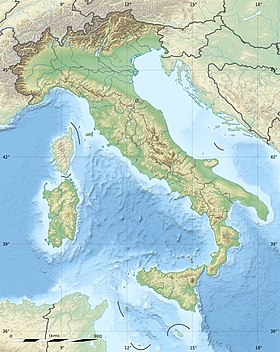
Gavia ( Italian: Passo di Gavia , Italian. Colle del Piccolo San Bernardo ) - a pass in the Southern Limestone Alps in Italy . Located between the mountains of Sobretta Gavia in the west and Ortles in the east.
| Gavia | |
|---|---|
| ital. Passo di gavia | |
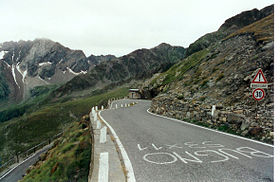 At the Gavia Pass in August 1997. | |
| Characteristics | |
| Saddle Height | 2618 m |
| Location | |
| A country |
|
| Mountain system | Southern Limestone Alps |



Content
- 1 Position
- 2 History
- 3 Cycling
- 4 notes
- 5 Links
Regulation
Gavia Pass is located in Lombardy and connects the Bormio commune in the north with the Ponte di Legno commune in the south with a complex 43-kilometer automobile crossing. Near the pass point with a mark of 2618 meters, the road makes ten sharp turns on the north side of the pass and 15 on the south side. The total height of the pass to the pass is about 1400 meters.
On the north side of the pass, the road is wide enough to allow cars to move in two lanes. On the south side, the road was completely asphalted only in the late 1990s and until now in some places the width of the carriageway at very sharp bends ranges from 1.9 to 3 meters. To prevent dangerous situations, several “pockets” have been built. On the same side, a 800-meter-long tunnel has been cut for one-way traffic, used in cases of traffic jams on the narrowest section of the highway. On busy days, situations happen when two oncoming cars are not able to part.
The crossing point is located between the peaks of Gavia (Monte Gavia, 3223 m.) And Corno dei Tre Signori (Corno dei Tre Signori, 3360 m.). It offers a beautiful view of the glaciers of the Adamel massif (Gruppo dell'Adamello).
History
For a long time, the Gavia Pass was considered a minor pass, but archaeological excavations a little north of the pass showed that this area was inhabited by people back in the Stone Age . The significance of the pass was realized only at the end of the Middle Ages . Then the Venetian merchants paved a trade route here, which allowed avoiding both control from the Habsburg Tyrol and from Lombardy , which competed with the Venetian Republic . In the sixteenth century, Gavia and the crossroads became busy and one of the most important for the Venetians, and since then quite reasonably the trade route began to be called the Imperial (Strada Imperiale). For all its economic importance, the transit road had and has one significant drawback: due to its height, it can be used by transport only for a few summer months in a year.
After the decline of the Venetian republic, the pass was practically not used for a long time. It was only during World War I that they remembered and began to equip it.
Cycling
In the summer, the path to the pass is actively used by cycling enthusiasts. And due to the fact that the Giro d'Italia cycling stages have passed through the pass many times, the pass has become legendary for lovers of world cycling, although from a purely economic point of view it has little transport significance.
In 1960, a stubborn struggle for the title of leader Giro was fought on the pass. Then the Frenchman Jacques Anketil was already in the pink jersey of the leader, but the situation should be strengthened. Velolive writes: “Imerio Massignan is the first to pass the snow-covered peak, but on the downhill he punctures the wheel, Charly Gaul wins the stage, Gastone Nencini finishes third, only 28 from the young Frenchman in the general classification seconds. In Milan (Milano), Jacques Anquetil finished the winner of the Giro d'Italia ” [1] .
In 1961, the Gavia Pass declared in the Giro was not completed due to snow and part of the stage had to be moved to the Passo dello Stelvio Pass. This led to the fact that the Giro Pass was not allowed out for another 27 years, and when they tried it again in 1988, it came out even more tragically than in 1960.
Velolive: “Gavia did not spare the cold for the participants in the Giro. The 14th stage (Chiesa Val Malenco - Bormio, 120.00 km.), Held on June 5, 1988, went down in history. Then the riders from the summer fell into a real winter, heavy snowfall fell on Gavia. The Dutchman Johan Van de Velde rode up with the stubbornness of a madman, without even wearing a jacket. He completely froze when he reached the top and could not start the descent to the finish of that stage. While Van de Velde was warming in the car, other racers also reached the top, and Erik Breukink won the stage, who dared to go down the snow to the finish line ” [2] .
In 1989, the pass was again closed to cyclists due to meteorological conditions, but in 1996 , 1999 , 2000 , 2008 and 2010, the pass was overcome by Jiro riders quite normally. However, in 2010 it was not simple, as in all subsequent years.
The first of the riders of the Giro d'Italia to the Gavia Pass climbed:
| Year | Winner | a country |
|---|---|---|
| 1960 | Imerio Massignan | Italy |
| 1988 | Andy hampsten | USA |
| 1996 | Hernan Buenagora | Colombia |
| 1999 | Chepe Gonzalez | Colombia |
| 2000 | Chepe Gonzalez | Colombia |
| 2004 | Vladimir Mikholevich | Croatia |
| 2006 | Juan Manuel Garate | Spain |
| 2008 | Julio Alberto Perez | Mexico |
| 2010 | Johann Chopp | Switzerland |
| 2014 | Robinson Shalapud | Colombia |
Notes
- ↑ Pages of Cycling History: Giro d'Italia - 1960 Network Edition Velolife
- ↑ Giro 2010: Bormio - Ponte di Legno / Tonale. Does Gavia cook vendetta? online edition of Velolife
Links
- Passo di Gavia (2618 m) (German)
- Map, photo and description (German)
- Pass Description (German)