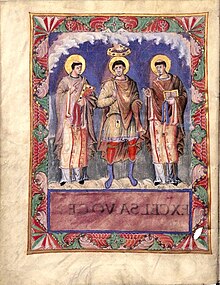
The sacramentary of Karl Lysy ( fr. Sacramentaire de Charles le Chauve ) is an illuminated manuscript , a monument to the book art of the Carolingian Renaissance . It is stored in the National Library of France (catalog designation Ms. lat. 1141 ). Only 10 sheets have been preserved, including 2 initials and 5 full-page thumbnails. Fields in some cases are colored in purple.
The manuscript is dated 869-870 years and refers in style to the palace school of Karl Lysy. The scriptorium where it was executed is not installed, but, in any case, it could not be created in the touristic abbey of Saint-Martin. According to the stylistic features, F. Eber-Suffrin suggested that the manuscript was created in Metz , because its design is similar to the Golden Code from Saint-Emmeram and the Bible from São Paulo Fuori-le-Moura . In 1675, the manuscript was in the Colbert library, in 1732 the heirs transferred the manuscript to the royal library.
Only 10 sheets of 27 × 21 cm format have been preserved. The coronation scene is presented on the first of the miniatures, the portrait of St. Gregory, who was traditionally considered the author of the sacramentarium, is presented. The following is an image of Christ in glory, surrounded by evangelists, angels and seraphim; the image of the heavenly hierarchy and another image of Christ in glory, with pagan allegories: the Ocean in the form of titanium and the Earth in the form of a nursing woman, there is also an image of the crucifix. The text is entirely in gold ink by the Carolingian minuscule, the initials in capital rustic writing over the magenta field.
Literature
- Marie-Pierre Laffitte, Charlotte Denoël et Pierre-Edouard Wagner, Trésors carolingiens: Livres manuscrits de Charlemagne à Charles le Chauve, Bibliothèque nationale de France / Seuil / Volumen, 2007, 240 p. ( ISBN 978-2-7177-2377-9 ), notice 18
- Le Chemin des reliques, Metz, Musée de la Cour d'Or - Éditions Serpenoise, 2000, 192 p. ( ISBN 2876924811 ), p. 62.