cis- Diammine dichloroplatin (II) ( Peyronet salt, cisplatin , lipoplatin ) is an inorganic substance, complex ammonium chloride-divalent platinum , cis - [ Pt ( N H 3 ) 2 Cl 2 ].
| Cis-Dichlorodiammineplatinum | |
|---|---|
 | |
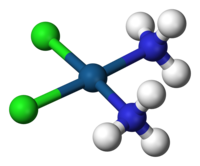 | |
| General | |
| Systematic name | (SP-4-2) -diammindichloroplatin (II) |
| Traditional names | cis- dichlorodiammineplatin, Peyronet salt, cisplatin, lipoplatin |
| Chem. formula | Pt (NH 3 ) 2 Cl 2 |
| Physical properties | |
| condition | dark yellow powder or yellow-green large crystals |
| Molar mass | 300.051 ± 0.014 g / mol |
| Density | 3.7 g / cm³ |
| Thermal properties | |
| T. melt. | 270 ° C |
| T. decomp. | over 270 ° C |
| Chemical properties | |
| Solubility in water | 2.53 g / 100 ml |
| Classification | |
| Reg. CAS number | 15663-27-1 |
| PubChem | |
| Reg. EINECS number | 239-733-8 |
| Smiles | |
| Reg. EC number | 239-733-8 |
| RTECS | TP2450000 |
| Chebi | CHEBI: 27899 |
| UN number | 3288 |
| Security | |
| MPC | 0.002 mg / m 3 |
| LD 50 | 26 (rat, oral), 32.7 (mice, oral) |
| Toxicity | highly toxic, requires careful use |
Registration number of the substance in the base of the American Chemical Society (CAS number): 15663-27-1.
Structurally similar to cis- dihydroxydiamindichloroplatin (II) .
It has pronounced cytotoxic , bactericidal and mutagenic properties. The basis of biological properties, according to the generally accepted opinion, is the ability of a compound to form strong specific bonds with DNA [1] .
Other names of this substance used in the scientific and medical literature: Peyrone chloride, Peyron chloride, cis - diamindichloroplatin (II), cis - diamindichloroplatin , cis - DDP, cis - platinum (II), CDDP, CPDD, CACP, CPDC, DDP, DDPt, cispt (II), neoplatin , platinum, dCDP, cisplatil, platiblastil, PT01, NSC-119875, lipoplatin .
Content
- 1 Application
- 1.1 Chemistry
- 1.2 Medicine
- 2 Synthesis
- 3 References
- 4 See also
- 5 notes
Application
Chemistry
Medicine
This platinum complex is currently widely used in medicine as an anti-cancer agent (a cytotoxic drug with an alkylating effect). The cytotoxic effect of platinum compounds was discovered by Barnett Rosenberg in the early 1960s by observing the effect of electric current on bacterial growth. In Rosenberg's experiments, complex compounds of platinum formed during electrochemical corrosion of platinum electrodes caused impaired division and death of E. coli cells.
It was found that cis- dichlorodiammineplatin has the most pronounced biological effect. Subsequent mouse tests revealed the antitumor activity of this compound [2] . Since the early 1980s, cis- dichlorodiammineplatin began to be used in clinical practice under the name cisplatin , later this substance was used in the form of an emulsion of nanoparticles called lipoplatin (also nanoplatin, liposomal cisplatin).
Synthesis
A fragment about obtaining cisplatin from the Brockhaus and Efron encyclopedia :
Peyrone chloride is most easily obtained from a hydrochloric acid solution of PtCl 2 ; supersaturated acidic liquid with a large excess of ammonium carbonate and heated to a boil, and the initial garnet-red solution becomes yellow and a dirty green precipitate is formed; the filtrate from this precipitate during crystallization and gives the desired chloride in the form of small yellow crystals; it is much more soluble in water than chloride of the second Reise base ( trans compound of the same composition).
Links
See also
- trans-dichlorodiammineplatinum (II)
- Cis-tetrachlorodiammineplatinum (Cleve salt)
Notes
- ↑ Chemical Reviews. 1999. Vol. 99, N. 9. P. 2467-2498, 2499-2510
- ↑ Nature 222 : 385-386