Yuan ( Chinese trade. 圓 , ex. 元 , pinyin : Yuán ) is the modern monetary unit of the People’s Republic of China , which measures the value of the renminbi ( Chinese ex. 人民币 , pinyin : Rénmínbì , literally: “people's money”, abbreviated RMB ) . Included in the "basket" of special borrowing rights of the IMF [1] . The international currency designation in ISO 4217 is CNY .
| Yuan (Russian) | |||
|---|---|---|---|
圓 / 人民幣(Chinese) , 圆 / 人民币(Chinese) | |||
| |||
| Codes and Symbols | |||
| ISO 4217 Codes | CNY (156) | ||
| Characters | ¥ • 元 • 圆 • 圓 | ||
| Territory of circulation | |||
| Issuing country |  China China | ||
| Derivative and parallel units | |||
| Fractional | Jiao ( 1 ⁄ 10 ) | ||
| Fyn ( 1 ⁄ 100 ) | |||
| Coins and banknotes in circulation | |||
| Coins | 1, 2, 5 cousins, 1 and 5 jiao, 1 yuan | ||
| Banknotes | 1, 5, 10, 20, 50, 100 yuan | ||
| Currency history | |||
| Chronicle | Yuan (People's Bank Dollar) (CNX [a 1] ) Yuan (Renminbi) (CNY) | ||
| Issue and production of coins and banknotes | |||
| Emission Center (Regulator) | People's Bank of China | ||
| www.pbc.gov.cn | |||
| Courses on October 22, 2019 | |||
| 100 RUB | = 11.12 CNY | ||
| 1 USD | = 7,076 CNY | ||
| 1 EUR | = 7.876 CNY | ||
| 1 GBP | = 9,169 CNY | ||
| 100 JPY | = 6.434 CNY | ||
| 2019 inflation | |||
| Inflation | 3% (September) | ||
| |||
 Wikimedia Commons Media Files Wikimedia Commons Media Files | |||
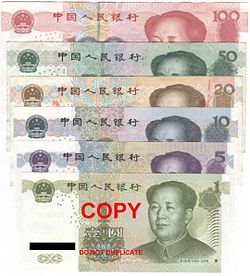
One yuan is divided by 10 jiao (角), which, in turn, are divided by 10 cousins (分). For example, the sum of 3.14 yuan is pronounced 3 yuan 1 jiao 4 fyn ( 三元 一角 四分 ). The words jiao and fyn also denote the decimal prefixes 10 −1 and 10 −2, respectively. In circulation are coins in denominations of 1, 2, 5 cubes, 1 and 5 jiao, 1 yuan.
Emission Institute - People's Bank of China (established December 1, 1948) [2] .
From 1994 to July 2005, the yuan was tightly tied to the US dollar with an exchange rate of 8.28: 1.
The inscriptions in four languages - ( Zhuang , Mongolian , Uigur , Tibetan ), which are official in the autonomous regions of the PRC - ( Guangxi Zhuang , Mongolian , Xinjiang Uigur and Tibetan ) are available on all Chinese banknotes [3] .
In the All-Russian Classifier of Currencies, the national currency of the PRC was called:
- Chinese Yuan (from December 26, 1994 to January 1, 2001),
- renminbi renminbi (from 01.01.2001 to 01.02.2007),
- RMB Renminbi (from February 1, 2007 to 2009),
- RMB (from 2009 to the present).
According to Bloomberg , in the interbank turnover in the SWIFT system from May 2013 to May 2014, the renminbi's share was 1.47% (0.84% a year earlier). At the same time, the share of the American dollar (for the same period of time) is 42%, the euro is 32%, the Russian ruble is 0.35% [4] .
Content
- 1 Banknotes
- 1.1 Banknotes of 1980
- 1.2 Banknotes of the sample 1999-2005
- 2 Exchange Rate Mode
- 3 notes
- 4 References
Banknotes
1980 Banknotes
| 1980 series [5] | ||||||||||
|---|---|---|---|---|---|---|---|---|---|---|
| Picture | Face value | Dimensions (mm) | The main colors | Description | date of output (modification) | date of retirements | ||||
| Front side | Back side | |||||||||
| 1 jiao | 115 × 52 | yellow green | left: Khao Shan ; on the right is the representative of the Manchu people | coat of arms of the PRC | September 17, 1988 | April 30, 2019 | ||||
| 2 jiao | 120 × 55 | green | on the left is a woman of the Bui nationality; right - a representative of the Korean ethnic group | coat of arms of the PRC | May 6, 1979 | May 1, 2018 | ||||
| 5 jiao | 125 × 58 | Violet | on the left is a Miao girl; on the right is a Zhuang girl | coat of arms of the PRC | May 2, 1983 | April 30, 2019 | ||||
| 1 yuan | 140 × 63 | red | representatives of the Yao peoples (Left) and Dong (Right) | the great Wall of China | May 27, 1981 | May 1, 2018 | ||||
| 2 yuan | 145 × 63 | green | on the left is a girl of the people and on the right is a Uigur girl | south nanshan mountain | April 1, 1983 | May 1, 2018 | ||||
| 5 yuan | 150 × 70 | Orange | on the left is a representative of the Hui ethnic group; on the right is a Tibetan woman | Yangtze River near the Three Gorges | July 12, 1984 | May 1, 2018 | ||||
| 10 yuan | 155 × 70 | gray blue | on the left is a Mongol man, on the right is a Han man | Mount Everest | June 30, 1978 | May 1, 2018 | ||||
| 50 yuan | 160 × 77 | yellow | professor, peasant woman and worker | Hukou Waterfall on the Yellow River | May 16, 1974 | May 1, 2018 | ||||
| 100 yuan | 165 × 77 | Violet | participants of the Great Campaign from left to right: Zhu De , Liu Shaotsi , Zhou Enlai , Mao Zedong | place of the beginning of the Great Campaign | May 16, 1974 | May 1, 2018 | ||||
Banknotes of 1999-2005 sample
| 1999 series | |||||||||
|---|---|---|---|---|---|---|---|---|---|
| Picture | Face value (yuan) | Dimensions (mm) | The main colors | Description | Year release | ||||
| Front side | Back side | ||||||||
| one | 130 × 63 | olive | Mao Zedong | Xihu Lake | 2004 | ||||
| 5 | 135 × 63 | Violet | Mao Zedong | Taishan Mountain | 2002 | ||||
| 10 | 140 × 70 | blue | Mao Zedong | three rapids of the upper Yangtze River | 2001 | ||||
| twenty | 145 × 70 | brown | Mao Zedong | Guilin landscape | 2000 | ||||
| fifty | 150 × 70 | green | Mao Zedong | Potala Palace | 2001 | ||||
| one hundred | 155 × 77 | red | Mao Zedong | Beijing People's Congress Palace | 1999 | ||||
| 2005 series | |||||||||
|---|---|---|---|---|---|---|---|---|---|
| Picture | Face value (yuan) | Dimensions (mm) | The main colors | Description | Year release | ||||
| Front side | Back side | ||||||||
| 5 | 135 × 63 | Violet | Mao Zedong | Taishan Mountain | 2005 | ||||
| 10 | 140 × 70 | blue | Mao Zedong | three rapids of the upper Yangtze River | 2005 | ||||
| twenty | 145 × 70 | brown | Mao Zedong | Guilin landscape | 2005 | ||||
| fifty | 150 × 70 | green | Mao Zedong | Potala Palace | 2005 | ||||
| one hundred | 155 × 77 | red | Mao Zedong | Beijing People's Congress Palace | 2005 | ||||
Exchange Rate Mode
Until 1974, the renminbi to foreign currencies was established mainly through the pound sterling , as well as the Hong Kong dollar . Since August 1974, the daily quotation of the renminbi against the US dollar and other currencies was introduced based on the currency basket.
Since 1994, the Chinese authorities have mothballed the renminbi at 1 dollar = 8.27 yuan. However, recently China has been under increasing pressure from the EU countries , Japan and especially the United States , who insisted on the liberalization of the renminbi. According to them, the RMB rate is underestimated and, as a result, Chinese goods gain an additional competitive advantage. The US negative balance in trade with China amounted to $ 162 billion in 2004, and in the first quarter of 2005 increased by another 40% compared to the same period last year. [6]
On July 21, 2005, the PRC refused to peg the yuan to the dollar and raised the national currency by 2%.
Since that time, the yuan exchange rate was determined based on its attitude to the currency basket of 13 countries - the main trading partners: US dollar, Euro, British pound, Russian ruble, Australian, Hong Kong, Canadian, New Zealand and Singapore dollars, Malaysian ringgit, Thai baht, South Korean Won and Japanese Yen. [7] Formally, monetary aggregates act as a criterion for the effectiveness of exchange rate policy (exchange rate anchor), but in fact, the US dollar is still the exchange rate anchor. [8]
Linking to currency baskets will make the RMB more responsive to the global economic environment, but will not create a threat to the stability of the country's financial system. By July 2008, the renminbi rate gradually strengthened by 21.6%.
According to the World Bank , in 2003 the purchasing power of the yuan was approximately 1 dollar = 1.8 yuan.
On November 30, 2015, the IMF Executive Council decided to include the renminbi in the basket of reserve currencies SDR, the IMF's unit of account. [9] Actually, the world reserve currency from October 1, 2016, the yuan, strictly speaking, will not be considered. He will still have to grow up to this status, since in the understanding of the expert community, the currency becomes global when it is actively used in cross-border trade and its share is high in central bank reserves. Another important point is the ability to use the reserve currency during the financial crisis (currency-refuge) [10] .
Currently, five SDR currencies have a reserve status: US dollar, Euro, Chinese yuan, British pound sterling, Japanese yen, as well as three more units not included in the currency basket: Swiss franc, Canadian and Australian dollars, which are not officially yet is, but the IMF is taken into account in the statistics of reserves of the central banks of leading countries. All the above currencies (with the exception of RMB) are freely convertible (for current and capital operations), and to maintain their stability, the regime of freely floating exchange rates is used, where inflation indicators act as a criterion for the effectiveness of the exchange rate policy. [eleven]
Also, additional factors of the reserve currency are the sufficiently developed and deep financial markets of the main countries, the sovereign debt of which is expressed in national currency and the size of the economy, of which the Chinese yuan predominantly meets only the last criterion [12] .
Therefore, the question of including the renminbi in the basket of reserve currencies remains quite controversial, since it is not literally “freely used” and fully convertible (that is, market-type currency), is not used in the calculations of the CLS international payment system for currency exchange transactions, is not traded actively on the FOREX market, and the exchange rate is still regulated by the People's Bank of China [13] [14] .
The inclusion of the renminbi in the SDR currency basket is of symbolic rather than economic importance, which means that it cannot be used in significant quantities by the Central Banks and other economic agents as a long-term investment asset and reserve means of payment [15] [16] .
In 2016, China's foreign exchange reserves fell by almost $ 320 billion, to $ 3.011 trillion [17] .
In August 2017, the PRC authorities lowered the renminbi, setting it at the level of: 1 dollar = 6.65 yuan [18] .
Two special administrative regions, Hong Kong and Macau , have their own currencies in accordance with the principle of “ one country, two systems ” and the basic laws of the two territories [19] [20] . Thus, the Hong Kong dollar and Macau pataca remain legal currencies in these two territories, and the yuan, although sometimes accepted, is not legal tender. Banks in Hong Kong allow people to keep accounts in RMB [21] . Due to changes in legislation in July 2010, many banks around the world [22] are gradually offering people the opportunity to keep deposits in RMB.
| Market rate | ||||||||
|---|---|---|---|---|---|---|---|---|
| ||||||||
Notes
- ↑ The IMF Executive Board completed the revision of the SDR currency basket and decided to include the Chinese yuan . IMF (November 30, 2015). Date of treatment December 22, 2015.
- ↑ Article 2, The People's Bank of China Law of the People's Republic of China (December 27, 2003). Archived March 20, 2007.
- ↑ Autonomy in China . Publishing House Medina (September 9, 2010). Date of appeal April 10, 2018.
- ↑ Ye Xie, Halia Pavliva. Putin's Land Grab Undermines Global Ambition for Ruble BloombergBusiness (July 7, 2014). Date of treatment January 30, 2015.
- ↑ LETTER OF THE CBR OF 07.04.97 N 29-5 / 1388 INFORMATION MESSAGE N 8/97 “ON MONEY TREATMENT OF CHINA” . Archived March 9, 2013.
- ↑ Strelkov I.V. The currency strategy of internationalization of the Chinese yuan // Bulletin of the International Institute of Economics and Law. - 2012. - No. 1 (6) . - S. 20-26 . - ISSN 2220-9387 .
- ↑ China untie the yuan from the dollar and tie it to a basket of 13 currencies , Politforum (December 14, 2015). Date of appeal April 10, 2018.
- ↑ China this year actually pegged the yuan to the dollar , Vedomosti (May 25, 2017). Date of appeal April 10, 2018.
- ↑ What does the inclusion of the yuan in the number of reserve currencies mean , Vedomosti (December 7, 2015). Date of appeal April 10, 2018.
- ↑ Shelter currencies and their role in the Forex market. (inaccessible link) . Rating of Forex brokers (June 19, 2017). Date of treatment April 10, 2018. Archived December 16, 2017.
- ↑ Expert: China does not need a freely convertible yuan . RBC (September 28, 2011). Date of appeal April 10, 2018.
- ↑ Renminbi Internationalization: Risks and Negative Consequences , South China - A Special Look (April 10, 2018). Date of appeal April 10, 2018.
- ↑ Gregory Sukhman. Yuan is firmly pegged to the US dollar - take it easy! . Proza.ru (January 11, 2015). Date of appeal April 10, 2018.
- ↑ Andreev V.P. Internationalization of the Chinese Yuan - on the Way to the World Currency // Money and Credit, 2014, No. 7, p. 49-54
- ↑ Yuan has become the reserve currency. Why it doesn't matter: The main financial news of November has more politics than economics , Meduza (December 1, 2015). Date of appeal April 10, 2018.
- ↑ Valentin Katasonov. Internationalization of the renminbi . Comte (October 30, 2014). Date of appeal April 10, 2018.
- ↑ This “honey” is not as sweet as it was in October . ZERICH Capital Management (January 10, 2017). Date of appeal April 10, 2018.
- ↑ The People's Bank of China weakened the national currency , REGNUM news agency (August 25, 2017). Date of appeal April 10, 2018.
- ↑ The Basic Law of the Hong Kong Special Administrative Region of the People's Republic of China (April 4, 1990). - “Article 18: National laws shall not be applied in the Hong Kong Special Administrative Region except for those listed in Annex III to this Law.” Date of treatment March 23, 2007.
- ↑ The Basic Law of the Macao Special Administrative Region of the People's Republic of China (March 31, 1993). - “Article 18: National laws shall not be applied in the Macao Special Administrative Region except for those listed in Annex m to this Law.” Date of treatment March 23, 2007.
- ↑ Hong Kong banks to conduct personal renminbi business on trial basis , Hong Kong Monetary Authority (November 18, 2003). Date of treatment March 22, 2007.
- ↑ Bank of China New York Offers Renminbi Deposits . Date of treatment February 15, 2011.
Links
- Classification of Exchange Rate Arrangements and Monetary Policy Frameworks
- China Banknote Gallery (German )
- Gallery of Currency Certificates (FEC) (German) (English) (French)