Californian stingray [1] ( lat. Dasyatis dipterura ) is a species of cartilaginous fish of the genus stingrays from the family of the caudate - stingrays of the caudate -like superorder of rays . Representatives of this species live in the subtropical waters of the eastern part of the Pacific Ocean . These bottom fish are found on a muddy or sandy bottom near rocky reefs or in algae thickets up to a depth of 355 m. The maximum recorded width of the disc is 122 cm. The pectoral fins of these slopes grow together with the head, forming a diamond-shaped disk. The dorsal surface of the disc is evenly brown or gray in color, along the midline and in the area of the wings there are a number of bone plaques. Behind the spine on the caudal stem are the upper and lower fin folds. This trait distinguishes Californian stingrays from a similar species, Dasyatis longa .
| California stingray |
 |
| Scientific classification |
|---|
| No rank : | Bilateral symmetrical |
|
| International scientific name |
|---|
Dasyatis dipterura DS Jordan & CH Gilbert , 1880 |
| Synonyms |
|---|
- Dasyatis hawaiensis Jenkins, 1903
- Dasybatus dipterurus Jordan & Gilbert, 1880
- Trygon brevis Garman, 1880
|
| Area |
|---|
|
| Security status |
|---|
Not enough data IUCN Data Deficient : 60152 |
|
While searching for food, California stingrays can gather in large flocks of up to hundreds of individuals. They are nocturnal. These stingrays prey mainly on benthic invertebrates and small bony fish . They prey or dig up prey buried in the ground. Like other caudate-tailed California stingrays, they breed by egg-production . Embryos develop in the womb, feeding on the yolk and histotroph . There are 1-4 newborns in the litter. Females bring posterity every summer. Mating is followed by a 10-month embryonic diapause , after which the embryos develop rapidly in 2-3 months. Californian stingrays are the slowest-growing stingrays among members of their family, so they are very sensitive to overfishing . These ramps are generally not aggressive, but when disturbed and in case of danger, they are capable of delivering painful injections that are potentially life-threatening with a poisonous thorn. They are the subject of targeted fishing. By- catch is often found in commercial shrimp fishing by trawling [2] [3] .
In 1880, a new species was twice scientifically described by three American ichthyologists: David Starr Jordan and Charles Henry Gilbert as Dasybatus dipterurus and Samuel Garman as Trygon brevis [4] [5] . An article by Jordan and Gilbert was published in May, and by Garman in October. Therefore, according to the principle of primacy, a specific epithet of lat was adopted . dipterura - feminine adjective lat. dipterurus . However, in 1913, Garman recognized these two species as synonyms, making the species epithet lat a priority . brevis , which led to a long confusion [6] . The genus Dasybatus and the genus Trygon were later recognized as synonyms of the genus Dasyatis , however, many authors continued to give preference to the name Dasyatis brevis [7] [8] . Garman's recognition in 1913 of the synonyms of Californian stingray and Dasyatis hawaiensis still requires further research to confirm [9] .
|
| Neotrygon kuhlii |
|
|
| Pteroplatytrygon violacea |
|
|
| Pastinachus sephen |
|
|
| Dasyatis pastinaca |
|
|
|
| Dasyatis dipterura |
|
| Dasyatis say |
|
|
|
| other Dasyatis |
|
|
|
|
|
|
|
|
|
|
|
|
| Phylogenetic tree of the genus of stingrays according to Rosenberg (2001). Given modern taxonomic names |
The syntypes were collected at San Diego Bay [7] . The species epithet comes from other Greek. δύο “two”, πτερόν “wing” and οὐρά “tail” [10] and is associated with the presence on the tail stalk of these slopes of two folds of skin - dorsal and ventral. In 2001, a phylogenetic analysis of 14 species of stingrays based on morphology was published. As a result, the California stingray and fringed stingray , which lives in the western Atlantic Ocean, were recognized as closely related species. The fact that their ranges are located in different oceans probably indicates that the formation of species occurred before the formation of the Isthmus of Panama (about 3 million years ago). In addition, they were recognized as the second after an ordinary stingray basal members of a kind [11] .
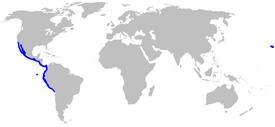
California stingrays live in the subtropical waters of the eastern Pacific Ocean from southern California to the northern coast of Chile , including the waters that wash the Galapagos and Hawaiian Islands . Off the coast of Baja California and the Gulf of California they are widespread. They swim to the most northern and southern limits of their range only during warming periods associated with the arrival of El Nino [8] . The data on the presence of Californian stingrays in British Columbia are not confirmed and are doubtful, since these stingrays are found only in tropical and warm temperate waters [3] .
In the summer of California stingrays can be found in shallow water
These bottom fish inhabit coastal waters; they prefer a sandy or silty bottom next to rocky reefs and algae thickets. Along the southern coast of California in the summer they are found in the surf zone to a depth of 7 m, and in the fall and winter they fall to 13-18 m [3] . For unknown reasons, California stingrays prefer to spend the winter in algae thickets rather than on the sandy bottom [8] . In the waters of Chile, they are kept at a depth of 3-30 m. On the other hand, in the Hawaiian islands, stingrays of this species were observed at a depth of up to 355 m. If this information is correct, it can be assumed that the range of depths of habitat for California stingrays is much wider than was believed previously [3] [2] .
The pectoral fins of these slopes fuse together with the head, forming a diamond-shaped flat disk, the width of which slightly exceeds the length, the edges of the fins (“wings”) form an almost right angle. The snout is blunt and does not protrude beyond the disc. Behind fairly large eyes are sprinklers . On the ventral surface of the disc are 5 gill slits, mouth and nostrils. Between the nostrils lies a flap of skin with a fringed lower edge. The mouth is slightly curved. The bottom of the oral cavity is covered by 3-5 outgrowths. Small blunted teeth are staggered and form a flat surface. On the upper jaw there are 21–37, and on the lower 23–44 dentitions [8] [9] [12] The whip-like tail is 1.5 times longer than the disk. Like other stingrays, on the dorsal surface in the central part of the caudal stem there is a serrated spike connected by ducts to the poisonous gland. Periodically, the spike breaks off and a new one grows in their place. Sometimes stingrays have 2 spikes due to the fact that the previous one has not yet broken off, and the new one has already grown. Upper and lower skin folds are located behind the spine on the caudal peduncle [9] . The presence of a dorsal fold distinguishes California stingrays from similar in appearance and sharing with them most of the range of Dasyatis longa . In skates, the tail is often damaged, which complicates species identification [13] . In young California stingrays, the skin is completely smooth, while in adults a series of bone plaques appear on the disc along the spine, in addition, two short rows of plaques cover the area at the base of the “wings”. Behind the poisonous spike, the tail to the tip is studded with small spines [12] . Coloring of the dorsal surface of the disc of an even gray or olive color, tail darker than the main background. The ventral surface of the disc is whitish [8] [13] .
California stingrays are nocturnal. In the afternoon, as a rule, they lie at the bottom under a layer of precipitation so that only the eyes protrude from the outside. Sometimes they hunt alone, but more often form flocks of up to 100 individuals. In such clusters, there is a clear segregation by sex and age. The diet of California stingrays consists of crustaceans , mollusks and other invertebrates, as well as small bony fish . The powerful jaws and blunt teeth of these slopes are capable of crushing strong shells [8] [13] . They prey mainly on burrowing animals. A female with a 69 cm wide disc at a time swallowed 30 small crabs [13] . In Bahia Magdalena , Southern Baja California , Pinnotheres pisum crabs serve as the main food source for California stingrays , followed by the importance of mollusks Solyema valvulus and polychaete worms [3] .
Californian stingray in the waters of the Galapagos Islands
Hunting California stingrays glide at the bottom and, finding a victim, freeze over it. Then they begin to raise and lower the disk, creating negative pressure to extract the prey from the shelter [8] . It is known that, in search of food, these slopes dig up large pits with wave-like disk movements [3] . Californian stingrays are often followed by small fish, such as the bodian Bodianus diplotaenia , the pair Calamus taurinus , Haemulidae Haemulon sexfasciatum , the Halichoeres nichols, and the hedgehog fish [14] . On Californian stingrays, tapeworms Acanthobothrium bullardi, A. dasi, A. rajivi and A. soberoni [15] , Anthocephalum currani [16] , Parachristianella tiygonis [17] and Pseudochristianello elegantissima [18] , leeches Anuzremolum prob ] and monogenes Listrocephalos kearni [20] .
Reproduction
Like other caudate, California stingrays are ovoviviparous fish. Embryos develop in the womb, feeding on the yolk and histotroph. In adult females, only the left ovary and left uterus function [21] . There are several natural nurseries located on the Pacific coast of Baja California [8] . Females bring offspring annually. In the litter of 1–4 newborns 18–23 cm long. The mating season begins at the end of summer, however, due to diapause, embryo development begins only the next year and lasts only 2-3 months. Childbirth occurs in the summer from July to September. Natural nurseries are located in small estuaries [3] [21] . During the arrival of El Nino, the duration of pregnancy is reduced due to an increase in water temperature [8] . California stingrays have the slowest growth rate among all stingrays currently studied. In males, puberty occurs when the disc width reaches 43–47 cm, which corresponds to the age of 7 years, and in females with a disc width of 57–66 cm at the age of 10 [3] [21] . The maximum life expectancy is estimated at 19 years for males and 28 years for females [21] .
Californian stingrays are found both individually and in groups.
California stingrays generally do not show aggression and, if possible, float away to avoid a collision with a person. However, at least one lethal case associated with these ramps was recorded off the coast of southern California. In the waters of the United States due to their small numbers, they are not of interest for commercial fishing. In other places they are caught in sufficient quantities, in addition, they are caught as by- catch in bottom trawls, longlines and traps. The meat is eaten, the wings of stingrays come to the market in fresh, fillet or salted form [8] . In Mexico, Californian stingrays are an important component of the plate-gill fishery and account for up to 1/10 of the annual catch. Probably, their value is exaggerated due to species identification errors. These stingrays are caught mainly in summer and autumn. In 1998-2000, it was the most mined in Baia Magdalena and the second most abundant species of stingrays in the waters of Sonora . In these places, fishing was carried out mainly with the help of gill nets; both adult stingrays and juveniles fall into these nets. A slow reproduction cycle makes Californian stingrays susceptible to overfishing . The species suffers from environmental degradation, particularly related to the development of shrimp aquaculture . There is insufficient data to assess the conservation status of the International Union for Nature Conservation , but in Mexican waters it has been given the status of “Close to a vulnerable position” [3] .

