Nizami Park [1] ( azerb. Nizami parkı ) is one of the oldest parks in the capital of Azerbaijan , the city of Baku . It is located in the Khatai district of the city, on the territory of Villa Petrolea , a residential village built by the Nobel brothers in the late XIX century for employees of their company on the border of the Black City in the suburbs of Baku. The total area of the park is 13.6 hectares [1] . This park in an industrial landscape, located on a vast territory, had a positive impact on the landscape architecture of Absheron . After 1920, the former garden of Villa Petrolea was named after Lunacharsky , later - “Rote Fane”, in honor of the German newspaper of the same name , and then was named after Nizami Ganjavi [2] .
| Nizami Park | |
|---|---|
| azerb. Nizami parkı | |
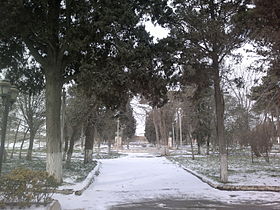 Park in winter | |
| basic information | |
| Square | 13.6 ha |
| Established | 1882-1883 |
| Architect | E. Beckle |
| Location | |
| A country |
|


Content
Park History
Park Creation
In 1882-1883 the efforts of the Nobel brothers involved in the development of oil fields in the Absheron peninsula , on the border of the Black and White cities in Baku, a village for employees of the company - "Oil Villa" (Villa Petrolea) was created. In just one or two years, the capital achieved an area of 10.26 hectares of landscaping in the village. The area of public plantings of the city of Baku reached almost the same area (10.03 ha) by 1920 , over 80 years of the existence of buildings outside the city walls [3] .
The Zavodsky district of Baku, which is almost 8 km away from the center, was unfavorable both by natural data and by improvement. Nevertheless, it was considered acceptable for the residence of the Baku proletariat. However, administrative and technical personnel did not agree to work, much less live in such an environment, even for a large fee. In this regard, the Nobels, in order not to lose the invited specialists, created favorable living conditions for them. To create a large green massif with an area of about 10 hectares among the mass of oil tanks, barns, oil refineries near the village of Kishla, a famous specialist E. Bekle was invited, under whose leadership many gardens and parks in Warsaw were created [3] .
After Bekle got acquainted with the site saturated with oil waste, he demanded the delivery of fertile soil for the park. Soon, barges with fresh land from Lankaran County began to moor to the company’s pier in the Black City. However, the issue of delivering fresh water for irrigation turned out to be more complicated. Then the company of the Nobel brothers ordered to fill the bulk carriers returning from the Astrakhan raid with Volga water as ballast and direct them to the berths of the Black City [3] .
Thus, at the junction of the Black and White cities, a garden appeared, called Villa Petrolea. The gardener E. Bekle studied the natural features of Absheron , and he paid special attention to the selection of tree species to solve the planning and spatial structure of the Villa. Bekle picked up planting material in Lenkoran , Tiflis , Batum and other cities, and also wrote out from nurseries of Russia and Europe [3] .
About 80,000 bushes and trees grew in the Villa's park. Among them, there were a large number of fruit. The terrain (with a slope to the sea), the placement of residential and other buildings and the choice of the directions of the main alleys determined the lay-out planning structure of Villa Petrolea. A lot of paths and alleys led to the constructions in front of which the platforms with flower beds were broken or trees were grouped. The main alleys overlooked the viewpoints. From there, one could see the factory chimneys of the Black City through dense greenery, and then the Caspian Sea [3] .
The name of the master plan architect and buildings with south-facing terraces, porches and balconies, eclectic with Romanesque motifs, has not been established. However, the fact that the master plan of the Villa, skillfully executed vertical layout taking into account terraces and the compositional idea of the park, testifies to the fact that the architect was. Doctor of Architecture Shamil Fatullaev believes that all this was developed by an anonymous architect with the direct participation of Bekle. The same community was observed in the work of the architect Skurevich and the city gardener Vasiliev in the process of solving the head part of the coastal boulevard. According to Fatullayev, this "magnificent park in an industrial landscape, located on a vast territory, had a positive impact on the landscape architecture of Absheron, where country villas were created that opened a new theme in the architecture of capitalist Baku" [3] .
Renaming a Park
On July 9, 1931, an all- Baku gathering of oil drums was held in this Park of Culture and Leisure of Baku Oil Workers, dedicated to the arrival of the Red Banner “Rote Fane” [4] . The rally decided to send a telegram to Ernst Thälmann [4] , the leader of the German Communists. The park where the rally took place was named the “Rote fan” Culture and Rest Park.
In the Rote-Fane recreation park in the working district of Baku, a large cycle of concerts opened the 1932 season with a radio broadcasting symphony orchestra together with an orchestra of folk instruments [5] .
Park Reconstruction
In 1939, the Baku Worker newspaper reported that reconstruction of the park would begin this summer. So, the design bureau of the Garden and Park Administration of the Baksovet has begun developing a project for the reconstruction of the Rote-Fane recreation park. The authors of the project were architects - M. Kokhman, V. Ivanov, A. Alekseev. It was reported that the park is expanding, and its territory will grow by 6 hectares, alleys, paths that will decorate subtropical and evergreen trees will be redone [6] .
Behind the dance floor, a large area was allotted for the "free recreation alley." It was planned to create an atmosphere of a park-forest, trees were planted, lawns were created. In the center of the park pool, it was planned to arrange a green island with a fountain and stage, surrounded by water. The park was planned to be painted with sculpture. Pavilions and kiosks were transformed. Also, the construction of a sports stadium was planned in the park. It was planned to complete the reconstruction in 1941 [6] .
Notes
- ↑ 1 2 A.A. Gasanova. Gardens and Parks of Azerbaijan / Ed. prof. F.M. Huseynov. - Baku: Ishig, 1996 .-- 304 p.
- ↑ Mir-Babaev M. A Brief History of Azerbaijani Oil / Scientific Editor prof. R.I. Shukurov. - (3rd edition, revised and supplemented). - B. , 2010 .-- S. 26.
- ↑ 1 2 3 4 5 6 Fatullaev S.S. Urban planning of Baku XIX — early XX centuries / Ed. prof. V.I. Pilyavsky. - Leningrad: Stroyizdat , 1978.- 215 p.
- ↑ 1 2 Moses P. B. The international community of the Azerbaijani people with the German proletariat. - B .: Azerbaijan State Publishing House, 1965. - P. 68. - 112 p.
- ↑ Art of Azerbaijan. - B .: Publishing House of the Academy of Sciences of the Azerbaijan SSR, 1968. - T. XII. - S. 126.
- ↑ 1 2 Reconstruction of the park named after Rote-Fane // Baku Worker: newspaper. - 1939.