Crematogaster scutellaris (lat.) Is a species of wood ants of the genus Crematogaster from the subfamily Myrmicinae ( Formicidae ). They use their poison against ants of other species (scaring them away by spraying poison from the abdomen bent upwards), but not against their species and not for food.
| Crematogaster scutellaris | |||||||||||||||||||||||||||||||||||||||||||||||
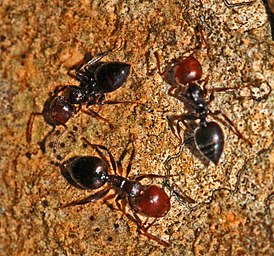 Ant Crematogaster scutellaris | |||||||||||||||||||||||||||||||||||||||||||||||
| Scientific classification | |||||||||||||||||||||||||||||||||||||||||||||||
|---|---|---|---|---|---|---|---|---|---|---|---|---|---|---|---|---|---|---|---|---|---|---|---|---|---|---|---|---|---|---|---|---|---|---|---|---|---|---|---|---|---|---|---|---|---|---|---|
| |||||||||||||||||||||||||||||||||||||||||||||||
| International scientific name | |||||||||||||||||||||||||||||||||||||||||||||||
Crematogaster scutellaris | |||||||||||||||||||||||||||||||||||||||||||||||
| Synonyms | |||||||||||||||||||||||||||||||||||||||||||||||
according to the Bolton catalog of 1995 [2] :
| |||||||||||||||||||||||||||||||||||||||||||||||

Content
- 1 Distribution
- 2 Description
- 2.1 Ecology
- 3 Value
- 4 Systematics
- 5 notes
- 6 Literature
- 7 References
Distribution
Europe and North Africa , mainly the Mediterranean countries [3] [4] : Austria , Andorra , Bulgaria , Hungary , Greece , Georgia , Israel , Spain , Italy , Macedonia , Malta , Portugal , Romania , Slovenia , Tunisia , Turkey , France , Croatia , Switzerland . Introduced with wood into the greenhouses of Great Britain [5] [6] [7] , Germany [8] , Holland [9] .
Description
Small ants (workers have a length of 3-5 mm, females - up to 9.5), two-tone: the abdomen and breast are brownish-black, and the head is red-brown. The first segment of the stalk ( petiol ) is trapezoid (top view). The back of the chest ( propodeum ) with spikes. The antennae of workers and females are 11-segmented (12 in males). The scape of the antennae of males is very short (equal to the following two segments). The stalk between the breast and the abdomen consists of two segments: the petiolus and postpetiolus (the latter is clearly separated from the abdomen), the sting is developed, but weak; naked pupae (without cocoon). Postpetiol attaches to the dorsal surface of the first abdominal segment. The ability to recline the abdomen on the back when spraying acid [3] [5] [6] [10] is characteristic.
Ants use their poison by spraying it against ants of other species (which are scared away by spraying the poison from the abdomen bent upwards), but not against their species. Also, the use of poison in capturing prey was not noted [11] .
Ecology
Dendrobiont view. Anthills arrange in various places, mainly in the cavities of wood, under the bark, as well as under stones and in the cavities of stone walls. They can arrange cardboard nests, the walls of which are composed of chewed wood pulp [12] [13] [14] [15] . The Crematogaster scutellaris diet consists of plant juices secreted by homogeneous winged insects ( Homoptera ), such as aphids and worms [16] , as well as living or dead arthropods [17] .
Ant uterus lay their eggs during the summer. Young larvae appear in autumn (mainly in September) and winter in the second stage of development. In the spring of next year, the larvae pass into the third age stage, which pupate during the summer. By the middle or end of summer, workers and sexual winged individuals emerge from the pupae. The founding of new families is independent: young uterus independently establish new colonies without the help of workers. Under natural conditions, the colonies live for several decades [12] [18] [19] [20] .
Value
In habitats, the number of pine camp silkworms ( Thaumetopoea pityocampa ), a pest of pine forests, is reduced. Studies in the forest of Aleppo pine ( Pinus halepensis ) located in the province of Valencia (Spain) showed that ants damage an average of 27.5% of the eggs laid by these butterflies [12] .
They can serve as candidates as bioindicators of soil pollution with heavy metals . A study of the concentration of certain metals ( Cu , Cd , Ni , Mn , Pb , Zn ) in the tissues of Crematogaster scutellaris , conducted in Italy, showed a different degree of assimilation by their ants. Zinc and cadmium accumulate in ants according to their content in the soil (body content correlates with the concentration of elements in the soil). The proportion of copper in the body of ants did not depend on its concentration in the soil, while the concentrations of nickel, manganese, and lead were lower in ants than in soil. Most metals were concentrated in the middle intestine, malpigian tubules, and fat deposits in the body, supporting the role of these organs as primary storage sites for metal [21] .
Systematics
The species was first described using materials from France in 1792 by the French entomologist Guillaume Antoine Olivier ( Olivier, AG ) under the original name Formica scutellaris Olivier, 1792 ; for a long time mixed with the species Crematogaster schmidti (all indications from the USSR relate to Cr. schmidti ) [3] [5] [6] .
Crematogaster scutellaris is included in the nominative subgenus Crematogaster s.str. (= Acrocoelia ) and is indicated as a type species of the genus Crematogaster [22] [23] .
Winged female
Working
Side view
Head
View from above
Uterus
Front worker
Notes
- ↑ Olivier, AG Encyclopédie méthodique. Histoire naturelle. Insectes. Tome 6. (pt. 2). - Paris: Panckoucke, 1792. - P. 369-704. (page 497, description of the worker).
- ↑ Bolton B. A new general catalog of the ants of the world. - Cambridge, Mass .: Harvard University Press, 1995 .-- P. 166. - 504 p.
- ↑ 1 2 3 Dlussky G.M. , Soyunov O.S., Zabelin S.I. Ants of Turkmenistan / Otv. ed. prof. Tokgayev T. B. - Ashgabat: Ylym, 1989 .-- S. 242-246. - 273 p. - 500 copies. - ISBN 5-8338-0392-6 .
- ↑ Fauna Europaea: Crematogaster scutellaris ( Olivier , 1792)
- ↑ 1 2 3 Baroni Urbani, C. 1971. Catalogo delle specie di Formicidae d'Italia (Studi sulla mirmecofauna d'Italia X). Mem. Soc. Entomol. Ital. 50: 5-287 (page 79)
- ↑ 1 2 3 Bernard, F. 1967 [1968]. Faune de l'Europe et du Bassin Méditerranéen. 3. Les fourmis (Hymenoptera Formicidae) d'Europe occidentale et septentrionale. Paris: Masson, 411 pp. (page 164, senior synonym for species C. grouvellei and C. lichtensteini )
- ↑ Villagrán, M. & Ocete, ME 1990. Datos preliminares de la distribución de nidos de Crematogaster scutellaris en alcornocales de Andalucía occidental. - Boletín de sanidad vegetal. Plagas 16: 151–157
- ↑ Heller G. 2004. Ein Vorkommen von Crematogaster scutellaris (Olivier, 1791) (Hymenoptera: Formicidae) in Süddeutschland. - Myrmecol. Nachr. 2004; 6: 1-3.
- ↑ Boer P. & Vierbergen B. 208. Exotic ants in The Netherlands (Hymenoptera: Formicidae). - Entomol. Ber. (Amsterdam) 2008; 68, 121-129.
- ↑ Cagniant, H. (2005). Les Crematogaster du Maroc (Hym., Formicidae). Clé de détermination et commentaires. - Orsis 20: 7-12.
- ↑ Marlier JF, Quinet Y. & de Biseau JC 2004. Defensive behavior and biological activities of the abdominal secretion in the ant Crematogaster scutellaris (Hymenoptera: Myrmicinae). - Behavioural Processes. 2004; 67, 427–444.
- ↑ 1 2 3 López-Sebastián E., Tinaut A. & Selfa J. Acerca de Crematogaster scutellaris (Olivier, 1791) (Hymenoptera, Formicidae) como depredador de huevos de la procesionaria del pino (Spanish) // Boletín de sanidad vegetal . Plagas: Magazine. - 2004. - Vol. 30, n o 4 . - P. 699–702. - ISSN 0213-6910 .
- ↑ Krausse, AH 1911. Ueber kartonnester von Crematogaster scutellaris Ol. auf Sardinien. Intern. Ent. Zs. Guben, 4: 259.
- ↑ Soulie, J. 1957. La nidification chez les espèces françaises du genre Crematogaster Lund (Hymenoptera, Formicoidea). Ins. Soc. 3: 93-105.
- ↑ Soulie, J. 1961. Les nids et le comportement nidificateur des fourmis du genre Crematogaster d'Europe, d'Afrique du Nord et d'Asie du sud-est. Ins. Soc. 8 (3): 213-297.
- ↑ Martelo M., Arru, G. 1958. Rocerche preliminari sull'entomofauna della Quercia da sughero (Quercus súber) in sardegna. Boll Zool. agr. Bachic, Serie II, 1: 5–49
- ↑ Redolfi I., Tinaut A., Pascual F., Campos M. 1999. Qualitative aspects of myrmecocenosis (Hym., Formicidae) in olive orchards with different agricultural management in Spain. J. Appl. Ent., 123: 621-627
- ↑ Villagrán, M., Soria, FJ & Ocete, ME 1998. Fenología de los hormigueros de Crematogaster scutellaris (Olivier, 1792) (Hymenoptera, Formicidae) en el SO de España. Archived June 19, 2010 on Wayback Machine - Bol. R. Soc. Esp. Hist. Nat. (Sec. Biol.) , 94 (3-4): 97-100
- ↑ Casevitz-Weulersse, J. 1972. Habitats et comportement nidificateur de Crematogaster scutellaris Olivier (Hym. Formicidae). - Bull. Soc. Ent. France, 77: 12-19.
- ↑ Casevitz-Weulersse, J. 1991. Reproduction et développement des sociétés de Crematogaster scutellaris (Olivier, 1791) (Hym., Formicidae). - Annls. Soc. Ent. France, 27: 103-111.
- ↑ Elisa Gramigni, Silvia Calusi, Nicla Gelli, Lorenzo Giuntini, Mirko Massi, Giovanni Delfino, Guido Chelazzi, David Baracchi, Filippo Frizzia, Giacomo Santini. 2013. Ants as bioaccumulators of metals from soils: Body content and tissue-specific distribution of metals in the ant Crematogaster scutellaris. - European Journal of Soil Biology. Volume 58, September - October 2013, Pages 24–31
- ↑ Santschi, F. (1937). Contribution à l'étude des Crematogaster paléarctiques. - Mém. Soc. Vaudoise sci. Nat., 5: 295-317
- ↑ Blaimer, BB A subgeneric revision of Crematogaster and discussion of regional species-groups (Hymenoptera: Formicidae) (Eng.) // Zootaxa : Journal. - Auckland , New Zealand : Magnolia Press, 2012 .-- Vol. 3482. - P. 47-67. - ISSN 1175-5326 .
Literature
- Dlussky G.M. , Soyunov O.S., Zabelin S.I. Ants of Turkmenistan / Ed. ed. prof. Tokgayev T. B. - Ashgabat: Ylym, 1989 .-- S. 242-246. - 273 p. - 500 copies. - ISBN 5-8338-0392-6 .
- Agosti, D .; Collingwood, CA A provisional list of the Balkan ants (Hym. Formicidae) and a key to the worker caste. I. Synonymic list (Eng.) // Mitt. Schweiz. Entomol. Ges. - 1987. - Vol. 60. - P. 51-62.
Links
- Hormigas.org: Crematogaster scutellaris (Olivier, 1792 ) . hormigas.org. Date of treatment June 29, 2015. (+ Photo and distribution in Spain)
- Youtube.com: Crematogaster scutellaris youtube.com. Date of treatment June 29, 2015. (+ Video)
- biolib.cz: Crematogaster scutellaris (Olivier, 1792 ) . biolib.cz. Date of treatment June 29, 2015. (+ Photo)
- Fauna Europaea: Crematogaster scutellaris ( Olivier , 1792 ) . faunaeur.org. Date of treatment June 29, 2015.
- ION: Crematogaster . organismnames.com. Date of treatment June 29, 2015.
- Zipcodezoo: Crematogaster (English) (inaccessible link) . zipcodezoo.com. Date of treatment June 29, 2015. Archived January 9, 2015.