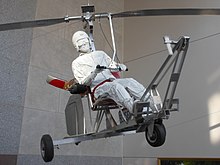
Igor Vasilyevich Bensen ( born Igor Bensen , April 1, 1917, Rostov-on-Don - February 10, 2000) is a Russian-American engineer, gyroplane developer, founder of Bensen Aircraft.
Content
Biography
The son of Vasily Mitrofanovich and Alexandra Benzin. His father worked in the agricultural department, was known as a breeder. and was appointed to the service in 1917 in Czechoslovakia [1] . Together with his family, Igor left Russia during the Civil War and went to Prague. In 1934, he began to study as an engineer in Belgium, receiving a bachelor of science degree, three years later received a scholarship to study and moved to the United States, where he continued his studies at the Stevens Institute of Technology in Hoboken, New Jersey and graduated with honors in 1940.
I received an offer to work with Sikorsky, but was forced to refuse due to foreign citizenship. He worked at General Electric , piloting the Kellet XR-3. Back in 1946, he was building his first gyro leader, named by him B-1. The model resembled the Focke-Achgelis Fa 330 , which Bensen was able to research while working at the company. In 1951-1953 he worked at Kaman Aircraft . From the first model to the one that went on sale later, there were several more attempts to create an all-metal model.
Bensen Aircraft
He founded his aircraft company Bensen Aircraft in 1953 in Raleigh, North Carolina . built gyros and propeller gliders of their own designs. The first model to go into production in 1953 was the B-5, followed in 1954 by the B-6 Gyro-Glider, a tube frame construction with small rear wheels and a nose wheel. The B-6 “Gyro-Glider” had an upper control lever and for takeoff it had to be dispersed with the help of a car. The B-6 had a more minimal design compared to the previous model, took off at a speed of 31 km / h and could accelerate to 100 km / h. The manufacturer did not recommend disconnecting the gyro leader from the car during the flight [2] .
The next model was also the towed glider B-7, followed by the B-7M - the first gyroplane with an engine. Then Bensen discovered that there were problems in the design with round metal pipes and began to work on creating a model from an extruded 2x2 profile. These developments formed the basis of the Bensen B-8, a model that enthusiasts independently reproduce today according to Bensen's original drawings. The B-8M was the most successful gyro leader in the history of the company, one of the models was created for use in agriculture and spraying fields. Further developments led to the creation of the B-16 - a two-seater gyroglider with two engines and four blades [3] .
Modifications to B-8 [4]
| Title | Specifications |
|---|---|
| B-8 Gyro-Glider | first model in the series |
| B-8HD | Super Gyro-Copter, for takeoff the take-off was short and landing was carried out vertically. |
| B-8W Hydro-Glider | The glider did not have a motor, designed to be towed by a motor boat, had a chassis with two floats. Motorized version - B-MW Hydro-Copter. |
| B-8B Hydro-Boat | Modification of the B-8W Hydro-Glider with a hull in the form of a boat. |
| B-8M Gyro-Copter | Version of the first model, gyroplane with engine. |
| B-8MH Hover-Gyro | With two coaxial screws, it could hang, fly back and sideways. |
| B-8MJ Gyro-Copter | Motorized gyroglider with the possibility of vertical take-off (due to the promotion of the rotor). |
| B-8 Super Bug | It had two engines and a smaller take-off run before take-off. |
| B-9 Little Zipster | The helicopter based on the B-8M, had two coaxial propellers. |
| B-10 Prop-Copter | Flying platform for one person, with two small screws. |
| Mid-jet | Helicopter weighing 45 kg, ultralight, with two air-jet engines. |
Models were sold for self-assembly by aircraft enthusiasts, in sets or wiring diagrams. The kits were priced from $ 995 to $ 2,900. In 1987, the company went bankrupt and in 1989 production was discontinued [5] .
He was president and founder of the Popular Rotorcraft Association (PRA), a national non-profit organization created in 1962 for helicopter and gyroplane owners and companies. A model of his gyro-leader (rotorcraft), “Spirit of Kitty Hawk”, is located at the Smithsonian Institution [6] . It is best known among all Bensen's devices, since it was on this model that 12 world and national records for the gyro leader were set in 1967-1968, including speed, height and distance records [7] .
Igor Bensen, like his father, was a church figure and in 1968 was ordained a deacon by the St. Vladimir Seminary. In 1968, he received an honorary doctorate in theology from Indiana University.
The wife of Igor Bensen in 1942 was Mary, his colleague at the company General Electric. In 1955 and 1956, their sons David and Ricky were born.
Died in February 2000 from Parkinson's disease.
In memory of Bensen in the United States are Bensen Days - an annual review of gyroplanes and similar equipment [8] .
Notes
- ↑ Savinsky Yuri Ezekeylevich. Helicopter World .: Helicopter universe . - Triumph Triumph www.triumph.ru, 2014-02-20. - 521 p. - ISBN 9785893925999 .
- ↑ Can a helicopter fly without a motor? (Russian) (unopened) ? . Popmech.ru. Date of treatment April 9, 2019.
- ↑ Igor Bensen . www.gyroplanepassion.com. Date of treatment April 9, 2019.
- ↑ Benson B-8 Gyro-Glider . www.airwar.ru. Date of treatment April 12, 2019.
- ↑ Alan Farnham. Dr. Bensen's Magnificent Flying Machine . Forbes Date of appeal April 9, 2019. (unavailable link)
- ↑ Palmer, Alex . Gyrocopter Popularity Soaring (Eng.) , The New York Times (November 7, 1971). Date of treatment April 9, 2019.
- ↑ Igor Bensen . www.gyroplanepassion.com. Date of treatment April 9, 2019.
- ↑ Savinsky Yuri Ezekeylevich. Helicopter World .: Helicopter universe . - Triumph Triumph www.triumph.ru, 2014-02-20. - 521 p. - ISBN 9785893925999 .