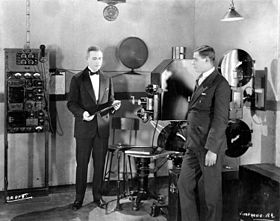
Waitafon , Vitafhone ( English Vitaphone ) - the first mass system of sound cinema , based on separate recording and reproduction of sound and image. The technology did not provide for the production of a combined phonogram on film copies . Instead, the soundtrack of the film was recorded on a phonograph record , which was played by a player synchronized with a movie projector with a common drive [1] [2] . For phonograph records with a diameter of 16 inches (40.64 centimeters ), a speed of 33 ⅓ revolutions per minute was used for the first time, very low for that time [3] . On the contrary, the standard frequency of shooting and projection increased to 24 frames per second compared to 16 in silent cinema . Such a sound recording system was used in the early sound films of Warner Bros. and First National Pictures , which were shot from 1926 to 1931. The premiere of the first film shot on the system "Waitafon" - "Don Giovanni" - took place on August 6, 1926 .
Later the name “Waitafon” was used for cartoons and short films with a more modern optical soundtrack on film .
Content
Creation History
In the early 1920s, Western Electric was developing sound cinema systems with shared and separate media. The development was based on the latest achievements: the first triode ("Audio"), created by Lee de Forest in 1913, success in the development of loud-speaking devices and the first condenser microphone , created by the company in 1916. At that time, there was already a Forest Soundtrack sound cinema system with optical phonogram on a common medium , demonstrated in 1923. However, the extremely low quality of its sound, in comparison with the excellent sound of Western Electric demo samples, convinced Warner Brothers to use the system with the usual gramophone record [4] .
The Waitafon production base housed in Bell’s laboratories in New York was acquired by the film company in April 1925. A public presentation took place a year later at the same time as showing a silent picture "Don Juan", equipped with musical accompaniment and sound effects [5] . The film screening was preceded by short episodes with a synchronous phonogram of opera singing and the only speech fragment on which was recorded a greeting from the president of the Association of Producers and Distributors of the USA William Hayes [6] [7] . Don Juan was never able to recoup the costs of developing the Waitafon system. Success came on October 6, 1927 , with the release of the movie “ Jazz Singer ”, which brought in impressive revenues and placed Warner Brothers among the main players in the American film market [8] . In the history of cinema, this film is considered the first sound, despite the fact that separate pictures with sound on other technologies came out before [9] . In addition to the musical accompaniment, the first and almost the only uttered phrase in the picture was a replica of the protagonist - “Wait, wait! You have not heard anything yet! ”- which has become a symbol of the onset of the era of sound cinema [4] . According to many historians, the painting was the first work of art to convincingly show that sound cinema is possible and that the more than thirty-year period of the “great dumb” is nearing completion. A full-fledged speech phonogram appeared only in the following picture, filmed according to the Waitafon system - The Singing of Fools ( Eng. The Singing Fool ).
Description
In the first years of sound cinema, the synchronization of filming and sound recording apparatuses was carried out using a common AC source for synchronous electric motors of drives. The Waitafon system used the same principle of synchronous shooting . Despite the difference in rotational speed and diameter of the phonograph records from those used for ordinary sound recording, the recorder did not differ from the traditional one. A spiral sound track going from the center to the edge of the wax disc was recorded with an electromechanical head with a needle. The duration of continuous recording on a 16-inch Waitaf disk was approximately 11 minutes, which was enough for the standard part of a 35-mm film 300 meters long . Cinemas operating on the "Vytofon" system were equipped with ordinary silent movie projectors, the drive of which was connected by a common shaft to the player. Additional audio equipment consisted of an amplifier , volume control and speakers . Before starting the projector, the projectionist combined the mark on the movie record with the frame window and set the pickup needle exactly opposite the arrow on the record label. Thus, synchronization was achieved.
The system differed from all previous gramophone ones (for example, the Gaumont Chronophone of 1910) by several fundamental improvements [10] . The recording time of ordinary phonograph records, not exceeding 2-3 minutes, was increased by reducing the speed and increasing the diameter of the disc. In addition, for the first time, such a novelty was used as an electrophone that reproduces sound through an electronic amplifier and speakers loud enough for a large audience . The synchronization accuracy achieved by the developers of the system was incomparable with all previous technologies on separate media. The quality and volume of sound recorded and reproduced in an electromechanical way were also much higher than traditional mechanical systems with horn amplification, and the frequency range of the condenser microphone was sufficient to obtain excellent speech intelligibility.
Weaknesses
About 1000 short films were filmed using the Waitafon system, the length of which was limited to one part. The production of full-length films, consisting of several parts, was difficult, because with each change of the post of the film projection , re-synchronization was required. Violation of the synchronization of sound was also inevitable in the event of a broken film copy and its subsequent gluing [11] . Even in the absence of these problems, the synchronization was not ideal, and the film installations were equipped with a regulator that allowed the projection mechanic to change the projection frequency to some extent and restore the coincidence of sound. The distribution of sound films was complicated, as it required additional infrastructure for the delivery of records stored separately from film copies. The service life of shellac discs with sound did not exceed 20 sessions, after which their replacement was required. To control the number of plays on the label of each plate, a special table was printed, filled out by the cinema staff.
Another inconvenience of the system was the impossibility of editing the phonogram recorded on the disk. This greatly limited the creative capabilities of directors who were forced to shoot entire sound scenes. Therefore, with the advent of competitive systems with an optical phonogram on a common film with the image of the film, the system “Waitofon” refused all film producers [4] . A separate sound carrier again appeared in the cinema only in 1952 in the Cinemarama panoramic cinematic system , which provides for synchronization of a separate 35 mm perforated magnetic tape with a film film using gear drums and synchronous electric drive motors [12] [8] . The same technology was used in earlier versions of the IMAX format. Currently, part of the films is supplied with the DTS soundtrack on a separate CD , synchronized using the time-address code printed on the film.
See also
- Talkies
- Triergon
- Forest phonofilm
- Moviton (cinema)
- RCA Photophone
- Tagefon
- DTS
Notes
- ↑ The End of Silent Cinema, 1929 , p. 21.
- ↑ Sound in the cinema . 625 Magazine (June 11, 2010). Date of treatment January 6, 2015.
- ↑ Sound Engineer, 2001 , p. 68.
- ↑ 1 2 3 D. Merkulov. ... And I don’t hear what she sings . Archive magazine . “ Science and Life ” (August 2005). Date of treatment January 7, 2015.
- ↑ The End of Silent Cinema, 1929 , p. 26.
- ↑ World of Cinema Engineering, 2013 , p. 37.
- ↑ Nadezhda Zavarova. Parallel editing: the best kisses in the cinema . "Motion picture" (July 4, 2010). Date of treatment January 7, 2015.
- ↑ 1 2 Cinema Technology, 1998 , p. 9.
- ↑ Beginning of a sound movie . Make a film (June 27, 2010). Date of treatment January 7, 2015.
- ↑ Oliver Chesler. Gaumont Chronophone . Time Machine . Wire To The Ear (June 15, 2012). Date of treatment January 9, 2015.
- ↑ Goldovsky, 1971 , p. 44.
- ↑ Fundamentals of Film Production, 1975 , p. 34.
Literature
- Leonid Antonov. Phonogram restoration (rus.) // “ Sound engineer ”: magazine. - 2001. - No. 10 . - S. 68-75 . - ISSN 0236-4298 .
- Weisenberg E. End of silent cinema. - L .: “Teakinopechat”, 1929. - 32 p.
- Goldovsky , E. Chapter I // Film projection in questions and answers. - 1st ed. - M .: Art , 1971. - S. 42–47. - 220 p.
- B. N. Konoplev . Fundamentals of film production / V. S. Bogatova. - 2nd ed .. - M .: "Art", 1975. - 448 p. - 5,000 copies.
- N.A. Mayorov. The very first in the history of the development of world cinema (rus.) // “World of Cinema Technique”: magazine. - 2013. - No. 3 (29) . - S. 34-40 . - ISSN 1991-3400 .
- Bernard Happé. The History of Sound in the Cinema (Eng.) // “Cinema Technology”: magazine. - 1998. - No. 7/8 . - P. 8-13 . - ISSN 0995-2251 . Archived October 11, 2010.
Links
- A blog dedicated to films shot on the system "Waitafon" (English) . VITAPHONE VARIETIES. Date of treatment January 6, 2015.
- Collection of phonograms “Waitafon” (English) . Audio Community. Date of treatment January 6, 2015.
- Block diagram of the Waitafon system . The American Widescreen Museum. Date of appeal October 13, 2015.