The Battle of Prague is the battle of the Thirty Years' War , which took place from July 25 to November 1, 1648 between the Swedish troops led by General Hans Königsmark and the Austrian army led by Rudolf Colloredo . The attempt of the Swedish flying detachment to take Prague failed, the garrison and the townspeople forced the Swedes to retreat.
| Battle of Prague | |||
|---|---|---|---|
| Main Conflict: Thirty Years War | |||
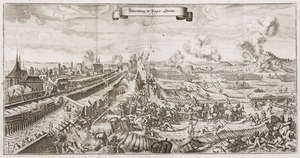 representation of the siege, engraving from Theatrum Europaeum , based on paintings by Karel Shkret | |||
| date | July 25 - November 1, 1648 | ||
| A place | Prague , Bohemia (kingdom) , Habsburg Monarchy | ||
| Total | The Swedes sacked the Prague Castle , but could not capture the Old Town | ||
| Opponents | |||
| |||
| Commanders | |||
| |||
| Forces of the parties | |||
| |||
| Losses | |||
| |||


Content
Battle
After the unsuccessful siege of Brno , the Swedish forces were forced to retreat from Vienna to Sweden . However, on July 15, General Königsmark united with Ernst Ottowaldu 10 days later approached Prague . Taking advantage of the weak vigilance of the garrison celebrating the wedding of the emperor, the Swedes were able to quietly penetrate the city and capture Mala Strana and Prague Castle . Immediately after the capture of the western part of Prague, the soldiers began the sacking of the city, 12 million guilders became their prey, and 80 prominent residents were taken prisoner, for whom they demanded a ransom. The Swedes got valuable collections collected in Prague Castle by Emperor Rudolf II . Königsmark ordered the delivery of everything looted under a reinforced convoy to Sweden. Many of the captured values were used to decorate the Swedish Royal Palace .
After the Swedes captured the West Bank of the Vltava , the garrison under the command of Rudolf Colloredo organized the defense of the Old and New Towns . The Swedes believed that the inhabitants of Prague would meet them as liberators from the Habsburg oppression, but they faced strong resistance from the garrison and the townspeople.
Count Colloredo began to form the city police, and also welcomed the creation of student legions from the University of Prague . The Swedish army was busy plundering the captured part of the city instead of continuing to attack the city. On July 31, a Swedish army approached Prague under the command of General Wittenberg and began its siege. On August 3 and 4, Prague was heavily bombed by two Swedish armies. The Swedes did not dare to storm the city, the troops of Wittenberg took up positions south of Prague , and began to plunder the surroundings.
The besieged were able to rest for several days, and begin urgent repairs of the city walls. In late September, an army approached Wittenberg under the command of Karl Gustav. On October 6, all three Swedish armies simultaneously attacked the city, but were unsuccessful; the largest assault took place from October 10 to 11 . On October 24, the Peace of Westphalia was signed, but without knowing this, the Swedes continued the siege. On this day, the fourth major assault on the city took place. The Swedes attempted a breakthrough at the city gates and managed to achieve partial success. The garrison and the townspeople courageously fought back, counterattacked, there was gunpowder at the end. Count Colloredo decided to start negotiations with the Swedes, but they put forward so humiliating conditions that the townspeople resolutely abandoned them and continued the struggle. On November 1, Carl Gustav received news of the conclusion of peace and the end of the Thirty Years War . The Swedish troops withdrew, and the townspeople buried 219 dead defenders of the city.
Consequences
Emperor Ferdinand III described the Old Town as, “A hand with a sword that is going to protect the open gate from invaders.” This “two-handed sword” is now part of the coat of arms of Prague. In gratitude for the salvation of Prague, a column of the Virgin Mary was built on Old Town Square.
The remaining exhibits of the Kunstkamera (a collection of precious stones and minerals from various regions collected by Emperor Rudolf II) were taken out of Prague by Swedish troops. The most valuable of the exported exhibits are the Giant Code and the Silver Code .
Memory
- The battle of Prague is sung in the song "1648" by the Swedish power metal band Sabaton .
Sources
- Peter Čornej, Pavel Belina, Famous battles of our history
- Liva Wenceslas, Storm over Prague 1648. Prague: Vladimir Žikeš, 1948
- Zatočil Z LEVENBRUKU, Jan Norbert. Chronicle of the siege of Prague from the Swedes. Prague: Šolc, 1914
- Zupanici, Jan Student Legion 1648, Historical Horizon 1998, 9 (5-6), pp. 98-101. ISSN 1210-6097.
- Siege of the Swedes (July-October 1648)
- Karel Oktábec: Karel Oktábec: The Wrong Teacher of the Nations - The Last Battle of the Thirty Years War (Part 01.) - (Part 16.)
- Jitka Lenkková and Vaclav Pavlik :. of the most important battles in Czech history Alpress, SRO, Frydek-Mistek 2007
- Toulky českou minulostí Rambles Czech Republic Past 464 levels. Encounters: Defenders of Prague LP 1648: Heroes or Traitors?