Giuseppe Poggi ( Italian: Giuseppe Poggi ; April 3, 1811 , Florence - March 19, 1901 , ibid.) - Italian architect and engineer. Along with Giordo Vasari and Bernardo Buontalenti is considered one of the three architects who had the greatest influence on the modern architectural appearance of Florence.
| Giuseppe Poggi | |
|---|---|
| ital. Giuseppe poggi | |
| Basic information | |
| A country |  Italy Italy |
| Date of Birth | April 3, 1811 |
| Place of Birth | Florence , Italy |
| Date of death | March 19, 1901 (89 years old) |
| Place of death | Florence , Italy |
| Work and Achievements | |
| Study | Florence Academy of Fine Arts |
| Worked in the cities | Florence |
| Architectural style | neo-renaissance |
Since 1828 he studied at the Florentine Academy of Fine Arts and the studio of the architect Bartolomeo Silvestri. After working as an engineer for some time, in the early 1840s he devoted himself completely to architecture. He visited London and Paris to explore the local architectural sights. As an officer in the engineering corps, where he served with his friend, later a famous physician, , took part in the Italian revolution of 1848-1849 .
Returning from the war, Poggi again returned to architectural work, engaged in the construction, reconstruction and redevelopment of Florentine palaces, gardens and villas for private orders. The most famous of these works are the architect on the , the in and the in .
The most ambitious architectural work of Poggi was the ambitious reconstruction project of Florence in the 1860s as part of the so-called , that is, rehabilitation or cleansing that befell a number of Italian cities in the process of unification of the country and gaining independence . Destroying the ancient in several places, he built around the ring road . On the south coast, an eight-kilometer winding was built according to the architect’s design, at the highest point of which is also Poggi Square Michelangelo , known for its panoramic views of the city.
Giuseppe Poggi is named after the on the , and the street connecting it with the square of Michelangelo.
The younger brother of Giuseppe Poggi is the politician and statesman (1812-1890).
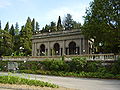
Loggia on Piazzale Michelangelo

Poggi's plan for the reconstruction of Florence
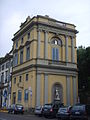
Palace

Literature
- C. Del Lungo, Cenni sulla vita e sui lavori dell'architetto Giuseppe Poggi , Civelli, Firenze 1911. (Italian)
- F. Borsi, La capitale a Firenze e l'opera di Giuseppe Poggi , Colombo, Roma 1970. (Italian)
- C. Cresti-L. Zangheri, Architetti e ingegneri nella Toscana dell'Ottocento , Uniedit, Firenze 1978, pp. 192-193. (ital.)
- EMAgostini, Giuseppe Poggi: la costruzione del paesaggio , Diabasis, Napoli 2004. (Italian)
- V. Arrighi, Scheda su Giuseppe Poggi , in Guida agli archivi di architetti e ingegneri del Novecento in Toscana , a cura di E. Insabato, C. Ghelli, Edifir, Firenze 2007, pp. 297-300 (Italian)
Links
- Giuseppe Poggi's biography on the website of the gallery of modern art Lorenzo Viani (Italian)