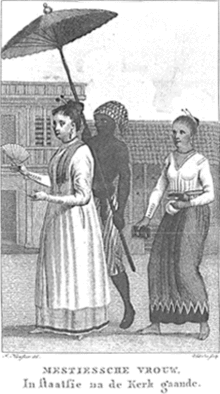
The burghers of Sri Lanka (from the Dutch. Burgher - "city dweller", the self-names of Hollandsche and Tupass ) - an ethnic group that has developed in Sri Lanka as a result of the mixing of Portuguese , Dutch and British immigrants with the local population. The total number in Sri Lanka is 39,599 people [1] (2001-2007 censuses). As a result of emigration, burgher communities have developed in Australia , South Africa , Great Britain and other countries.
Content
History
The burgher community began to take shape in the 16th century as a result of the colonization of the coast of Sri Lanka by immigrants from Portugal, among whom were both Portuguese and Portuguese Jews, Germans, Italians, Galicians and others.
In the XVII century, when the coast was captured by the Netherlands , most Portuguese were forced to leave the colony, but some of the descendants from joint marriages moved to lands controlled by Sinhala rulers. An exception was made for Portuguese Jews. The Dutch East India Company helped attract immigrants from Europe who were involved in local government, plantation farming, crafts and trade.
After the capture of Sri Lanka by Great Britain in the late XVIII - early XIX centuries, European-educated creoles of Dutch and Portuguese descent were employed in the colonial administration, had official and unofficial privileges. The number of burghers began to grow. In 1899, the Dutch Union "Dutch Union" organization was formed, and in 1897-1898 the Ceylon Union of Dutch Burghers. Since 1908, the Union magazine was published in English.
The declaration of independence of Sri Lanka (1948), the declaration of the Sinhala language as the state language (1956) and the nationalization of part of the economy led to the crowding out of burghers from administrative posts and business. Since the 1950s, there has been constant burgher emigration to other, primarily English-speaking countries. Their number in Sri Lanka is gradually declining. During the civil war of 1983-2009, some burghers demanded the creation of a burgher state in Sri Lanka, but it was not taken seriously by the authorities or the burgher community itself.
Culture Features
Traditionally, burghers focused on the colonial authorities, therefore, they built their daily lives in accordance with the requirements imposed on them by the metropolis. It is noteworthy that already in the XIX - first half of the XX century, most of them abandoned the Portuguese and Dutch Creole dialects in favor of the English language.
Although the majority belonged to descendants from marriages of Europeans with Sinhala and Tamils , they tried to keep their distance from the natives. Moreover, among the burghers themselves, there was an inequality in determining status. Thus, the Dutch burghers of Hollandsche were considered superior to the Portuguese burghers of Tupass , and those, in turn, were superior to the “black burghers” who lived in the countryside and were related to local Christians. The word "burgher" itself sometimes had a negative connotation. It was first officially applied by the British administration during the 1871 census.
Believers are Protestants and Catholics.
See also
- Ceylon-Dutch Creole
- Anglo-Indians
- Anglo-Burmese
- Kristangi
- Black dutch
Notes
- ↑ “Census of the Burger Community in Sri Lanka” Archived October 25, 2015 on the Wayback Machine