A critical magnetic field is the magnitude of the magnetic field that destroys superconductivity .
Superconductors are characterized not only by the absence of electrical resistance, but also by the Meissner effect , which consists in pushing the magnetic field beyond the limits of the superconductor. For a given temperature, the Meissner effect is manifested only for fields smaller than critical. Fields larger than the critical field penetrate the superconductor and destroy superconductivity.
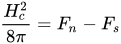
Critical magnetic field connected with the difference of free energies of the normal and superconducting phases:

Its temperature dependence is well described by the empirical formula
- ,
![{\ displaystyle H_ {c} (T) = H_ {c} (0) [1- (T / T_ {c}) ^ {2}]}](https://wikimedia.org/api/rest_v1/media/math/render/svg/cbbf193a45b2ae7f6a3b73901af0cfe21799a383)
Where - critical temperature .

Superconductors of the second kind are characterized by two critical fields - and . With an external magnetic field Meissner effect is observed. In the range of fields a mixed state arises - a magnetic field penetrates into the superconductor in the form of quantized vortices . With the magnitude of the magnetic field superconductors of the second kind also go into a normal state.




Literature
- Schmidt V.V. Introduction to the physics of superconductors. M., "MCCMO", 2000.
- Critical magnetic field // Physical Encyclopedia : [in 5 vol.] / Ch. ed. A.M. Prokhorov . - M .: Soviet Encyclopedia, 1990. - T. 2: Q-factor - Magnetooptics. - 704 s. - 100,000 copies. - ISBN 5-85270-061-4 .
- Superconductivity // Physical Encyclopedia : [in 5 vols.] / Ch. ed. A.M. Prokhorov . - M .: Great Russian Encyclopedia, 1994. - T. 4: Poynting - Robertson - Streamers. - 704 s. - 40,000 copies. - ISBN 5-85270-087-8 .