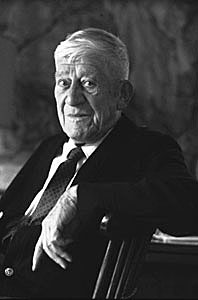
Oscar Kokoszka ( German: Oskar Kokoschka , March 1, 1886 , Pöchlarn , Austria-Hungary - February 22, 1980 , Villeneuve , Switzerland ) is an Austrian artist and writer of Czech origin, the largest figure of Austrian expressionism .
| Oscar Kokoschka | |
|---|---|
| him. Oskar Kokoschka | |
 | |
| Birth name | Oskar Kokoschka |
| Date of Birth | |
| Place of Birth | Pöchlarn , Lower Austria Austria-Hungary |
| Date of death | |
| A place of death | Villeneuve , Vaud Switzerland |
| Citizenship |  Austria-Hungary → Austria-Hungary → Austria Austria |
| Genre | |
| Study | |
| Style | expressionism |
| Awards | Erasmus Prize ( 1960 ) |
Content
- 1 Biography and creativity
- 2 Literary works
- 3 Oscar Kokoschka Award
- 4 notes
- 5 Literature about Kokoschka
- 6 References
Biography and Creativity
My father belonged to the family of famous Prague jewelers. In 1903 - 1909 he studied at the Vienna School of Arts and Crafts, among his teachers were Gustav Klimt and Karl Otto Czech . In 1908 , his works were presented at the exposition of modernist artists close to Klimt. The staging of Kokoschka’s drama “ The Killer, the Hope of Women ” ( 1907 ) on the Vienna stage caused a scandal (in 1921 , Paul Hindemith wrote an opera based on it).
Kokoschke was patronized by the famous Viennese architect Adolf Loos (whose portrait he painted); Portraits of Viennese celebrities (Karl Kraus et al.) also belong to this period. In 1910 , he became close friends in Berlin with the expressionist group "Sturm", met with Kandinsky .

In 1911 - 1913 Kokoschka survived a stormy romance with the famous Viennese beauty Alma Mahler , at that time - the widow of the famous composer and conductor Gustav Mahler (later she was married to the architect Walter Gropius , and then to Franz Werfel ). Unable to get rid of painful memories of her, Kokoshka in 1919 ordered a life-size female doll to the master in Stuttgart , which he later described in the book Fetish ( 1925 ). He dedicated to Alma one of his best paintings - “The Bride of the Wind”. Under the same name, in 2001, Bruce Beresford's feature film Bride of the Wind was released , in which their relationship was reflected.
Kokoshka participated in the First World War , was wounded in 1915 on the Galician Front, survived captivity, and was recognized by doctors as mentally unstable. In 1916, Kokoschka met with Hoffmannsthal and Rilke . Impressions of the war entered the drama "Job" ( 1917 ). In 1919 - 1924 Kokoschka was a professor at the Dresden Academy of Arts . In his drama “Orpheus and Eurydice” ( 1919 ), the opera by Ernst Kshenek ( 1923 ) was written.
In 1922 he painted a portrait of actress Maria Orskaya , which is now stored in the form of lithographs in several museums. In 1922 and 1932 the artist's works participated in the Vienna Biennale .
Mussolini spoke negatively about the artist, who was supported by pro-Nazi authorities in Vienna. In 1937 , Kokoschka’s paintings featured at the famous propaganda exhibition, Degenerative Art , organized by the Nazis.
In 1934, Kokoschka moved to Prague , in 1938 , after the Munich Agreement , to Great Britain , and in 1946 received British citizenship. Since 1947 he lived in Switzerland . After the end of World War II, his works were presented in 1945 at an exhibition in Vienna along with paintings by Klimt and Schiele , in 1947 his exposition was successfully held in Bern , and in 1952 a separate hall was allocated to him at the Vienna Biennale.
In 1952 - 1963 Kokoshka taught at the Summer Academy of Fine Arts in Salzburg . In 1955 , 1959 and 1964 his works were presented at the documentary cassette exhibition. In the 1960s, he also acted as a stage designer ( Mozart's Magic Flute , 1964 , etc.), worked as a graphic designer on television (Rosmerholm, based on Ibsen's drama, 1961 ). In 1960, Oscar Kokoschka won the Erasmus Prize .
In 1981 , large retrospective exhibitions of Kokoshka’s works were held in London and New York , and in 1986 at the New York Solomon Guggenheim Museum .
Literary works
- Dichtungen und Dramen. Hamburg: H. Christians, 1973
- Erzählungen. Hamburg: H.Christians, 1974
- My life. New York: Macmillan, 1974
- Aufsätze, Vorträge, Essays zur Kunst. Hamburg: H. Christians, 1975.
Oscar Kokoschki Award
The Oscar Kokoschka Prize, one of the largest Austrian awards in the field of contemporary art , was established by the Federal Government of Austria in the year of the artist's death, in 1980 [4] . The cash bonus for 2012 is € 20 thousand [4] . The prize is awarded once every two years to an artist living in Austria or abroad.
Notes
- ↑ 1 2 BNF identifier : Open Data Platform 2011.
- ↑ 1 2 Oskar Kokoschka
- ↑ 1 2 Oskar Kokoschka - 2006.
- ↑ 1 2 Own. correspondent Yoko Ono received the Kokoshka Prize // artchronika.ru. - 2012 .-- March 5.
Kokoshka Literature
- Wingler HM Oskar Kokoschka, the work of the painter. Salzburg: Galerie Welz , 1958
- Hodin JP Oskar Kokoschka; the artist and his time: a biographical study. Greenwich: New York Graphic Society, 1966
- Oskar Kokoschka drawings, 1906-1965. Coral Gables: University of Miami Press, 1970
- Oskar Kokoschka: drawings and watercolors; the early years 1906-1924 / Sabarsky S., ed. New York: Rizzoli, 1986
- Whitford F. Oskar Kokoschka, a life. New York: Atheneum, 1986
- Orbis pictus, the prints of Oskar Kokoschka, 1906-1976. Santa Barbara: Santa Barbara Museum of Art, 1987
- Oskar Kokoschka, Emigrantenleben: Prag und London 1934-1953 / Jutta Hülsewig-Johnen (Hrsg.). Bielefeld: Kerber, 1994
- Klimt, Schiele, Kokoschka, Kubin. Weitra: Bibliothek der Provinz, 2004
- Ernst Krenek, Oskar Kokoschka und die Geschichte von Orpheus und Eurydike / Hrsg. von Jürg Stenzl. Schliengen: Ed. Argus 2005
- Oskar Kokoschka - Erlebnis des Augen-Blicks. München: Hirmer, 2005
- Klimt, Schiele, Moser, Kokoschka - Vienne 1900. Paris: Réunion des Musées Nationaux, 2005
- Klimt, Schiele, Kokoschka: Akt - Geste - Psyche. Heidelberg: Ed. Braus, 2006