Distichlis (lat.) Is a genus of perennial herbaceous plants of the Cereals family.
| Distichlis | |||||||||||||||||||||||
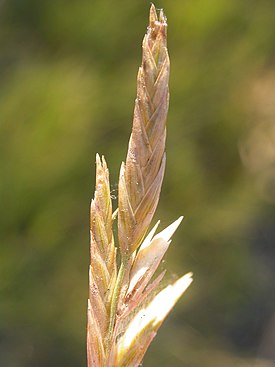 Inflorescence Distichlis spicata | |||||||||||||||||||||||
| Scientific classification | |||||||||||||||||||||||
|---|---|---|---|---|---|---|---|---|---|---|---|---|---|---|---|---|---|---|---|---|---|---|---|
| |||||||||||||||||||||||
| International scientific name | |||||||||||||||||||||||
Distichlis Raf. | |||||||||||||||||||||||
Content
Systematics
The original description of the genus appeared in the French publication Journal de Physique, de Chimie, d'Histoire Naturelle et des Arts in 1819, its authorship belongs to the American naturalist Constantin Rafinesc [2] [3] . The scientific name in translation from ancient Greek means “two-row”, thus indicating a characteristic arrangement of leaves in two rows [4] . The authors include the genus either in the tribe Festuceae of the subfamily Festucoideae [5] [6] , or in the tribe Aeluropodeae of the subfamily Chloridoideae [7] [8] .
Distribution
The genus includes up to 9 species, most of which are common in the New World . One species ( Distichlis distichophylla ) grows in Australia . Previously, on the basis of only one specimen, the Sudanese species Distichlis sudanensis was described, but recently it is usually considered as a synonym for creeping coastal ( Aeluropus lagopoides ) [9] [10] . All species are typical halophytes , grow on saline soils of sea coasts and in deserts [11] .
Botanical Description
Dioecious , perennial herbaceous plants. The stalk is stiff, smooth, straight and ascending (up to 60 cm) or, in rare cases, tangled (up to 5 cm), develops from scaly rhizomes or, less commonly, a smooth stolon . Leaves are arranged in two rows (double row). At the base of the leaf, short (less than 1 mm) outgrowths in the form of a tongue ( ligula ) with a membrane structure are developed. The leaf blade is narrow (usually spiky), stiff, smooth, in some species with pubescence in the region of the nodule, even or with edges curved inward. An inflorescence is a compressed panicle or brush (single spikelet ) located in the terminal part of the stem, often immediately above the upper leaves. The spikelet is sessile, unisexual or rarely bisexual, compressed laterally, contains from 2 to 20 flowers. Spikelet scales have from three to seven veins, floral scales from 9 to 11 veins [3] [12] [11] .
Views
- Distichlis australis (syn. Monanthochloe australis ) (Speg.) Villamil - Argentina
- Distichlis distichophylla (Labill.) Fassett - South and Western Australia , Tasmania
- Distichlis humilis Phil. - northwest Argentina, northern Chile , western Bolivia , Peru
- Distichlis laxiflora hack. - northern and eastern Argentina
- Distichlis mendocinus Phil.
- Distichlis palmeri (Vasey) Fassett ex IMJohnst. - Mexico (Baja California, Sonora)
- Distichlis scoparia (Kunth) Arechav. - Argentina
- Distichlis spicata (L.) Greene - Canada , USA (including Hawaii ), Mexico
- Distichlis bajaensis HLBell - Mexico (Baja California)
- Distichlis littoralis (syn. Monanthochloe littoralis [13] ) - North America, Islands of the Caribbean
Notes
- ↑ For the conventionality of indicating the class of monocotyledons as a superior taxon for the plant group described in this article, see the APG Systems section of the Monocotyledonous article .
- ↑ Rafinesque, 1819 .
- ↑ 1 2 Quattrocchi, 2006 , p. 706.
- ↑ Distichlis spicata . Marine Botany . Monterey Bay Aquarium Research Institute. Date of treatment December 27, 2014. Archived December 27, 2014.
- ↑ Hitchcock, 1950 .
- ↑ Gould, 1951 .
- ↑ Marcum & Murdoch, 1994 .
- ↑ Texas A&M Herbarium
- ↑ Khan & Weber, 2008 , p. 336.
- ↑ Distichlis sudanensis Beetle . The Plant List . Date of treatment December 27, 2014. Archived December 27, 2014.
- ↑ 1 2 Distichlis Raf. . Intermountain Herbarium . Utah State University. Date of treatment December 28, 2014. Archived December 28, 2014.
- ↑ Distichlis . Jepson Flora Project (eds.) . University of California, Berkeley. Date of treatment December 28, 2014. Archived December 28, 2014.
- ↑ Bell, HL & JT Columbus. (2008). Proposal for an expanded Distichlis (Poaceae, Chloridoideae): support from molecular, morphological, and anatomical characters. Syst. Bot. 33: 536-551.
Literature
- Clayton, WD; Renvoize, SA Genera Graminum: Grasses of the world. - Royal Botanic Gardens, Kew, 1999 .-- 389 p. - (Kew Bulletin Additional Series). - ISBN 978-1900347754 .
- Gould, F. Grasses of southwestern United States. - University of Arizona, 1951. - 343 p.
- Hitchcock, AS Manual of the grasses of the United States. - Dover Publications, 1950 .-- 525 p. - ISBN 978-0486227177 .
- Hitchcock, AS Manual of the grasses of the United States. - Misc. Publ. No. 200. - Washington, DC: US Department of Agriculture, Agricultural Research Administration, 1951. - 1051 p.
- Khan, M. Ajmal (Editor); Weber, Darrell J. (Editor). Ecophysiology of High Salinity Tolerant Plants. - Springer, 2008 .-- 404 p. - (Tasks for Vegetation Science). - ISBN 978-1402092985 .
- Marcum, KB; Murdoch, CL Salinity tolerance mechanism of six C4 turfgrasses // J. Amer. Soc. Hort. Sci .. - 1994 .-- T. 119 . - S. 779-784 .
- Quattrocchi, Umberto. CRC World Dictionary of Grasses: Common Names, Scientific Names, Eponyms, Synonyms, and Etymology. - CRC Press, 2006 .-- 2408 p. - ISBN 978-0849313035 .
- Rafinesque, CS Distichlis // Journal de Physique, de Chimie, d'Histoire Naturelle et des Arts. - 1819. - T. 89 , No. 104 .