Dasyatis brevicaudata (lat.) - cartilaginous fish of the genus of stingrays from the family of the caudate - tailed squad of the caudate-like superorder of rays . They are widespread in the temperate waters of the southeast Atlantic , Indian Ocean and the southwestern and centralwestern Pacific . They are found from the surf zone to a depth of 480 m. They lead mainly a bottom lifestyle and rarely swim in the open sea. The maximum recorded disk width is 210 cm and the weight is 350 kg. The pectoral fins of these slopes fuse with the head, forming a diamond-shaped disk, the width of which slightly exceeds the length. The dorsal surface of the disc is evenly colored; behind the head there are white pores on both sides. Smooth skin is devoid of scales even in adult stingrays. As a rule, the tail is shorter than the disk, the base of the tail is thick. A number of large bone plaques lie along the midline of the disk, and a row of spines is located in front of the caudal spine. Behind the spine on the caudal stem are the upper and lower fin folds.
| Dasyatis brevicaudata |
 |
| Scientific classification |
|---|
| No rank : | Bilateral symmetrical |
| View: | Dasyatis brevicaudata |
|
| International scientific name |
|---|
Dasyatis brevicaudata FW Hutton , 1875 |
| Synonyms |
|---|
- Trygon schreineri gilchrist, 1913
- Dasyatis brevicaudatus (Hutton, 1875)
- Bathytoshia brevicaudata (Hutton, 1875)
- Dasyatis schreineri (Gilchrist, 1913)
- Trygon brevicaudata Hutton, 1875
|
| Area |
|---|
|
| Security status |
|---|
Least ConcernedIUCN 3.1 Least Concern : 41798 |
|
These stingrays prey mainly on invertebrates and bony fishes , including species burrowing into the ground and floating in the water column. They tend to be in a limited individual habitat , preferring to stay in depth in winter. It is not known whether they make long migrations . In certain places, for example, in the summer at the Pur Knights Islands, New Zealand, they gather in large flocks for mating and breeding. Like other caudate-like Dasyatis brevicaudata, they reproduce by egg-production . Embryos develop in the womb, feeding on the yolk and histotroph . In the litter of 6-10 newborns. These ramps are generally not aggressive, but when disturbed and in case of danger, they are able to deliver painful injections with a poisonous spike, potentially life-threatening. Not subject to target fishing. By- catch is often found in commercial fishing. Caught fish are usually thrown overboard, breaking off the spike. Occasionally they are kept in public aquariums [1] [2] .
Content
For the first time, Dasyatis brevicaudata was scientifically described by Frederick Wollaston Hatton , curator of the Otago Museum , New Zealand, as Trygon brevicaudata in 1875. His description referred to a female with a 1.2 m wide disc, caught off the coast of Dunedin [3] . Species epithet comes from the words lat. brevis - "short" and lat. cauda - “tail” [4] . Later it was assigned to the now obsolete genus Bathytoshia , and then to the genus of stingrays [5] . Dasyatis brevicaudata is a closely related species of Dasyatis matsubarai , which lives in the northwestern Pacific Ocean [6] .
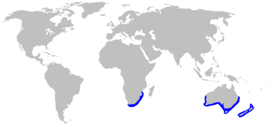
Dasyatis brevicaudata are widely distributed in temperate waters of the Southern Hemisphere . On the southern coast of Africa they are found from Cape Town , South Africa , to the mouth of the Zambezi River , Mozambique . Along the coast of Australia, these ramps come from Shark Bay , Western Australia , to Marushido , Queensland , including Tasmania . In the waters of New Zealand, they live on the island of North and in the Chatham archipelago , on the South island and the islands of Kermadek this species is rare. The data on the presence of Dasyatis brevicaudata off the northern coast of Australia and in the waters of Thailand are most likely erroneous and relate to Himantura fai and Dasyatis matsubarai, respectively [7] [5] . Over the past few decades, the range has expanded and the number of these slopes along the southeastern coast of Tasmania has increased, probably as a result of climatic changes [8] .
Off the coast of Australia and New Zealand, these ramps are often found in shallow water.
Off the southern coast of Africa, Dasyatis brevicaudata are rarely found in shallow water, they prefer to stay on submarine banks in the open sea. at a depth of 180-480 m. On the shores of Australia and New Zealand, on the contrary, they do not sink deeper than 156 m [2] . In this part of the range, the largest abundance of this species is observed in shallow water in summer. By tagging two individuals in the waters of New Zealand, it was possible to find out that in winter they tried to stay deeper and there were no long-term migrations [9] .
These bottom fish inhabit various biotopes , including brackish waters of estuaries, shallow waters with a sandy or silty bottom, narrow sea bays and bays, reefs and the edge of the continental shelf [2] [6] . In addition, they regularly rise into the middle column of water [9] .
The pectoral fins of these slopes fuse together with the head, forming a diamond-shaped flat disc, the width of which slightly exceeds the length, with rounded fins (“wings”). The front edge of the disk is almost arched, the snout is slightly pointed, slightly protruding beyond the disk. Behind small eyes are sprays that exceed their size. On the ventral surface of the disc are 5 gill slits, mouth and elongated, narrow nostrils. Between the nostrils lies a flap of skin with a fringed lower edge. The medium-sized mouth is curved in the form of a wide arc, grooves are located at the corners. The bottom of the oral cavity is covered with tubercles. Tiny growths dot the lower jaw and nasal skin flap. Small and blunt teeth with diamond-shaped bases are staggered and form a flat surface. Each jaw has 44–55 dentitions. Large ventral fins rounded [7] [10] .
The tail is usually shorter than the disk. Like other stingrays, on the dorsal surface in the central part of the caudal stem of Dasyatis brevicaudata there is a serrated spike connected by ducts with a poisonous gland. Sometimes stingrays have 2 spikes, periodically the spikes break off and a new one grows in their place. Upper and lower skin folds are located behind the spine of the caudal peduncle. The skin of this ramp is generally smooth, only the tail is covered with scales. At the base of the tail of individuals with a disc width of more than 45 cm there is a spine. In front of the poisonous spike along the center line of the tail lies a series of large spines facing back. Behind the poisonous spike, the tail to the tip is covered with small spines. The dorsal surface of the disc is gray-brown in color, the area above the eyes and the tail are darker in color. On both sides of the head are white pores. The ventral surface of the disc is whitish, the edges of the disc and the area under the tail are dark [7] [10] . Among Dasyatis brevicaudata albinos are found [11] . The maximum recorded disk width is 3 m [2] . Adult females are usually 1/3 larger than males [6] .
Most often,
Dasyatis brevicaudata is hunted at the bottom.
Usually, Dasyatis brevicaudata swim rather slowly, but they are able to make sharp jerks, waving pectoral fins with a force sufficient to cause cavitation of water and create an audible splash [12] . It is known that these ramps seasonally form numerous flocks. At the Pur Knights Islands, New Zealand, they gather annually from January to April under the arches of rocks. In some places with high tide they swim to a very shallow depth [9] [13] . These ramps have a limited habitat , the radius of which does not exceed 25 km [9] . Captive experiments have shown that Dasyatis brevicaudata are able to capture a magnetic field using electroreceptors (Lorencini ampoules), which helps them navigate in nature [14] .
These ramps hunt both at night and during the day [15] . Their diet consists of bony bottom fish and invertebrates such as crustaceans and mollusks and polychaetes . The lateral line allows them to catch the smallest fluctuations in water created by bivalve mollusks and ekhiura buried in the ground, which the slopes suck in; in this case, they are pushed out through sprinklers [16] . A significant part of the diet of Dasyatis brevicaudata is made up of fish and invertebrates floating in the water column, including salpids and amphipods [9] .
Every summer, the Poor Knights Islands have numerous concentrations of these rays.
Off the southern coast of Africa, these ramps visit the places of mass spawning of squid Loligo vulgaris reynaudii and catch them when they sink to the bottom to spawn [17] . Due to the large size of Dasyatis brevicaudata, only a small number of predators are at risk of becoming prey, including the narrow-toothed shark , the common hammerhead shark , the White shark and the killer whale [5] [9] . In case of danger, these ramps threateningly lift their tail up, like scorpions [7] . Sometimes smaller fish hunt "under cover" of a disk of a swimming ramp [12] . Nematodes Echinocephalus overstreeti [18] and the monogenes Heterocotyle tokoloshei and Dendromonocotyle sp. Parasitize Dasyatis brevicaudata . [19] [20] .
Reproduction
The massive concentrations of Dasyatis brevicaudata off the Pur Knights Islands are at least partly due to reproduction. In the middle of winter, the slopes mate, it is believed that a constant upward flow under the arches of rocks helps them maintain a stable position [6] [12] . Each female ready for copulation is followed by several males who try to grab her by the edge of the disk. Such persecution can last several hours. In the end, a successful challenger turns upside down under the female’s belly, inserts one of her pterygopodia into the female’s cloaca and begins to move her tail rhythmically from side to side. Copulation lasts 3-5 minutes [9] [13] . In captivity, one female mated with three different males sequentially [21] .
Photo from the Sydney Aquarium.
Like other caudate-like Dasyatis brevicaudata refers to ovoviviparous fish. Embryos develop in the womb, feeding on the yolk and histotroph. Females bring posterity in the summer. In the litter of 6-10 newborns 32-36 cm long. Probably males participate in the process of childbirth, pushing the females with a snout in the belly. Soon after birth, the females are again ready for breeding [2] [7] .
Dasyatis brevicaudata are curious and not aggressive, they allow people to get closer and even take food from their hands [22] . In the Bay of Hamlin Bay , Western Australia, stingrays regularly sail '' Dasyatis brevicaudata , Dasyatis thetidis , Australian brackets that are fed with pieces of fish. In recent years, the number of tourist attractions attracted by this has been growing [23] . However, if these stingrays are frightened or bothered by them, they become dangerous and can cause a serious and even fatal wound. The length of the poisonous spike reaches 30 cm, it pierces almost any shoe, including Kevlar ; the mucous membrane of the spike contains a toxin that causes necrosis . The most dangerous injuries to vital organs, severe blood loss and / or secondary sepsis and tetanus . There were cases when disturbed stingrays jumped out of the water and hit the offender with a spike in the chest. Off the coast of New Zealand, it is these species that inflict the most wounds on humans [24] [25] .
Across the range, Dasyatis brevicaudata are sometimes caught by-catch in commercial fisheries using trawls , seines , longlines and fixed nets. Fishing enthusiasts catch them on a hook from the shore or from the side of the boat, hit with a harpoon , these ramps are an object of spearfishing . Caught fish are usually released alive, having previously chopped off their tail for safety reasons, however, this practice probably does not significantly affect the survival of stingrays in the long term. Sometimes stingrays are kept for food or as a trophy. Occasionally they are kept in public aquariums [2] . In captivity, Dasyatis brevicaudata are able to breed. Commercial fishing of this species is prohibited in the waters of New Zealand. The International Union for Conservation of Nature has assigned this species a conservation status of “Least Concerned”.
- ↑ Dasyatis brevicaudata (English) in the FishBase database.
- ↑ 1 2 3 4 5 6 Dasyatis brevicaudata (English) . The IUCN Red List of Threatened Species .
- ↑ Hutton, FW Descriptions of new species of New Zealand fish. - 1875. - Vol. 16, No. (95) . - P. 313-317. - DOI : 10.1080 / 00222937508681859 .
- ↑ Large Latin-Russian Dictionary. (unspecified) . Date of treatment December 24, 2014.
- ↑ 1 2 3 Bester, C. Biological profile: Short-tail Stingray (neopr.) . Florida Museum of Natural History Ichthyology Department. Date of treatment December 24, 2014.
- ↑ 1 2 3 4 Hennemann, RM Sharks & Rays: Elasmobranch Guide of the World. - 2. - IKAN – Unterwasserarchiv, 2001. - S. 132. - ISBN 3-925919-33-3 .
- ↑ 1 2 3 4 5 Last, PR and JD Stevens. Sharks and Rays of Australia (second ed.). - Harvard University Press, 2009. - P. 420-421. - ISBN 0-674-03411-2 .
- ↑ Last, PR, WT White, DC Gledhill, AJ Hobday, R. Brown, GJ Edgar, and G. Pecl. Long-term shifts in abundance and distribution of a temperate fish fauna: a response to climate change and fishing practices // Global Ecology and Biogeography. - 2010 .-- Vol. 20, No. (58) . - S. 58–72 . - DOI : 10.1111 / j.1466-8238.2010.00575.x .
- ↑ 1 2 3 4 5 6 7 Le Port, A., T. Sippel and JC Montgomery. Observations of mesoscale movements in the short-tailed stingray, Dasyatis brevicaudata from New Zealand using a novel PSAT tag attachment method // Journal of Experimental Marine Biology and Ecology. - 2008 .-- Vol. 359, No. (2) . - P. 110-117. - DOI : 10.1016 / j.jembe.2008.02.024 .
- ↑ 1 2 Garrick, JAF Studies on New Zealand Elasmobranchii. Part II. A Description of Dasyatis brevicaudatus (Hutton), Batoidei, with a review of records of the species outside New Zealand // Transactions of the Royal Society of New Zealand. - 1954. - Vol. 82, No. (1) . - P. 189—198.
- ↑ Talent, LG Albinism in embryo gray smoothhound sharks, Mustelus californicus, from Elkhorn Slough, Monterey Bay, California // Copeia. - 1973. - Vol. 1973, No. (3) . - P. 595-597. - DOI : 10.2307 / 1443129 .
- ↑ 1 2 3 Anthoni, JF Poor Knights marine reserve: The mystery of the social sting rays (unopened) . Sea Friends. Date of treatment December 25, 2014.
- ↑ 1 2 Michael, SW Reef Sharks & Rays of the World. Sea Challengers. - 1993. - S. 83. - ISBN 0-930118-18-9 .
- ↑ Molteno, TCA and WL Kennedy. Navigation by Induction-Based Magnetoreception in Elasmobranch Fishes // Journal of Biophysics. - 2009. - No. 1 . - DOI : 10.1155 / 2009/380976 . - PMID 20130793 .
- ↑ Svane, I., S. Roberts and T. Saunders. Fate and consumption of discarded by-catch in the Spencer Gulf prawn fishery, South Australia // Fisheries Research. - 2008 .-- Vol. 90, No. (1-3) . - P. 158-169.
- ↑ Montgomery, J. and E. Skipworth. Detection of Weak Water Jets by the Short-Tailed Stingray Dasyatis brevicaudata (Pisces: Dasyatidae) // Copeia. - 1997. - Vol. 1997 . - No. (4) . - S. 881-883 . - DOI : 10.2307 / 1447310 .
- ↑ Smale, M., W. Sauer and M. Roberts. Behavioural interactions of predators and spawning chokka squid off South Africa: towards quantification // Marine Biology. - 2001. - Vol. 139, No. (6) . - P. 1095-1105. - DOI : 10.1007 / s002270100664 .
- ↑ Moravec, F. and J. Justine. Three nematode species from elasmobranchs off New Caledonia // Systematic Parasitology. - 2006. - Vol. 64, No. (2) . - P. 131-145. - DOI : 10.1007 / s11230-006-9034-x . - PMID 16773474 . Archived on September 30, 2011.
- ↑ Vaughan, DB and LA Chisholm. Heterocotyle tokoloshei sp. nov. (Monogenea, Monocotylidae) from the gills of Dasyatis brevicaudata (Dasyatidae) kept in captivity at Two Oceans Aquarium, Cape Town, South Africa: Description and notes on treatment // Acta Parasitologica. - 2010 .-- Vol. 55, No. (2) . - P. 108-114. - DOI : 10.2478 / s11686-010-0018-2 .
- ↑ Chisholm, LA, ID Whittington and ABP Fischer. A review of Dendromonocotyle (Monogenea: Monocotylidae) from the skin of stingrays and their control in public aquaria // Folia Parasitologica. - 2004. - Vol. 51, No. (2-3) . - P. 123-130. - DOI : 10.14411 / fp.2004.017 . - PMID 15357391 .
- ↑ Michael, SW Aquarium Sharks & Rays .. - TFH Publications, (2001). - S. 217. - ISBN 1-890087-57-2 .
- ↑ Aitken, K. Smooth Stingray (Dasyatis brevicaudata) Dasyatidae (neopr.) . Marine Themes Stock Library. Date of treatment December 26, 2014. Archived August 23, 2002.
- ↑ Lewis, A. and D. Newsome. Planning for Stingray Tourism at Hamelin Bay, Western Australia: the Importance of Stakeholder Perspectives // International Journal of Tourism Research. - 2003. - Vol. 5, No. (5) . - P. 331—346. - DOI : 10.1002 / jtr.442 .
- ↑ Adams, S. Bites and Stings: Marine Stings // Journal of the Accident and Medical Practitioners Association (JAMPA). - 2007. - Vol. 4, No. (1) . Archived May 25, 2010.
- ↑ Slaughter, RJ, D. Michael, G. Beasley, BS Lambie, and LJ Schep. New Zealand's venomous creatures // Journal of the New Zealand Medical Association. - 2009. - Issue. 122 . - No. (1290) . Archived June 3, 2010.