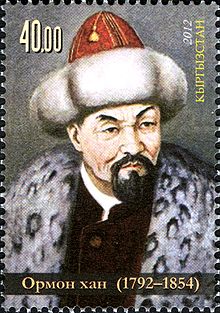
Ormon Khan (1792-1854) - Khan of the Kyrgyz (Kara-Kyrgyz) Khanate (1842-1854). The author of a set of legislative decrees, popularly known as “Ormon okuu” (“Teaching of Ormon”).
Content
Biography
Beginning of the path
Ormon was a manap of the Kyrgyz tribe Sarybagysh . According to popular legend, his great-grandfather Bolot-biy was predicted that one of his descendants would become a monarch, unite all the Kirghiz under his rule and create a national power ... Ormon since childhood was ambitious and domineering, had organizational skills and personal courage. From the age of 17, Ormon-manap took part in the battles.
The rise to power
The personality of Ormon Khan exalted at the turn of the era. At the age of 30, he was actively involved in the management of the Sarah-Bagyshes. His natural mind and the gift of the ruler were appreciated by many tribes, the fame of him spread beyond the borders of the Kyrgyz lands ... In the XIX century in Central Asia there was a constant redistribution of borders. Previously, the Kokand Khanate forced the Kyrgyz Manapes to recognize vassal dependence . The Kokand khan endowed Ormon Khan with valuable gifts and awarded the title of Parvanachi. However, by and large, the Kokand force was melting away, wasting itself in endless palace coups and internecine wars. In addition, Kokand suffered frequent oppression by the Bukhara Khanate [1] , as well as by the Qing Empire .
By the beginning of the 1840s, Ormon Manap controlled the Sayak and Sarbagysh tribes, spent a lot of effort on uniting the Solto, Cherik, Chon-Bagysh, Kushcha, Saruu and other northern Kyrgyz tribes. He refused to pay a huge tribute to Kokand, broke the vassality. He managed to deliver a series of crushing blows to the troops of the Kokandans, after which his authority among the Kyrgyz nobility increased sharply.
In the summer of 1842, in the area of Kutmaldy (on the western coast of Issyk-Kul ), Ormon-manap convened the Kurultay, on which the whole Kyrgyz nobility gathered. The biys (rulers) of the tribes arrived:
- Sary-bagysh (Ormon, Tere-geldy, Zhantai),
- Bugu ( Borombay , Balbai-batyr, Murat-ali),
- Zhantai (Mignazar),
- Zhetigen (Mederbek),
- Sayak (Medet, Kachyke, Chiny),
- Saru (Azhybek),
- Cherik,
- Kalpak
- Zhangarach
- Alibek,
- Solto,
- Kushchu.
The ambassadors of the Kokand Khanate also arrived. In Kurultai, Ormon, raising the question of the unity of the Kyrgyz people, of oppression by Kokand, of the approach of Russian outposts, proposed to elect all the Kyrgyz as khan. Kurultai participants supported the idea of unity. At the suggestion of Zhantai and Kachyke, they elected Khan Ormon. In Kurultai, the coronation of the newly elected monarch occurred. Observing the ancient rite, Ormona was put on a white nightmare, and a white mare was killed on Ai-Tuyak. Instead of a crown, they put a red-top tebet manap on the head.
Kurultay approved the symbols of the Khanate:
- Tuu (banner)
- Meer (seal),
- “Biilik-kurama” (power structure),
- "Jazz" (punishment),
- Ayip (fine),
- "Olchomdoru" (penalties and penalties for crimes and duties),
- "Tuyak-pool" (customs fees for the passage of caravans and cattle driving),
- “Konshuluk mamile” (relations with neighboring states).
Ormon issued a Decree, which read:
| Throughout Kyrgyzstan, a cap with a red top will be worn by only one person - Ormon Khan. |
The following penalties for crimes were established: for the murder of a person - a ransom (kun) of 300 horses, for an attempt on someone else's wife - 40 horses; for the theft - 9 horses. As a sign of firmness and immutability of the Decree before the people according to ancient rites, the oath was taken by cutting a rod. The Soviet historian S. M. Abramzon wrote about this event in the essay “At the Origins of Manapism”:
| The last time in the history of the Kyrgyz people was an attempt at political unification. It was a protest of a feudal society with a semi-natural nomadic cattle-breeding and economic base, against the beginner to penetrate into it and erode its foundation, commercial capitalism. |
Khan's commander in chief Ormon appointed his close relative Toregeldi (Turgeldi), and Kalygul-oluya became the main adviser.
| The support of feudal power was a military organization, very skillfully adapted to frequent defenses and attacks. In addition to the personal guard of Ormon Khan, which consisted of 30 of the most accurate shooters armed with wick guns (“champagne”) and was under the command of the son of Ormon Khan Chargyn, there was a commander in chief of the armed forces of Teregeldi, who had a reputation as a batyr among the Kirghiz and had not only his own squad, but and all armed forces in the event of military clashes. In those days, a saddle horse and a peak stuck in the ground stood near each yurt . The army had at its disposal a special military workshop. During the campaigns, the “army” was accompanied by a military orchestra of brass instrument similar to fanfare - “core” and two wooden flutes - “sourne”. The father of the famous Sagynbai, the narrator of the poem “Manas” Orozbak, played them . |
- wrote Abramzon.
In 1844, Ormon Khan temporarily captured the Kokand fortress Bishkek , which was the local stronghold of their troops, thereby making it clear that he is now equal to the Kokand ruler Khudoyar Khan .
Kyrgyz-Kazakh War
In 1846, the superior forces of the Russian troops forced Kenesary Kasymov out of the steppes of the last Kazakh khan, forcing him to retreat to the territory of Zhetysu (Semirechye) in the valleys of the Shu and Ili rivers. Here Kenesary tried to conclude an alliance with the Kyrgyz manapas, urging them to a joint struggle against Russia and Kokand. However, the Kirghiz, led by Manap Ormon, rejected his offer and launched raids on forces subject to Kenesary. A heavy war began. In April 1847, Kenesary with a 15,000th army invaded the Kyrgyz lands. In the town of Maitobe - Keklik-Sengir, a battle was fought with the Kyrgyz manapes led by Ormon Khan. But during the battle, the sultans Rustem and Sypatai betrayed Kenesara and took away a significant part of the army, the army of Kenesara was defeated, he himself was captured and executed [2] .
The defeat of Kenesary Kassymov’s troops, his capture by Ormon Khan and the execution [3] were accepted with approval both in Russia and in Kokand. The Russian government was satisfied that it had gotten rid of Kenesary, and awarded Ormon Khan and Zhantai with gold medals and donned gowns embroidered with gold on them. Also, 13 soldiers who were able to capture Kenesary and his associates Dairbek, Kalcha and Aksakal [2] [4] were awarded gold medals.
Foreign Policy
Until 1853, Ormon Manap tried to take advantage of the support of the imperial empire against the Kokand Khanate and the Kazakhs to preserve the independence of the Kyrgyz Khanate. After his request to secure the land of Chelek-Charyn in Semirechye in favor of the Kyrgyz instead of the proposal to join the Russian citizenship was rejected, he migrated back to Baysoorun (Semenovskoe gorge).
Domestic Policy
Although Ormon managed to create a state, it was more feudal than centralized. He wanted to pursue a tough policy, but often faced the interests of his vassals. They formally recognized Ormon as the head of state and their overlord, but in fact in their possessions remained full and even independent masters. Ormon created a code of laws: "Edification of Ormon." But this vault acted only in the personal possessions of the khan. The khan himself came from the Sarybagysh tribe, and therefore often supported his interests, thereby provoking the secret hatred of his vassals, and his tough policy ran into the interests of his most powerful and influential vassal - Borombai Bekmurat-uulu from the bugu tribe. As a result, Ormon Khan attacked the lands of Borombay in Issyk-Kul , but he miscalculated and was himself captured.
Captivity and death
After captivity, Ormon was held for some time as an honorary prisoner of war. Borombay wanted to release Ormon on certain conditions, with a promise not to attack his land anymore. But one of the Bugin leaders, Balbai Batyr, who was a longtime enemy of the Khan, upon learning of this, killed Ormon.
| Mortally wounded and hit by a spear from a horse, Ormon was transferred to the yurt of Burumbay’s son Omurzak and died in the arms of his wife and his beloved daughter. |
- wrote P. P. Semenov-Tyan-Shansky [5] . The death of Ormon Khan in 1854 led to the complete fall of the Kyrgyz Khanate .
In 1860, Russian troops under the command of Colonel Zimmerman drove the Kokand from the fortresses of Bishkek and Tokmak and extended the power of the Russian Empire to the Kara-Kyrgyz lands.
Notes
- ↑ Bukhara often interfered in the internal politics of the Kokand Khanate.
- ↑ 1 2 Kazakhstan. National Encyclopedia, 2004 .
- ↑ In modern Kazakhstan, Kenesary (aka “Khan Kene”) is considered the “last Kazakh khan” and a martyr hero.
- ↑ Ormon Niyazbek uulu (Ormon Khan, 1791-1854)
- ↑ In 1857, P.P. Semyonov visited the shore of Issyk-Kul, at the Bugu tribe.
Literature
- B. Zhamgerchinov "Kyrgyz in the era of Ormon Khan." Proceedings IJAL. Vol. 1. 1944. - Frunze: Cyrus. FAN, 1945.
- S. Abramzon “At the origins of manapapism”. Soviet Kyrgyzstan, 1931, April 1.
- Beishe Urstanbekov, Tynchtykbek Choroev Kyrgyz tarykhs: Kyskach encyclopedia lyk sөzdүk. - Frunze, Kyrgyz Council Encyclopedia of the Sons of Bashki Editorial Board. 1990. ISBN 5-89750-028-2 . Zhalpy kөlөmү - 288 bet.
- A. N. Bernshtam “ABOUT ORMON KHAN AND IVAN THE GROZNY”. T. I. Elect. Op. Bishkek 1997
- B. Soltonoev “Kyzyl Kyrgyz Tarykh”. 1 volume Bishkek, 1993.
- J. Toktonaliev “Ormon Khan Ilimiy Emgekterde Jean Archivdik Materialdard”, Bishkek, 2002.
- Kenesary Kasymov // Kazakhstan. National Encyclopedia . - Almaty: Kazakh encyclopedias, 2004. - ISBN 9965-9389-9-7 .