Destroyers of the type V-105 - the type of destroyers , who was in service with the Navy of Germany during the First World War . In total, four destroyers of this type were built - V-105 - V-108. V 107 May 8, 1915 sank as a result of an explosion on a mine near Libau . The rest after the end of the war passed on reparations to the allies.
| destroyers type V-105 | |
|---|---|
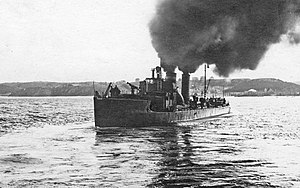 ORP "Kashub" (formerly V-108) between 1921 and 1925 | |
| Project | |
| A country |
|
| Manufacturers |
|
| Operators |
|
| Years built | 1914-1915 |
| Built by | four |
| Main characteristics | |
| Displacement | 421 tons (full load) |
| Length | 62.6 m (highest) |
| Width | 6.22 m (highest) |
| Draft | 2.56 m |
| Engines | 2 steam turbines |
| Power | 5500 l. with. |
| Mover | 2 screws ∅ 1.68 m [1] |
| Travel speed | 28 knots |
| Navigation range | 1,400 miles at 17 knots |
| Crew | 60 people (2 officers) |
| Armament | |
| Artillery | 2 88 mm (-106 2 52 mm) |
| Mine-torpedo armament | 2 × 450 mm torpedo tubes [1] |

Content
History
Before the First World War, the Dutch fleet ordered a series of destroyers of a small displacement to the well-known German company Vulcan in Stettin. After the outbreak of war, they were requisitioned by the German government. On August 10, 1914, the governments of Germany and the Netherlands agreed that similar ships would be built at Dutch shipyards according to German drawings.
In 1921, Poland received two destroyers - the V-105 and V-108. Kasub (b. V-108) died on 7/7/1925 as a result of a boiler explosion. Mazur (b. V-105) in 1931 was rebuilt into an artillery training ship - TA was removed from it, and the number of 75-mm guns was increased from two to four. The forecastle extended to the nasal superstructure. In 1935, the ship eliminated one KO (speed as a result decreased from 29 to 20 knots), removed the feed tube and rescheduled the superstructure. One of the 75-mm guns was replaced with a 40-mm automatic "pom-pom". "Mazur" sunk germ, aviation 1.9.193
Displacement and power plant
Displacement 340 tons (normal), 421 tons (full load). On ships of the type, two AEG “Vulkan” steam turbines with a total capacity of 5760 liters were installed as a power plant . with. (on tests) and four Yarrow boilers with a pressure of 18.5 atmospheres (two oil and two coal). The maximum reserves of fuel on the destroyers of this type: 60 tons of coal , 16.2 tons of oil [1] .
Armament
The destroyers were armed with two 88-mm guns (60 rounds of ammunition per barrel), 52-mm V-106 2 (100 rounds of ammunition per barrel). Torpedo armament destroyers consisted of two 450-mm surface torpedo tubes [1] .
Notes
- ↑ 1 2 3 4 Torpedoboote, 1983 , p. 62.
Literature
- Trubitsyn S. B. Squadron destroyers and destroyers of Germany (1871–1918). - SPb. 2000
- A.V. Dashyan . Warships of the Second World War of the Naval Forces of Poland and Scandinavian countries (Denmark, Norway, Sweden and Finland). - Maritime collection, 2005, № 3.
- Gröner, Erich. Die deutschen Kriegsschiffe 1815-1945 Band 2: Torpedoboote, Zerstorer, Scyntllboote. - Bernard & Graefe, 1983. - 224 p. - ISBN 3-7637-4801-6 .