Clever Geek Handbook
📜 ⬆️ ⬇️

Singular point curve

A singular point of the curve is a point in the vicinity of which there is no smooth parameterization. The exact definition depends on the type of curve being studied.

Algebraic Curves on a Plane

An algebraic curve in the plane can be defined as a set of points(x,y) {\ displaystyle \ left (x, y \ right)} {\displaystyle \left(x,y\right)} satisfying an equation of the formf(x,y)=0 {\ displaystyle f \ left (x, y \ right) = 0} {\displaystyle f\left(x,y\right)=0} wheref(x,y) {\ displaystyle f \ left (x, y \ right)} {\displaystyle f\left(x,y\right)} - polynomial functionf:R2→R {\ displaystyle f \ colon \ mathbb {R} ^ {2} \ rightarrow \ mathbb {R}} {\displaystyle f\colon \mathbb {R} ^{2}\rightarrow \mathbb {R} } :

f=a+bonex+b2y+conex2+2c2xy+c3y2+...{\ displaystyle f = a + b_ {1} x + b_ {2} y + c_ {1} x ^ {2} + 2c_ {2} xy + c_ {3} y ^ {2} + \ dots} {\displaystyle f=a+b_{1}x+b_{2}y+c_{1}x^{2}+2c_{2}xy+c_{3}y^{2}+\dots } .

If the origin(0,0) {\ displaystyle \ left (0,0 \ right)} {\displaystyle \left(0,0\right)} belongs to the curve thena=0 {\ displaystyle a = 0} a=0 . If ab2≠0 {\ displaystyle b_ {2} \ not = 0} {\displaystyle b_{2}\not =0} , then the implicit function theorem guarantees the existence of a smooth functiong {\ displaystyle g} g such that the curve takes the formy=g(x) {\ displaystyle y = g \ left (x \ right)} {\displaystyle y=g\left(x\right)} in the vicinity of the origin. Similarly, ifbone≠0 {\ displaystyle b_ {1} \ not = 0} b_{1}\not =0 , then there is such a functionh {\ displaystyle h} h that the curve satisfies the equationx=h(y) {\ displaystyle x = h \ left (y \ right)} {\displaystyle x=h\left(y\right)} in the vicinity of the origin. In both cases, there is a smooth mappingR→R {\ displaystyle \ mathbb {R} \ rightarrow \ mathbb {R}} {\displaystyle \mathbb {R} \rightarrow \mathbb {R} } , which defines a curve in the vicinity of the origin. Note that in the vicinity of the origin

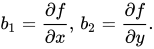
bone=∂f∂x,b2=∂f∂y.{\ displaystyle b_ {1} = {\ partial f \ over \ partial x}, \, b_ {2} = {\ partial f \ over \ partial y}.} {\displaystyle b_{1}={\partial f \over \partial x},\,b_{2}={\partial f \over \partial y}.}

The singular points of the curve are those points of the curve at which both derivatives vanish:
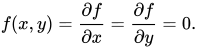
f(x,y)=∂f∂x=∂f∂y=0.{\ displaystyle f (x, y) = {\ partial f \ over \ partial x} = {\ partial f \ over \ partial y} = 0.} f(x,y)={\partial f \over \partial x}={\partial f \over \partial y}=0.

Regular Points

Let the curve go through the origin. Puttingy=mx {\ displaystyle y = mx} {\displaystyle y=mx} can imaginef {\ displaystyle f} f as

f=(bone+b2m)x+(cone+2c2m+c3m2)x2+...{\ displaystyle f = (b_ {1} + b_ {2} m) x + (c_ {1} + 2c_ {2} m + c_ {3} m ^ {2}) x ^ {2} + \ dots} {\displaystyle f=(b_{1}+b_{2}m)x+(c_{1}+2c_{2}m+c_{3}m^{2})x^{2}+\dots } .

If abone+b2m≠0 {\ displaystyle b_ {1} + b_ {2} m \ not = 0} {\displaystyle b_{1}+b_{2}m\not =0} then the equationf=0 {\ displaystyle f = 0} f=0 has a solution of multiplicity 1 at the pointx=0 {\ displaystyle x = 0} x=0 and the origin is the point of single contact of the curve with the liney=mx {\ displaystyle y = mx} {\displaystyle y=mx} . If abone+b2m=0 {\ displaystyle b_ {1} + b_ {2} m = 0} {\displaystyle b_{1}+b_{2}m=0} thenf=0 {\ displaystyle f = 0} f=0 has a pointx=0 {\ displaystyle x = 0} x=0 a solution of multiplicity 2 or higher and directy=mx {\ displaystyle y = mx} {\displaystyle y=mx} is tangent to the curve. In this case, ifcone+2c2m+c3m2≠0 {\ displaystyle c_ {1} + 2c_ {2} m + c_ {3} m ^ {2} \ not = 0} {\displaystyle c_{1}+2c_{2}m+c_{3}m^{2}\not =0} , the curve has double contact with directy=mx {\ displaystyle y = mx} {\displaystyle y=mx} . If acone+2c2m+c3m2=0 {\ displaystyle c_ {1} + 2c_ {2} m + c_ {3} m ^ {2} = 0} {\displaystyle c_{1}+2c_{2}m+c_{3}m^{2}=0} , and the coefficient atx3 {\ displaystyle x ^ {3}} x^{3} not equal to zero, then the origin is the inflection point of the curve. This reasoning can be applied to any point in the curve by transferring the origin to a given point. [one]

Double dots

 
The three snails of Pascal illustrate the types of double points. The left curve has an isolated point at the origin. The central curve, the cardioid , has a cusp at the origin. The right curve has a self-intersection point at the origin, forming a loop.

If in the above equationbone=0 {\ displaystyle b_ {1} = 0}   andb2=0 {\ displaystyle b_ {2} = 0}   but at least one of the quantitiescone {\ displaystyle c_ {1}}   ,c2 {\ displaystyle c_ {2}}   orc3 {\ displaystyle c_ {3}}   not equal to zero, then the origin is called the double point of the curve. Put againy=mx {\ displaystyle y = mx}   thenf {\ displaystyle f}   will take the form

f=(cone+2c2m+c3m2)x2+(done+3d2m+3d3m2+dfourm3)x3+....{\ displaystyle f = (c_ {1} + 2c_ {2} m + c_ {3} m ^ {2}) x ^ {2} + (d_ {1} + 3d_ {2} m + 3d_ {3} m ^ {2} + d_ {4} m ^ {3}) x ^ {3} + \ dots.}  

Double points can be classified by the roots of the equationcone+2c2m+c3m2=0 {\ displaystyle c_ {1} + 2c_ {2} m + c_ {3} m ^ {2} = 0}   .

Self-intersection points

If the equationcone+2c2m+c3m2=0 {\ displaystyle c_ {1} + 2c_ {2} m + c_ {3} m ^ {2} = 0}   has two real solutions form {\ displaystyle m}   that is, ifc22-conec3>0 {\ displaystyle c_ {2} ^ {2} -c_ {1} c_ {3}> 0}   , then the origin is called . The curve in this case has two different tangents corresponding to two solutions of the equationcone+2c2m+c3m2=0 {\ displaystyle c_ {1} + 2c_ {2} m + c_ {3} m ^ {2} = 0}   . Functionf {\ displaystyle f}   in this case has a saddle point at the origin.

Isolated

If the equationcone+2c2m+c3m2=0 {\ displaystyle c_ {1} + 2c_ {2} m + c_ {3} m ^ {2} = 0}   has no material decisions onm {\ displaystyle m}   that is, ifc22-conec3<0 {\ displaystyle c_ {2} ^ {2} -c_ {1} c_ {3} <0}   , then the origin is called an isolated point . On the real plane, the origin will be isolated from the curve, but on the complex plane the origin will not be isolated and will have two imaginary tangents corresponding to two imaginary solutions of the equationcone+2c2m+c3m2=0 {\ displaystyle c_ {1} + 2c_ {2} m + c_ {3} m ^ {2} = 0}   . Functionf {\ displaystyle f}   in this case has a local extremum at the origin.

Caspians

If the equationcone+2c2m+c3m2=0 {\ displaystyle c_ {1} + 2c_ {2} m + c_ {3} m ^ {2} = 0}   has one real solution form {\ displaystyle m}   multiplicity 2, that is, ifc22-conec3=0 {\ displaystyle c_ {2} ^ {2} -c_ {1} c_ {3} = 0}   , then the origin is called the cusp , or return point . The curve in this case at a singular point changes direction, forming a point. The curve at the origin has a single tangent, which can be interpreted as two coinciding tangents.

Further Classification

The term node is used as a generic name for isolated points and self-intersection points. The number of nodes and the number of cusps of the curve are two invariants used in the Plücker formulas .

If one of the solutions to the equationcone+2c2m+c3m2=0 {\ displaystyle c_ {1} + 2c_ {2} m + c_ {3} m ^ {2} = 0}   is also a solution to the equationdone+3d2m+3d3m2+dfourm3=0 {\ displaystyle d_ {1} + 3d_ {2} m + 3d_ {3} m ^ {2} + d_ {4} m ^ {3} = 0}   , then the corresponding branch of the curve has an inflection at the origin. In this case, the origin is called the point of contact . If both branches have this property, thencone+2c2m+c3m2 {\ displaystyle c_ {1} + 2c_ {2} m + c_ {3} m ^ {2}}   is a dividerdone+3d2m+3d3m2+dfourm3 {\ displaystyle d_ {1} + 3d_ {2} m + 3d_ {3} m ^ {2} + d_ {4} m ^ {3}}   , and the origin is called a bifflectoidal point (double contact point). [2]

Multiple Points

 
A curve with a triple point at the origin.

In the general case, when all terms with degree less thank {\ displaystyle k}   , and provided that at least one member with degreek {\ displaystyle k}   is not equal to zero, they say that the curve has a multiple point of order k . In this case, the curve hask {\ displaystyle k}   tangents at the origin, but some of them may be imaginary or coincide. [3]

Parametric Curves

The parametric curve in R 2 is defined as the image of the function g : R → R 2 , g ( t ) = ( g 1 ( t ), g 2 ( t )). The singular points of such a curve are the points at which

dgonedt=dg2dt=0.{\ displaystyle {dg_ {1} \ over dt} = {dg_ {2} \ over dt} = 0.}  
 
Casp

Many curves can be set in both forms, but these two tasks are not always consistent. For example, cusp can be found both in the algebraic curve x 3 - y 2 = 0 and in the parametric curve g ( t ) = ( t 2 , t 3 ). Both curve assignments give a singular point at the origin. However, curve y 2 - x 3 - x 2 = 0 at the origin is special for an algebraic curve, but with the parametric specification g ( t ) = ( t 2 −1, t ( t 2 −1)) derivatives g ′ ( t ) never vanishes, and therefore the point is not singular in the above sense.

Caution should be exercised when choosing a parameterization. For example, the line y = 0 can be set parametrically as g ( t ) = ( t 3 , 0) and it will have a singular point at the origin. If, however, it is parameterized as g ( t ) = ( t , 0), it will not have singular points. Thus, it is technically more correct to speak of singular points of a smooth map, rather than singular points of a curve.

The above definitions can be extended to implicit curves , which can be defined as the set of zeros f −1 (0) of an arbitrary smooth function . Definitions can also be extended to curves in spaces of higher dimensions.

According to the Hassler-Whitney theorem, [4] [5] any closed set in R n is the set of solutions f −1 (0) for some smooth function f : R n → R. Therefore, any parametric curve can be defined as an implicit curve.

Feature Point Types

Examples of singular points of various types:

  • Isolated point : x 2 + y 2 = 0,
  • : x 2 - y 2 = 0,
  • Casp ( return point ): x 3 - y 2 = 0,
  • Bill-shaped cusp: x 5 - y 2 = 0.

See also

  • Feature theory
  • Morse Theory

Notes

  1. ↑ Hilton Chapter II § 1
  2. ↑ Hilton Chapter II § 2
  3. ↑ Hilton Chapter II § 3
  4. ↑ Brooker and Larden. Differential Germs and Catastrophes. - London Mathematical Society. Lecture Notes 17. Cambridge. - 1975.
  5. ↑ Bruce and Giblin, Curves and singularities , (1984, 1992) ISBN 0-521-41985-9 , ISBN 0-521-42999-4 (paperback)

Literature

  • Harold Hilton. Plane Algebraic Curves . - Oxford, 1920.
Source - https://ru.wikipedia.org/w/index.php?title= Special_Curve_point&oldid = 99776671


More articles:

  • Rudensky, Nikolai Stepanovich
  • Phoxinellus pseudalepidotus
  • GIS Day
  • Vlasov Village Council (Konstantinovsky District)
  • Braverman, Emanuel Markovich
  • Orleans Tram
  • Monduzil
  • Melinte, Doina
  • Mon (Upper Garonne)
  • Son of Zorro (film)

All articles

Clever Geek | 2019