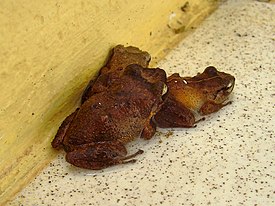
Caribbean leaf frog [1] (lat. Eleutherodactylus martinicensis ) is an extremely rare animal of the genus of leaf frogs from the family Eleutherodactylidae .
| Caribbean leaf frog |
 |
| Scientific classification |
|---|
| No rank : | Bilateral symmetrical |
| Squad: | Tailless Amphibians |
| Family: | Eleutherodactylidae |
| Subfamily : | Eleutherodactylinae |
|
| International scientific name |
|---|
Eleutherodactylus martinicensis Tschudi , 1838 |
| Security status |
|---|
Close to vulnerableIUCN 3.1 Near Threatened : 56747 |
|
The total length varies from 3.2 to 4.7 cm. Sexual dimorphism is observed - the female is larger than the male. The head is small, wide, with a cranial crest. The muzzle is short, blunt. The body is pretty slim. The fingers of the fore and hind limbs end with sticking plates. It has a whitish-gray, orange-brown or gray-brown color with a diverse pattern of brown spots.
He loves tropical forests near ponds. It occurs at an altitude of 1250 meters above sea level, active at night. It feeds mainly on small invertebrates and their larvae.
The female lays in the axils of the leaves 15-30 round transparent eggs with a diameter of 4-5 mm. The egg is whitish or pale straw in color. The female is kept near the masonry. The development of frogs occurs inside the egg, 14 days after laying the eggs young frogs 5-7 mm long emerge from them.
The species is common in the Antilles . Introduced to the Hawaiian Islands .