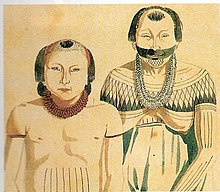
Munduruku is the Native American people in the South American Tupi language family. Self-designation - weidien ("our people"). The number is more than 10 thousand people [1] . Language - munduruku (also bet or carp), also use Portuguese. Religion is Catholicism .
| Munduruku | |
|---|---|
| Abundance and area | |
| Total: 10,065 (2002) | |
 Brazil Brazil | |
| Tongue | munduruku , portuguese |
| Religion | Catholicism |

Content
Origin Title
The word "mundurku" in the language of a neighboring tribe comes from the name of ants.
Settlement Area
Munduruca live in the center of Brazil , in the upper reaches of the Tapajos River, between the Tapajos and Madeira Rivers (the states of Para and Mato Grosso ).
Ethnic History
In the past, the munduruku was one of the most powerful and numerous tribes (in 1819 the number was up to 18-40 thousand people). Contacts with the Portuguese from 1768. Until 1795 they attacked Portuguese settlements in the Amazon. Subsequently became the main allies of Europeans in Central Brazil. Until 1912 (especially intensely until 1850), they fought a war against neighboring (except apiak) Indian tribes (especially kauahib and mura), partially inspired by the Portuguese, who supplied the mundurka with rifles and other European goods in exchange for cassava flour and rubber. Munduruku made military expeditions to a distance of 800 km, sometimes lasting more than a year. Most of the tribe, who resettled as a result of these trips to central Tapajos and the lower reaches of Madeira, was assimilated by the Brazilians towards the end of the 19th century.
Until the beginning of the 20th century, bounty hunting was developed. The heads of the enemies brought from the campaign for three years were objects of cult actions, then (having lost magical power) they were stored in the men's house. The protagonist of the myths of the munduruku is the first ancestor of Karusakaibyo.
Traditional economy
The main occupations are manual slash-and-burn agriculture , in the dry season - hunting, fishing and gathering. The main crops are bitter and sweet cassava , yams , taro , sweet potato , corn , beans , beans , rice , bananas , potatoes , sugarcane , pumpkin , pineapple , pepper , cotton . Brazilian type culture. A typical house is a large, oval, later appeared rectangular, with a roof to the ground. Two to five of these houses make up the village, houses stand in a circle, in the center is a man’s house facing the east. Until the beginning of the 20th century. Munduruku was widely hunted for the heads of enemies. The main character of the myths is Karusakaybe, the first ancestor.
Social Relations
The family is large, matrilineal . Several dozens of patrilineal genera form two phratries : red ("Ipakpukayu") and white ("Iryritayu"). Men have three sacred horns associated with the cult of their ancestors.
Notes
- ↑ According to the Brazilian National Health Fund, in 2002 the number of mundurucas was 10,065. (see detailed painting by region )
Literature
- Encyclopedia " Peoples and religions of the world ." - M.: Publishing House "Big Russian Encyclopedia", 1998. S. 359-360.
Links
- Munduruca in the Encyclopedia of the Indigenous Peoples of Brazil